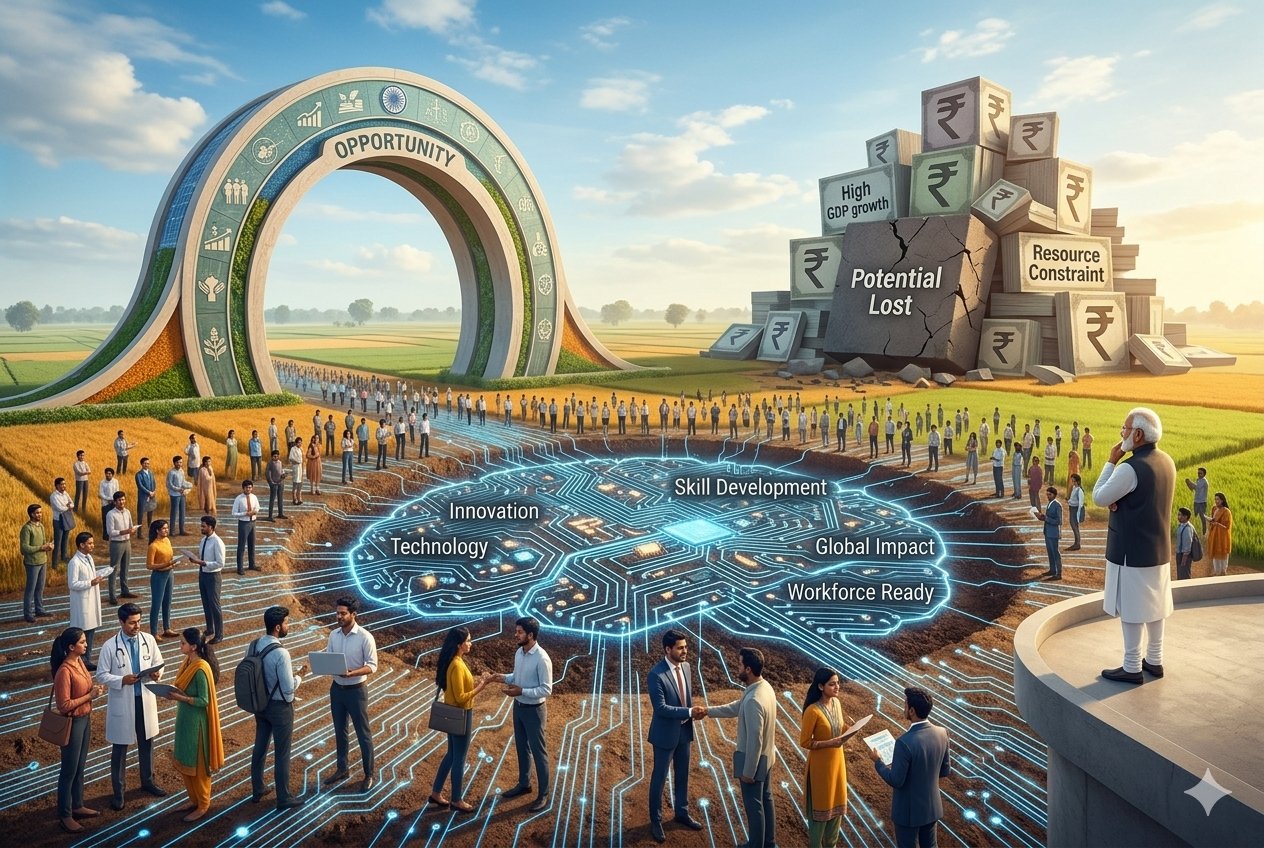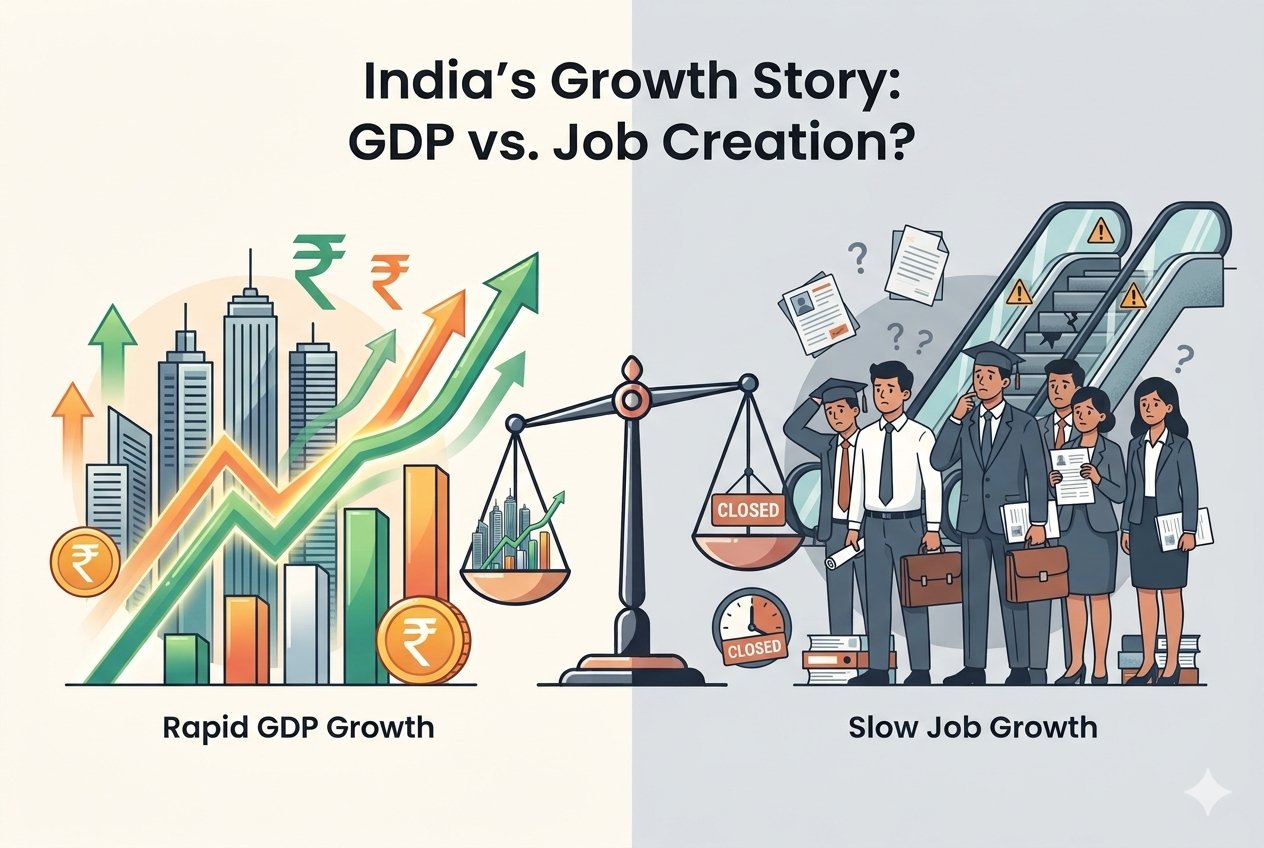
Economic growth is important, but its real success lies in the opportunities it creates for people.
India is one of the world’s major growing economies. From infrastructure development and digital transformation to manufacturing expansion and entrepreneurship, the country is witnessing significant economic changes.
However, behind these impressive growth ambitions lies an important question:
Is India’s economic growth translating into enough meaningful employment opportunities for its growing workforce?
Economic growth and employment generation are closely connected, but they do not always move at the same pace.
The Growth–Employment Gap
India’s economic progress has created opportunities across several sectors, including information technology, financial services, manufacturing, infrastructure and digital businesses.
Yet, for millions of young Indians, finding suitable employment remains a challenge.
According to the Periodic Labour Force Survey (PLFS) Annual Report 2025, India’s youth unemployment rate (15–29 years) stood at 9.9%. The report also estimated that an average of 61.6 crore people aged 15 years and above were employed during 2025.
These figures highlight the scale of India’s workforce and the importance of generating employment opportunities that match its aspirations.
The challenge is not simply to create more jobs, but to create jobs that offer stability, fair compensation and opportunities for professional growth.
1. Education vs Employability: A Critical Disconnect
One of the biggest challenges facing India’s employment ecosystem is the gap between academic qualifications and industry requirements.
Every year, educational institutions produce graduates in commerce, management, engineering, finance and other disciplines. However, employers increasingly seek practical knowledge, analytical thinking, communication skills and technological adaptability.
A degree may open the door to an interview, but relevant skills often determine career progression.
The focus must therefore shift from education alone to education combined with employability.
Industry-oriented learning, internships, professional certifications and practical exposure can help bridge this gap.
2. MSMEs: The Untapped Engine of Employment
Micro, Small and Medium Enterprises (MSMEs) play a significant role in India’s economic development.
They contribute to industrial activity, entrepreneurship, exports and employment generation, particularly beyond major metropolitan centres.
However, many small businesses face challenges such as limited access to affordable finance, rising operational costs, regulatory complexities, technological limitations and working capital constraints.
Supporting MSMEs through easier credit access, simplified compliance, digital adoption and better infrastructure can strengthen their capacity to expand and create employment.
India cannot achieve inclusive economic growth without strengthening the businesses that form the backbone of its economy.
3. Technology and AI: Threat or Opportunity?
Artificial Intelligence, automation and digitalisation are transforming the nature of work.
While technology may reduce the demand for certain repetitive tasks, it is also creating opportunities in data analytics, cybersecurity, financial technology, digital marketing and technology-enabled services.
The real concern should not be whether technology will replace jobs, but whether our workforce is prepared for the changing nature of those jobs.
Continuous learning and reskilling will become essential for both fresh graduates and experienced professionals.
The future belongs to individuals and businesses that can combine human judgement with technological capabilities.
4. The Quality of Employment Matters
Employment generation should not be measured only by the number of people engaged in economic activity.
The quality of employment matters equally.
Stable income, social security, workplace safety, skill development and career progression are essential elements of meaningful employment.
India must focus on expanding formal employment opportunities while improving working conditions and productivity across the informal sector.
A growing economy should create opportunities that improve living standards, not merely increase workforce participation.
5. What Should Be India’s Way Forward?
To make economic growth more employment-oriented, India needs a coordinated approach:
- Strengthen skill development: Align education and training with changing industry requirements.
- Promote manufacturing: Encourage investment, innovation and domestic production to generate employment at scale.
- Empower MSMEs: Improve access to finance, technology and business infrastructure.
- Encourage entrepreneurship: Build an ecosystem where young people can become job creators, not just job seekers.
- Invest in emerging sectors: Develop opportunities in renewable energy, artificial intelligence, financial technology and advanced manufacturing.
- Promote inclusive participation: Expand opportunities for women and workers from underserved regions.
These efforts must work together to create a sustainable and productive employment ecosystem.
Conclusion: Growth Must Create Opportunities
India’s economic ambitions are significant, and its demographic strength offers enormous potential.
But the true measure of economic success cannot be limited to GDP growth, infrastructure expansion or global rankings.
It must also be reflected in the opportunities available to its people.
A young graduate finding meaningful employment, a small entrepreneur expanding a business, a skilled worker earning a better livelihood and a woman entering the workforce are all important indicators of economic progress.
India does not just need a bigger economy. It needs an economy that creates opportunities, rewards skills and enables people to participate in its growth.
Because ultimately, the success of a nation’s growth story is not just about how much its economy grows, but how many lives grow with it.