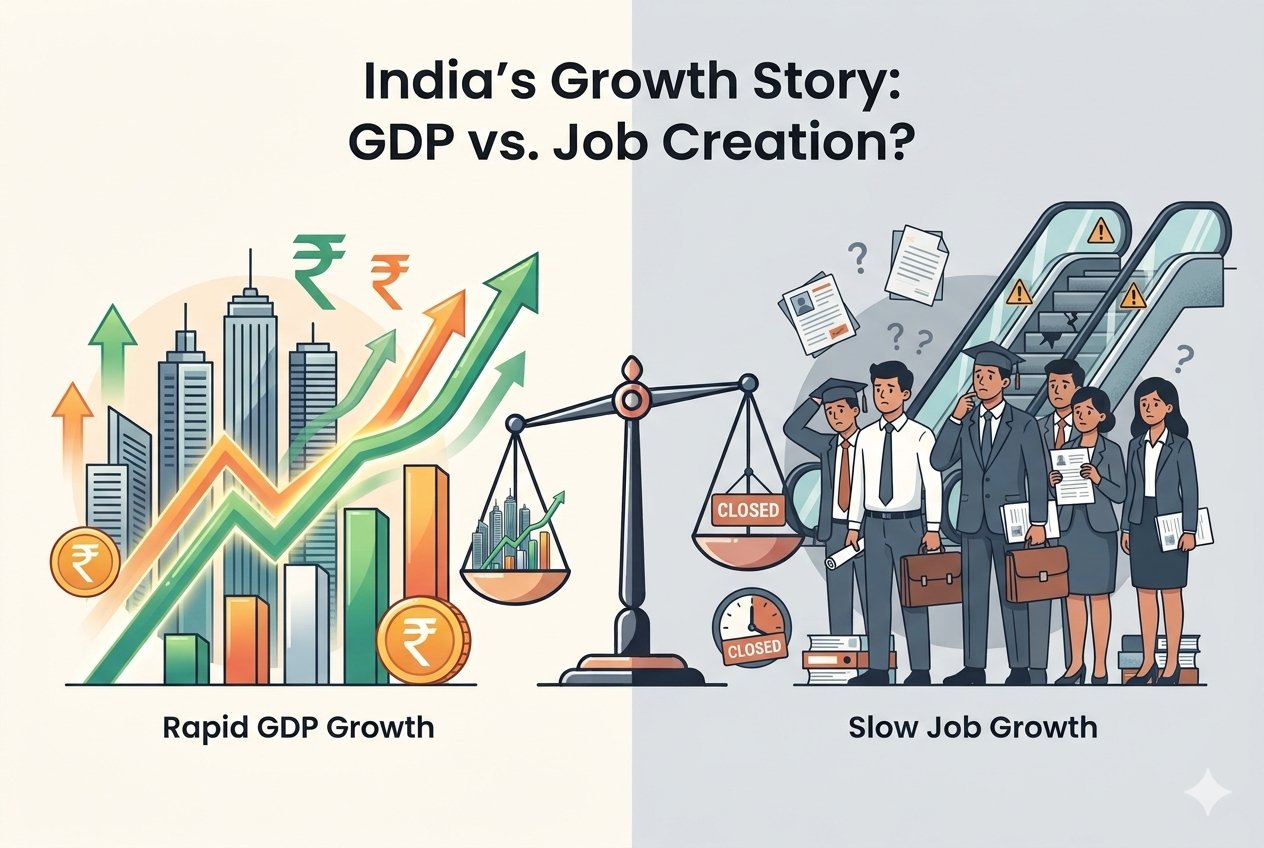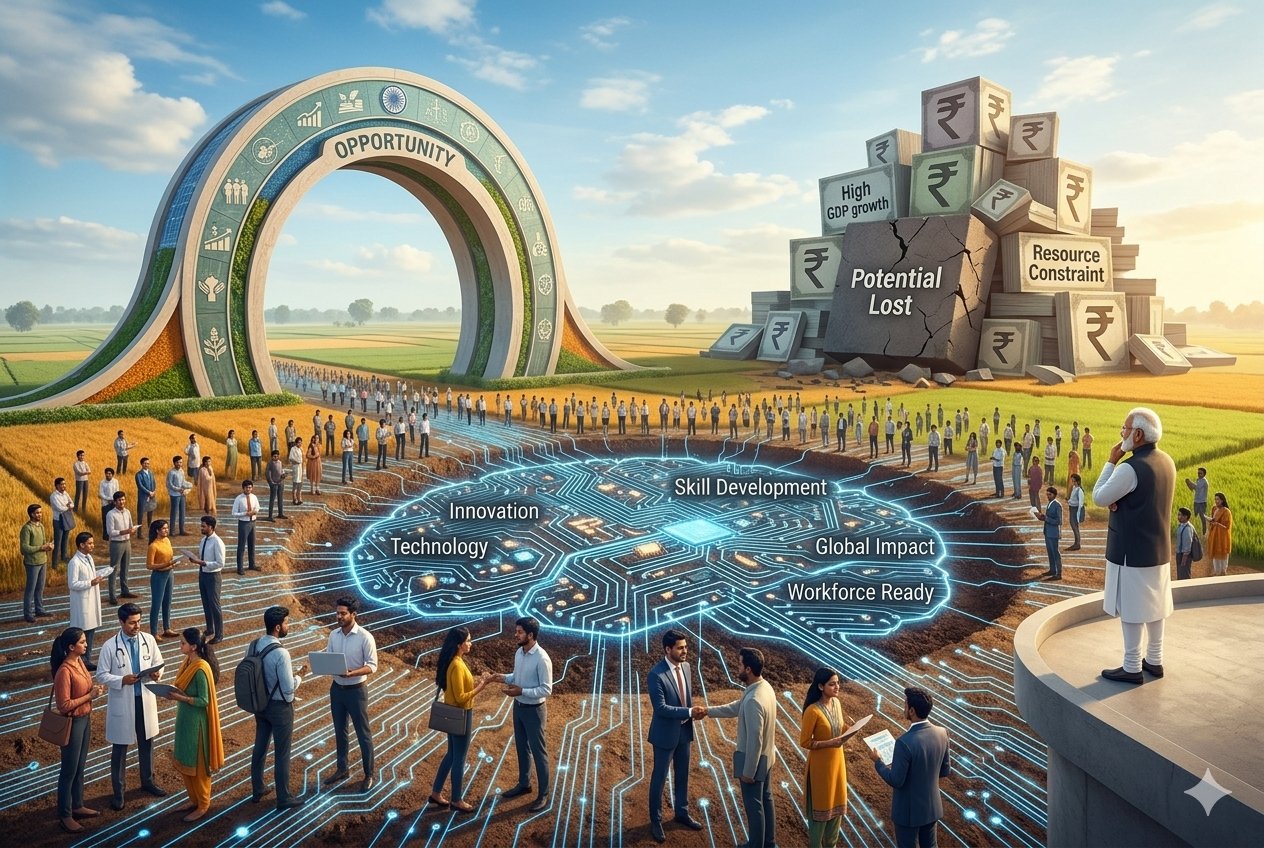
India is often described as one of the youngest nations in the world. With millions of young people entering the workforce, the country has a significant opportunity to accelerate economic growth, strengthen productivity and establish itself as a global economic powerhouse.
But there is an important question we need to ask:
Does having a large young population automatically make a country economically powerful?
The answer is no.
A young population creates potential. Education, employability, skill development and meaningful employment opportunities determine whether that potential translates into economic prosperity.
This is where India’s demographic dividend becomes particularly important.
Understanding India’s Demographic Dividend
Demographic dividend refers to the economic growth potential that arises when the working-age population forms a larger share of the total population compared with dependants such as children and elderly people.
India’s demographic structure provides a significant opportunity.
According to the Economic Survey 2025–26, nearly 65% of India’s population is projected to be in the 15–59 age group around 2030.
This creates an important window for India to strengthen its workforce, increase productivity, encourage entrepreneurship and accelerate economic development.
However, this opportunity is not permanent. The country must make effective use of its favourable age structure while the window remains open.
The Education-to-Employment Gap
India has made considerable progress in expanding access to education. More young people are pursuing higher education, professional courses and technical qualifications.
Yet, obtaining a degree does not necessarily guarantee employment.
The State of Working India 2026 report by Azim Premji University highlights a significant challenge: the transition from education to employment remains difficult for many young graduates.
The problem is not simply a shortage of educated individuals. It is also the gap between what students learn and what industries actually require.
Employers increasingly seek practical knowledge, communication skills, technological understanding and the ability to solve real-world problems.
India therefore needs to move beyond an education system focused primarily on qualifications towards one that develops employable capabilities.
Skills Will Determine India’s Economic Strength
The nature of work is changing rapidly.
Artificial Intelligence, automation, digital platforms and technological innovation are transforming industries and creating new professional requirements.
Traditional qualifications alone may not be sufficient to remain competitive in this changing environment.
India needs to strengthen:
- Digital and technological literacy.
- Industry-oriented vocational training.
- Financial and entrepreneurial awareness.
- Critical thinking and problem-solving abilities.
- Practical exposure through internships and apprenticeships.
- Continuous learning and professional development.
The objective should be to prepare young people not merely for their first job, but for a lifetime of changing career opportunities.
Employment Generation: The Real Test
A skilled workforce needs an economy capable of absorbing it.
India’s demographic advantage can only become an economic advantage when sufficient productive and sustainable employment opportunities are created.
Manufacturing, infrastructure, technology, financial services, healthcare, tourism and emerging industries can play important roles in generating employment.
Small businesses and MSMEs also deserve particular attention.
They contribute significantly to economic activity and can create employment across different regions. Easier access to finance, better infrastructure, technology adoption and a supportive business environment can help them expand and generate more jobs.
Economic growth must create opportunities not only for highly qualified professionals but also for workers with vocational, technical and practical skills.
Women’s Participation: An Essential Part of the Opportunity
India cannot fully utilise its demographic dividend without strengthening women’s participation in the economy.
Women contribute to economic activity as professionals, entrepreneurs, business owners and workers.
However, barriers such as unequal opportunities, unpaid care responsibilities, workplace constraints and limited access to resources can restrict their economic participation.
Affordable childcare, safe workplaces, skill development, financial inclusion and equal employment opportunities can help more women participate meaningfully in the workforce.
Greater participation by women is not merely a social objective; it is also an economic necessity.
The Role of Financial Inclusion and Entrepreneurship
Economic development is not limited to employment alone.
Young people must also have opportunities to create businesses, access finance, understand investments and participate in wealth creation.
A supportive financial ecosystem can encourage entrepreneurship and help transform innovative ideas into sustainable businesses.
Access to formal credit, digital financial services, financial literacy and responsible investment opportunities can strengthen the economic contribution of India’s younger generation.
The goal should be to create an economy where young people are not only job seekers but also job creators.
The Road Ahead: Opportunity or Missed Potential?
India stands at an important stage of its demographic transition.
The country has a young, increasingly educated and ambitious population. But demographic advantage alone cannot guarantee economic success.
It requires coordinated efforts from policymakers, educational institutions, industries, financial institutions and individuals.
Education must connect with employment. Skills must connect with industry requirements. Entrepreneurship must connect with finance. And economic growth must translate into productive opportunities.
The challenge is not simply to prepare millions of young people for the future. It is to build an economy capable of providing them with a meaningful future.
Conclusion
India’s demographic dividend is one of its greatest economic opportunities, but it is not an automatic guarantee of prosperity.
A large young population can become a powerful engine of growth only when supported by quality education, relevant skills, productive employment, women’s participation and entrepreneurial opportunities.
The next decade will be particularly important in determining how effectively India converts its demographic potential into sustainable economic development.
Because a nation’s real strength is not measured merely by how many young people it has, but by how effectively it empowers them to contribute to its future.
India does not just need a young population. It needs a skilled, productive, financially empowered and opportunity-driven generation.