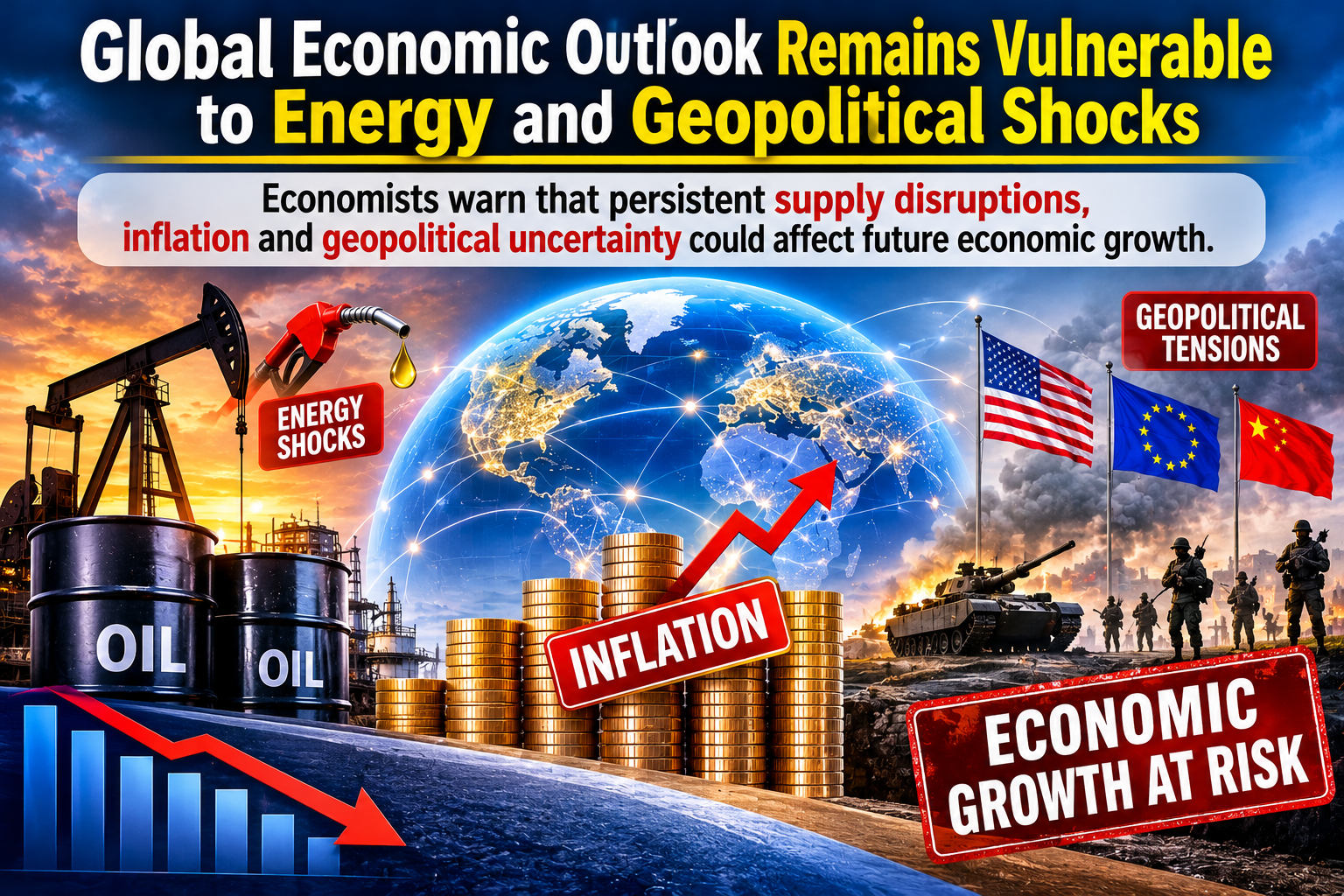
Global Economic Outlook Remains Vulnerable to Energy and Geopolitical Shocks
Economists warn that persistent supply disruptions, inflation and geopolitical uncertainty could affect future economic growth.
The global economy continues to demonstrate resilience despite repeated economic and geopolitical challenges. However, growing uncertainty surrounding energy supplies, international conflicts, inflation and trade relations is creating significant risks for future economic growth. Governments, businesses and financial markets are increasingly concerned that prolonged disruptions could weaken investment, reduce consumer purchasing power and make economic recovery more difficult.
The ongoing conflict in the Middle East has emerged as a major source of uncertainty for global markets. Disruptions to energy production and transportation routes have contributed to higher commodity prices, while concerns about further escalation continue to influence investor confidence. At the same time, persistent inflation and higher borrowing costs are limiting the ability of central banks and governments to provide additional economic support.
Global Growth Faces Increasing Uncertainty
The International Monetary Fund’s October 2026 World Economic Outlook projects global economic growth of 3.1% in 2026, followed by a moderate improvement to 3.4% in 2027. However, the relatively stable global forecast conceals significant differences between countries and regions.
The IMF expects global headline inflation to rise to 4.7% in 2026 before easing to 4.1% in 2027. Higher energy and food prices are among the major factors contributing to this temporary increase.
The IMF also warns that the global economy is operating with increasingly limited room to absorb additional shocks. Although businesses have adapted through alternative suppliers, inventory adjustments and changes in transportation routes, these measures cannot provide unlimited protection against prolonged disruptions.
The outlook remains particularly difficult for energy-importing economies that have limited access to technology-related investment and exports. Such countries face higher import bills, pressure on their currencies and weaker domestic demand.
Energy Supply Disruptions Remain a Major Risk
Energy markets remain highly sensitive to geopolitical developments. Oil and natural gas supplies are essential for transportation, electricity generation, manufacturing and agricultural production. Any significant disruption can therefore affect several sectors simultaneously.
The Middle East remains strategically important because of its role in international energy production and transportation. Restrictions or interruptions affecting shipping routes such as the Strait of Hormuz could create difficulties for global oil and gas supplies.
Higher energy prices increase operating expenses for manufacturers, logistics companies and electricity-intensive industries. Businesses may pass these additional costs to consumers, contributing to inflation across the wider economy.
The effects can also extend to agriculture. Higher fuel, fertiliser and transportation costs can increase food production expenses, putting additional pressure on household budgets, particularly in lower-income economies.
The Organisation for Economic Co-operation and Development (OECD), in its September 2026 Economic Outlook, identified prolonged disruptions to Middle Eastern energy exports and weather-related supply shocks as significant downside risks. It also highlighted that the recovery of energy supplies may take time even after geopolitical conditions improve.
Inflation Complicates Central Bank Decisions
Persistent energy-related inflation is creating a difficult environment for central banks. Monetary authorities must balance the need to control rising prices with the importance of maintaining economic growth and employment.
If energy prices remain elevated, inflation could become more persistent as higher transportation, electricity and production expenses spread throughout the economy. Businesses may increase prices, while workers may demand higher wages to compensate for declining purchasing power.
Central banks could consequently face pressure to maintain restrictive monetary policies or delay interest-rate reductions. Higher interest rates, however, increase borrowing costs for households, businesses and governments.
This creates a difficult economic cycle: inflation limits the scope for monetary easing, while higher borrowing costs can weaken investment, consumption and employment.
The IMF’s October outlook identifies renewed inflationary pressures and tighter financial conditions as important risks if geopolitical disruptions intensify.
Businesses Reconsider Investment and Supply Chains
Global businesses are increasingly focused on managing risks associated with international supply disruptions. Manufacturers that depend on imported energy, raw materials and intermediate goods may face higher operating costs and uncertainty over delivery schedules.
Companies are responding by diversifying suppliers, increasing inventory reserves and exploring alternative manufacturing locations. These strategies can improve resilience, but they may also increase operating expenses and reduce efficiency.
Uncertainty can additionally affect investment decisions. Businesses may postpone expansion projects when future energy prices, transportation costs and consumer demand become difficult to predict.
Small and medium-sized enterprises are particularly exposed because they often have fewer financial resources and less flexibility to absorb sudden cost increases.
Technology investment continues to provide an important source of support for global activity. The expansion of artificial intelligence infrastructure, semiconductor production and digital services is helping sustain investment in several major economies. However, this growth is unevenly distributed and cannot fully offset weakness in energy-intensive industries or countries with limited technology-sector exposure.
Emerging Economies Face Additional Pressure
Emerging markets are particularly vulnerable to international energy and financial shocks. Many developing countries depend heavily on imported oil, natural gas, fertilisers and industrial inputs.
When global energy prices rise, import bills increase and pressure may develop on national currencies. Currency depreciation can make imported goods and foreign-currency debt more expensive, adding to inflationary and fiscal challenges.
The World Bank’s 2026 Global Economic Prospects report projects global growth to slow to 2.5% in 2026, with recovery expected in 2027–28 as energy supplies improve and international trade strengthens. It also identifies the Middle East conflict, commodity-market disruptions and policy uncertainty as significant downside risks.
For India and other energy-importing economies, higher crude oil and natural gas prices can affect transportation expenses, manufacturing costs and the country’s external trade balance. Maintaining energy security, diversifying supply sources and improving domestic infrastructure will therefore remain important policy priorities.
Governments Must Strengthen Economic Resilience
Governments face the challenge of protecting households and businesses without creating unsustainable public spending commitments. Temporary and targeted assistance may help vulnerable groups manage higher energy and food expenses, but prolonged subsidies can increase fiscal pressure.
Investment in renewable energy, electricity networks, storage capacity and energy efficiency can reduce dependence on imported fossil fuels over the longer term. Diversifying international suppliers and strengthening strategic reserves can also help economies respond to future disruptions.
International cooperation remains equally important. Countries must work together to maintain reliable trade routes, improve energy-market transparency and prevent geopolitical disagreements from creating wider economic instability.
The Worldonomics Times Views
The global economy is entering a period in which resilience will be tested by the interaction of energy insecurity, geopolitical competition, inflation and financial uncertainty. Although economic activity has remained stronger than some earlier expectations, the capacity of businesses and governments to absorb repeated shocks should not be taken for granted.
Policymakers must prioritise stable inflation, sustainable public finances and reliable energy supplies. Governments should accelerate investment in diversified energy systems while maintaining targeted support for vulnerable households and essential industries.
Businesses, meanwhile, need to strengthen supply-chain flexibility, manage financial risks and improve operational efficiency. Greater diversification can reduce dependence on individual suppliers and markets, although it must be balanced against the costs of maintaining additional capacity.
Ultimately, sustainable global growth depends on more than short-term economic resilience. It requires stable international cooperation, predictable policies, responsible financial management and long-term investment in productive infrastructure. The ability of economies to adapt to energy and geopolitical shocks will play a decisive role in determining the strength and stability of global growth in the years ahead.