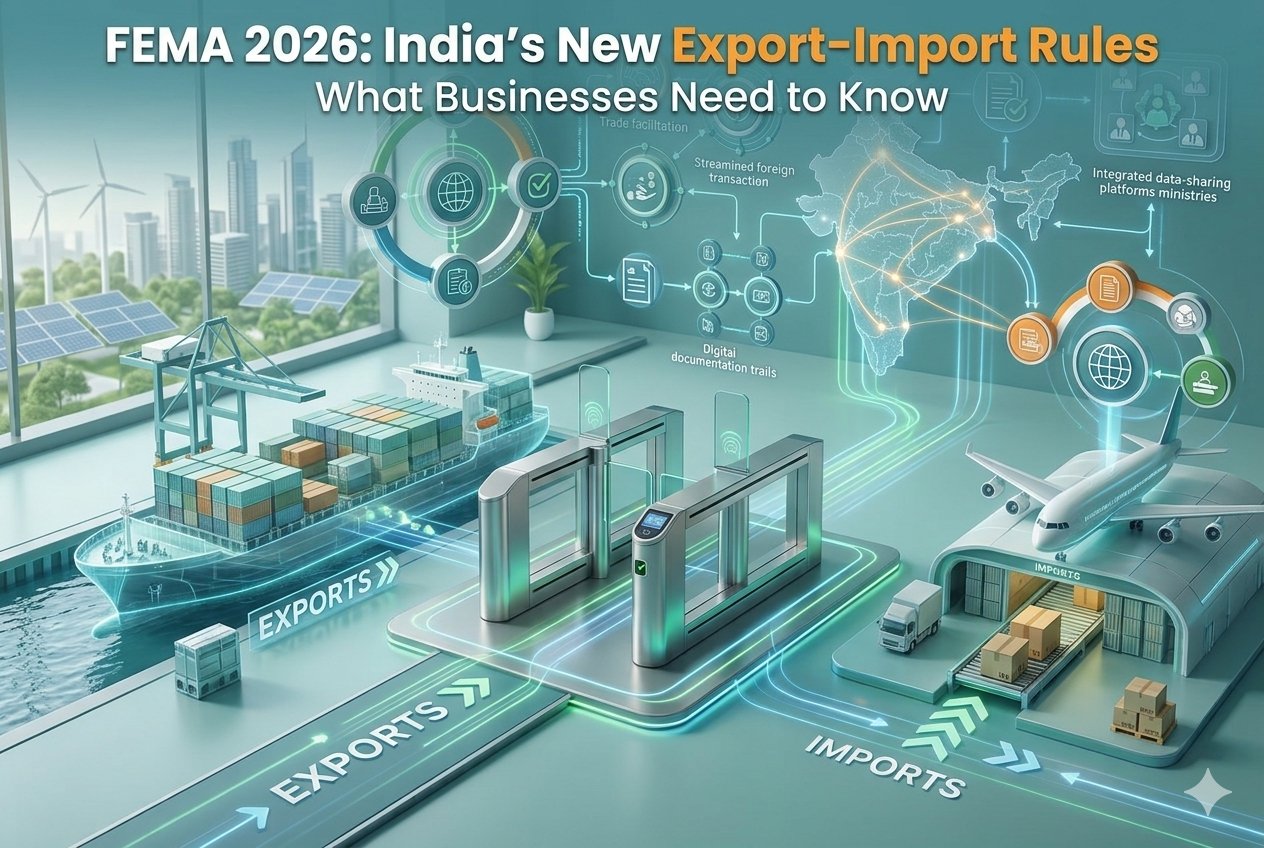
In an increasingly interconnected global economy, international trade is no longer limited to large corporations. Indian startups, MSMEs, freelancers, manufacturers and service providers are increasingly participating in cross-border business.
But international trade involves more than buying and selling goods or providing services. It also requires compliance with foreign exchange regulations, timely receipt of export proceeds, proper documentation and transparent financial reporting.
Recognising the need to simplify this framework, the Reserve Bank of India (RBI) has introduced a new regulatory framework under the Foreign Exchange Management Act, 1999 (FEMA).
The Foreign Exchange Management (Export and Import of Goods and Services) Regulations, 2026, effective from 1 October 2026, replace the earlier 2015 export regulations and introduce a more principle-based approach to managing international trade transactions.
The objective is clear: simplify compliance, improve operational flexibility and empower Authorised Dealer (AD) banks to provide more efficient services to businesses.
1. Why Were the New FEMA Regulations Introduced?
India’s international trade ecosystem has evolved significantly over the years.
Businesses increasingly undertake:
- Cross-border e-commerce transactions.
- International software and IT service exports.
- Global supply-chain operations.
- Merchanting trade transactions.
- Import of goods, technology and professional services.
The earlier regulatory framework required businesses and banks to navigate multiple instructions and procedures.
The RBI reviewed the existing framework after stakeholder consultations and introduced the 2026 Regulations and accompanying Directions.
The new framework aims to improve ease of doing business, particularly for small exporters and importers, while strengthening the role of Authorised Dealer banks.
2. Important Changes Under FEMA 2026
A. Export Declaration Form (EDF) for Services
The new framework provides a defined procedure for declaring exports of services.
Generally, an exporter of services must submit an Export Declaration Form within 30 days from the end of the month in which the invoice is raised.
However, the November 2026 amendment introduced important compliance simplifications:
- Resident individuals: An individual exporting services is deemed to have submitted the EDF when the required payment information is provided to the Authorised Dealer bank for crediting the export proceeds.
- Other exporters: Non-individual exporters are also deemed to have submitted the EDF where the inward remittance for the service does not exceed ₹10 lakh (or its equivalent in foreign currency), subject to the prescribed conditions.
- Monthly consolidation: An exporter may submit a single EDF covering services provided to one or more recipients during a month.
- Flexibility: An Authorised Dealer may extend the EDF submission period for reasons considered reasonable.
These provisions are particularly relevant for individual consultants, freelancers, software professionals and small service exporters.
B. Time Limit for Realisation and Repatriation of Export Proceeds
One of the most important changes concerns the time allowed for realisation and repatriation of export proceeds.
Under the amended Regulation 5, the general period has been reduced from 15 months to 9 months.
The applicable periods are:
| Nature of export | Time limit |
|---|---|
| Goods (other than warehouse exports) | 9 months from shipment |
| Services | 9 months from invoice |
| Goods exported to an overseas warehouse | 9 months from sale |
| Exports invoiced or settled in INR | 12 months |
| Project exports | As per contract terms |
An Authorised Dealer may grant an extension upon receiving a request from the exporter and being satisfied with the reasons.
This change makes timely monitoring of international receivables especially important for exporters.
C. Simplification of EDPMS and IDPMS Closure
The RBI has also introduced simplified procedures for smaller-value transactions.
EDPMS (Export Data Processing and Monitoring System) and IDPMS (Import Data Processing and Monitoring System) are important systems used by banks to monitor export and import transactions.
Under the new framework:
- Export transactions involving a shipping bill or service invoice up to ₹10 lakh may be closed in EDPMS based on the exporter’s declaration regarding realisation of payment.
- Import transactions involving a Bill of Entry or service invoice up to ₹10 lakh may be closed in IDPMS based on the importer’s declaration regarding payment.
- Such declarations may also be submitted quarterly for bulk closure.
This can reduce documentation and reconciliation burdens for smaller businesses.
D. Greater Flexibility for Authorised Dealer Banks
The new regulations give Authorised Dealer banks a more significant operational role.
They can consider requests relating to:
- Extension of export realisation periods.
- Reduction in export realisation.
- Set-off of export receivables against import payables.
- Third-party receipts and payments, subject to genuineness.
- Advance payments for imports and exports.
- Import payment extensions.
This does not mean that regulatory compliance has been removed. Rather, banks have greater responsibility and flexibility to assess transactions within the prescribed regulatory framework.
E. Merchanting Trade Transactions
Merchanting trade refers to transactions where goods are purchased from one country and sold to another without entering India’s domestic territory.
Under Regulation 16, the period between the outward and inward remittances, or vice versa, must not exceed six months.
An Authorised Dealer may grant an extension upon considering the reasons submitted by the merchant trader.
This provision is important for businesses engaged in international trading without physically importing goods into India.
F. New Amendment Dated 2 November 2026
An important development after the commencement of the new regulations is the Second Amendment dated 2 November 2026.
It introduced further simplifications relating to service-export declarations and reporting of service imports.
For service imports, the IDPMS reporting requirement is specifically linked to:
- Importers other than resident individuals; and
- Invoices or contracts exceeding ₹10 lakh (or equivalent foreign currency).
This reduces the reporting burden for certain smaller transactions while retaining monitoring requirements for larger transactions.
3. What Do These Changes Mean for Indian Businesses?
The new FEMA framework has practical implications for different categories of businesses.
For MSMEs: Simplified procedures and greater flexibility from banks can help reduce administrative difficulties in managing international trade.
For exporters: The revised realisation timelines make receivables management and foreign currency monitoring more important.
For freelancers and individual service providers: The simplified EDF provisions can reduce compliance requirements when receiving international service payments.
For importers: Greater clarity around payment monitoring and reporting can help businesses manage their international payment obligations.
For international traders: The framework provides clearer provisions for merchanting trade and cross-border settlement.
4. The Role of Finance Professionals in FEMA Compliance
Regulatory changes create responsibilities as well as opportunities for finance professionals.
Cost accountants, chartered accountants, company secretaries and financial managers can contribute by:
- Monitoring export receivables and import payables.
- Maintaining proper documentation of foreign exchange transactions.
- Reconciling EDPMS and IDPMS records.
- Ensuring timely realisation and repatriation of export proceeds.
- Reviewing merchanting trade transactions.
- Coordinating with Authorised Dealer banks.
- Identifying potential FEMA compliance risks.
The role of finance professionals is not merely to record international transactions but also to ensure that businesses conduct them within the applicable regulatory framework.
5. The Road Ahead: Simplification Without Compromising Compliance
The introduction of FEMA 2026 represents an important step towards modernising India’s foreign trade regulatory environment.
However, simplification should not be confused with the removal of responsibility.
Businesses must continue to maintain proper records, follow applicable FEMA provisions, comply with the Foreign Trade Policy and coordinate with their Authorised Dealer banks.
The effectiveness of the new framework will ultimately depend on how efficiently businesses and banks implement these changes.
Conclusion
International trade creates enormous opportunities for Indian businesses, but regulatory complexity can sometimes become a barrier to growth.
The new FEMA Regulations, 2026, attempt to address this challenge through simplified procedures, greater flexibility and stronger operational responsibility for Authorised Dealer banks.
For India to strengthen its position in global trade, businesses need more than access to international markets. They also need a regulatory environment that supports efficiency, transparency and responsible financial management.
The real success of FEMA 2026 will not simply be measured by the number of regulations simplified, but by how effectively Indian businesses can participate in global trade with confidence and compliance.
In a global economy, the ability to trade internationally is an opportunity. The ability to manage it compliantly is a competitive advantage.