From ISRO Missions to Private Space Enterprises: How Space Technology Is Creating New Business and Investment Opportunities
For decades, space exploration was largely associated with government agencies, scientific research and national missions. Today, the industry is undergoing a major transformation.
Private companies are building satellites, developing launch vehicles, providing satellite-based internet services and creating technologies that could reshape industries on Earth.
Space is no longer just about exploring the universe. It is becoming a commercial ecosystem with enormous economic potential.
Welcome to the Space Economy, where technology meets entrepreneurship, investment and global business.
1. What Is the Space Economy?
The space economy includes all economic activities connected with the development, manufacturing and use of space-related products and services.
It extends beyond rockets and satellites and includes:
- Satellite manufacturing and launch services.
- Satellite-based communication and navigation.
- Earth observation and geospatial intelligence.
- Space-based internet and connectivity.
- Space research and advanced technology.
- Satellite data analytics and commercial applications.
These services are increasingly supporting industries such as agriculture, telecommunications, banking, insurance, logistics, defence and disaster management.
2. India’s Space Economy: A Growing Commercial Opportunity
India’s space sector is moving beyond government-led missions towards greater private-sector participation.
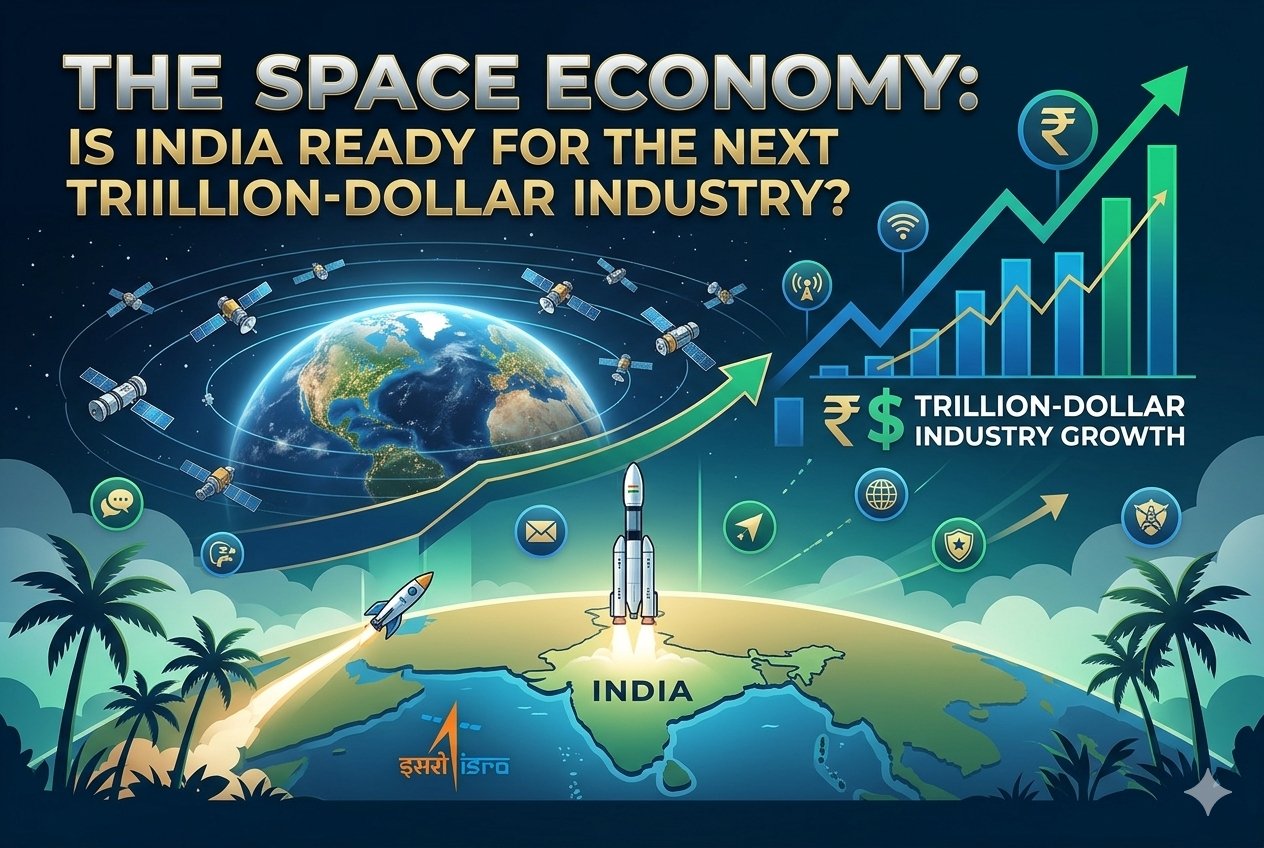
According to the Department of Space, India’s space economy was valued at approximately US$9 billion in October 2026 and is projected to reach US$40–45 billion over the next seven to eight years.
The expansion of India’s startup ecosystem is another significant development.
As of August 2026:
- Around 440 space-tech startups were registered in India.
- Private investment in the sector reached approximately US$618.5 million by March 2026.
- IN-SPACe had granted 113 authorisations to 52 non-government entities by mid-2026.
These figures reflect a changing business environment in which startups and private enterprises are becoming important participants in India’s space ambitions.
3. From Government Monopoly to Private Enterprise
One of the biggest changes in India’s space industry has been the opening of the sector to private participation.
The Indian Space Policy 2023 established a framework for encouraging private enterprises to participate across the space value chain.
The Indian National Space Promotion and Authorisation Centre (IN-SPACe) plays an important role in promoting, authorising and facilitating private-sector activities.
Meanwhile, NewSpace India Limited (NSIL) serves as the commercial arm of the Department of Space.
This institutional framework is helping transform space technology into commercial opportunities.
4. Investment and FDI: Making India Attractive for Global Players
A major step towards attracting private investment was the liberalisation of India’s Foreign Direct Investment policy in the space sector in February 2024.
The revised framework permits:
- Up to 74% automatic FDI: Satellite manufacturing and operations, satellite data products and ground/user segments.
- Up to 49% automatic FDI: Launch vehicles and associated systems, and spaceports.
- Up to 100% automatic FDI: Manufacturing of components and systems or subsystems for satellites and ground/user segments.
These provisions are subject to the applicable sectoral conditions and regulatory requirements.
The government has also introduced targeted financial support, including:
- ₹1,000 crore Venture Capital Fund for space startups.
- ₹500 crore Technology Adoption Fund to accelerate the commercialisation of indigenous space technologies.
These initiatives aim to improve access to capital, encourage innovation and strengthen domestic manufacturing capabilities.
5. Where Are the Business Opportunities?
The space economy offers opportunities beyond launching satellites.
A. Satellite Manufacturing
Companies developing satellite components, communication systems and advanced equipment can become important suppliers in the global space industry.
B. Earth Observation and Data Analytics
Satellite imagery can help businesses monitor agricultural productivity, urban development, infrastructure projects and environmental changes.
C. Space-Based Communication
Satellite communication can improve connectivity in remote regions and support industries requiring reliable communication infrastructure.
D. Launch Services
Private launch companies can provide cost-effective launch solutions for domestic and international satellite operators.
E. Space Technology and Software
Artificial intelligence, geospatial analytics, automation and advanced software are creating new opportunities for technology companies.
The biggest commercial opportunity may not always be in building rockets, but in developing the services and applications that use space-based infrastructure.
6. The Challenges: What Could Slow India’s Growth?
Despite its potential, the industry faces several challenges.
- High capital investment and long development cycles.
- Technological complexity and research requirements.
- Global competition in launch and satellite services.
- Regulatory, safety and national security considerations.
- Shortage of specialised technical talent.
- Uncertainty around predictable commercial demand.
For startups, access to funding and the ability to convert technological achievements into sustainable revenue will remain particularly important.
7. The Road Ahead: Building a Commercial Space Ecosystem
India’s next phase of growth will depend on its ability to build commercially sustainable space enterprises.
Stronger public-private partnerships, domestic manufacturing, technology transfers, research investments and international collaborations can help Indian businesses participate more actively in global space markets.
The proposed private-sector Earth Observation satellite constellation under the public-private partnership framework is one example of how government and industry can collaborate to build new capabilities.
The objective should not simply be to achieve more successful space missions, but to create businesses that generate employment, revenue, exports and long-term technological capabilities.
Conclusion: The Future of Business May Be Beyond Earth
The space economy represents one of the most exciting intersections of technology, finance and entrepreneurship.
For India, the opportunity is much larger than scientific achievement. It is about building globally competitive enterprises, attracting investment and developing technologies that create value across multiple industries.
The transition from government-led exploration to a commercially driven space ecosystem could redefine India’s position in the global technology economy.
The next great business opportunity may not be found only on Earth. It may be built in space, powered by innovation and financed by the ambition of a new generation of entrepreneurs.