By The Worldonomics Times
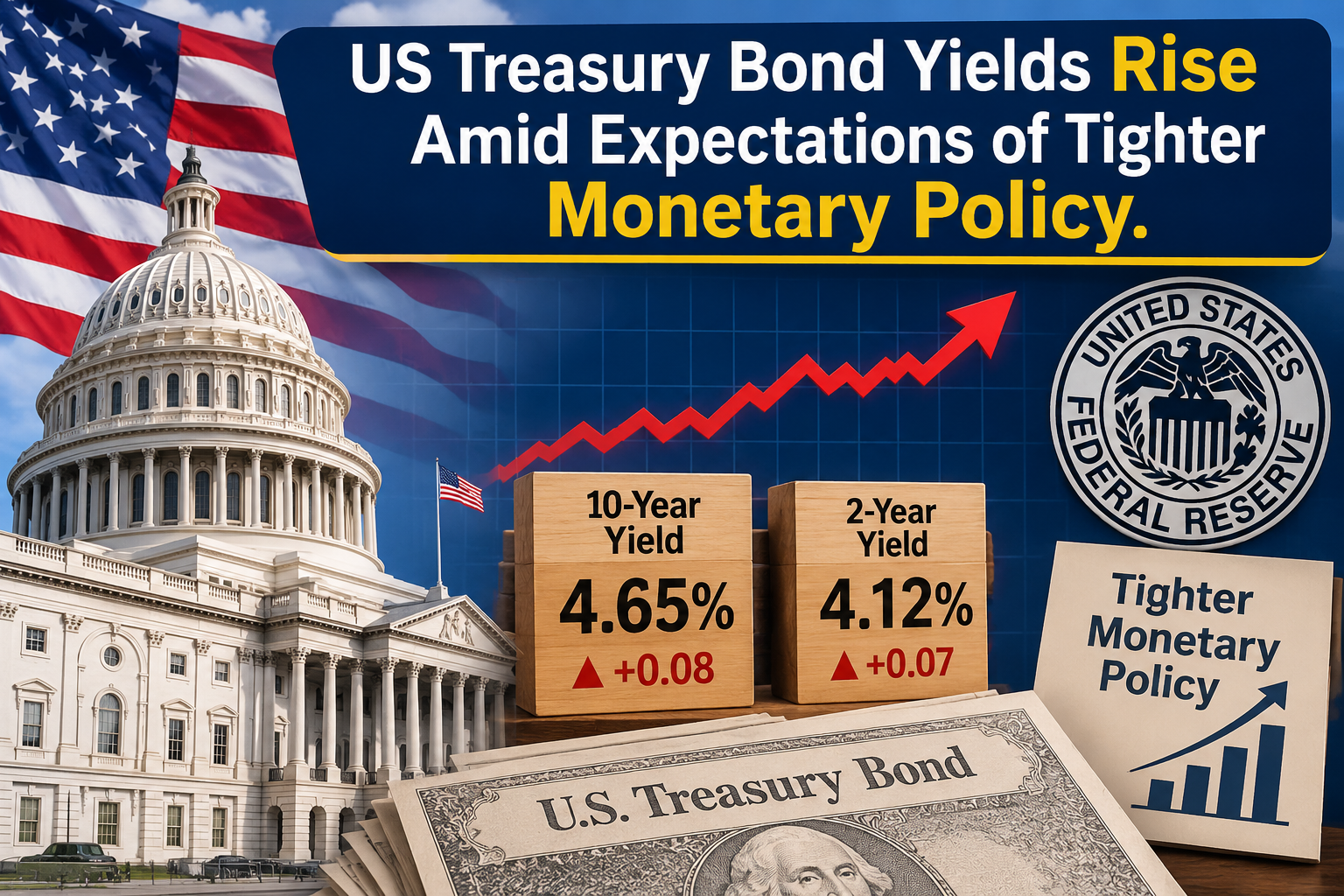
US Treasury bond yields are rising as investors increasingly anticipate tighter monetary policy from the Federal Reserve amid persistent inflationary pressures and signs of economic resilience. The movement has attracted considerable attention across global financial markets because Treasury securities play a central role in determining borrowing costs, investment decisions, currency movements, and international capital flows.
Recent increases in government bond yields reflect concerns that inflation may remain above the Federal Reserve’s target for longer than expected. Strong economic activity, higher energy costs, and uncertainty surrounding future interest rate decisions have encouraged investors to demand greater returns on government debt.
According to a Reuters report published on November 10, 2026, the benchmark 10-year US Treasury yield climbed to approximately 4.99%, while the two-year yield increased to around 4.74% following stronger-than-expected inflation data. Subsequent market reports indicated that the 10-year yield moved above the 5% threshold, highlighting the changing expectations surrounding US monetary policy.
These developments have important implications not only for the United States but also for international financial markets and emerging economies.
Inflation Concerns Increase Expectations of Higher Interest Rates
Inflation remains one of the most important factors influencing Treasury bond yields.
When consumer prices rise faster than expected, investors may anticipate that the Federal Reserve will maintain restrictive monetary conditions or increase its benchmark interest rate to control inflation.
US consumer prices increased by 0.4% in October 2026, compared with economists’ expectations of 0.3%, according to the inflation figures reported by Reuters on November 10. Core consumer inflation, which excludes food and energy prices, also increased by 0.3%, exceeding market expectations of 0.2%.
These figures raised concerns that inflationary pressures may be becoming more persistent.
Investors consequently reassessed the likely direction of monetary policy. Federal Reserve officials have also indicated that further interest rate increases could be considered if inflation remains elevated.
The possibility of additional tightening has encouraged investors to demand higher yields on Treasury securities, particularly those with shorter maturities that are closely linked to expectations for Federal Reserve policy.
Understanding Why Treasury Bond Yields Are Rising
Treasury bonds are debt securities issued by the US government to finance public expenditure and manage its borrowing requirements.
Their yields represent the returns investors receive for holding these securities. Bond prices and yields generally move in opposite directions: when investors sell existing bonds, their prices decline and their yields increase.
Expectations of higher interest rates can therefore reduce demand for existing bonds offering comparatively lower returns.
For example, if investors expect newly issued government securities to offer higher interest payments in the future, they may become less interested in purchasing older bonds at their existing prices.
However, long-term Treasury yields are influenced by more than Federal Reserve decisions. Expectations about future inflation, economic growth, government borrowing, and the additional compensation investors require for holding long-term debt also play important roles.
This explains why longer-term yields can increase even when the Federal Reserve has not immediately raised its benchmark interest rate.
Federal Reserve Policy Creates Uncertainty for Investors
The Federal Reserve faces the difficult task of controlling inflation without unnecessarily weakening economic growth.
Higher interest rates can reduce borrowing, spending, and investment, helping to moderate inflationary demand. However, prolonged monetary tightening can also increase financial pressure on households and businesses.
Federal Reserve officials have expressed concerns about the persistence of inflation. Reuters reported on November 10 that Governor Christopher Waller indicated a larger interest rate increase could be considered if inflation data deteriorated further.
The Federal Reserve’s October 29 policy decision also contributed to market uncertainty. Although the central bank kept interest rates unchanged at that meeting, it described the US economy as strong and highlighted continued investment and employment resilience.
Investors are therefore closely monitoring inflation reports, employment figures, consumer spending, and statements from Federal Reserve policymakers to understand the likely direction of monetary policy.
Higher Treasury Yields Affect Stock Markets and Businesses
Rising Treasury yields can influence the performance of equity markets and corporate investment.
When government bonds offer higher returns, investors may shift some of their capital away from equities towards fixed-income securities that are generally considered safer investments.
Higher yields can also reduce the present value of future corporate earnings, placing pressure on stock valuations, particularly in sectors where company valuations depend heavily on expected future growth.
Businesses face another challenge because Treasury yields influence borrowing costs across the wider economy. Corporate bonds, business loans, mortgages, and other financial products may become more expensive when government borrowing rates increase.
Companies planning infrastructure expansion, technology investment, or large-scale manufacturing projects may reconsider their financing requirements.
Small businesses and highly indebted companies can be especially vulnerable because higher interest expenses may reduce profitability and restrict expansion opportunities.
Global Financial Markets Face Additional Pressure
US Treasury securities have a major influence on international financial markets because they are widely used as benchmark assets for global borrowing and investment decisions.
When US yields rise, international investors may find dollar-denominated assets more attractive. This can encourage capital to move towards the United States and place pressure on currencies in emerging economies.
Countries that depend on foreign investment may experience increased financial volatility as international investors reassess the relative returns and risks of different markets.
Higher US yields can also increase the cost of international borrowing for governments and businesses that raise funds in dollars.
Emerging economies with substantial external debt may face additional repayment pressure, particularly if their domestic currencies weaken against the US dollar.
Implications for India and Emerging Economies
India is also influenced by changes in US Treasury yields because international interest rates affect capital flows, currency movements, and investor sentiment.
When US government bonds offer higher returns, foreign investors may become more selective about allocating funds to emerging markets, including India.
This can create pressure on domestic equity markets and the Indian rupee, particularly during periods of global financial uncertainty.
Higher international borrowing costs can also influence Indian companies seeking funds from overseas markets.
However, India’s large domestic financial system, expanding consumer market, infrastructure investment, and relatively diversified economy provide important sources of resilience.
Maintaining macroeconomic stability, strengthening domestic investment, improving export competitiveness, and encouraging long-term foreign capital will remain important for managing external financial risks.
The Worldonomics Times View
The rise in US Treasury bond yields reflects growing uncertainty about inflation, interest rate expectations, and the future direction of global financial conditions.
In our view, the most important issue is not simply the increase in bond yields but the possibility that borrowing costs may remain elevated for an extended period.
Policymakers must carefully balance inflation control with the need to maintain economic growth and financial stability. Excessively aggressive monetary tightening could weaken business investment, reduce consumer demand, and increase financial pressure on governments and households.
Investors should also pay attention to the distinction between short-term policy expectations and longer-term factors such as government debt, inflation expectations, and demand for Treasury securities.
For emerging economies, stronger domestic capital markets, responsible fiscal management, and diversified sources of investment can help reduce vulnerability to changes in US financial conditions.
Ultimately, Treasury yields are an important indicator of investor confidence and expectations about the future economy. Their movement will continue to influence global borrowing costs, financial markets, and international investment decisions.
The coming months will be particularly important as the Federal Reserve evaluates inflation and economic growth. The direction of US monetary policy will play a major role in determining whether global financial conditions become tighter or gradually stabilise.