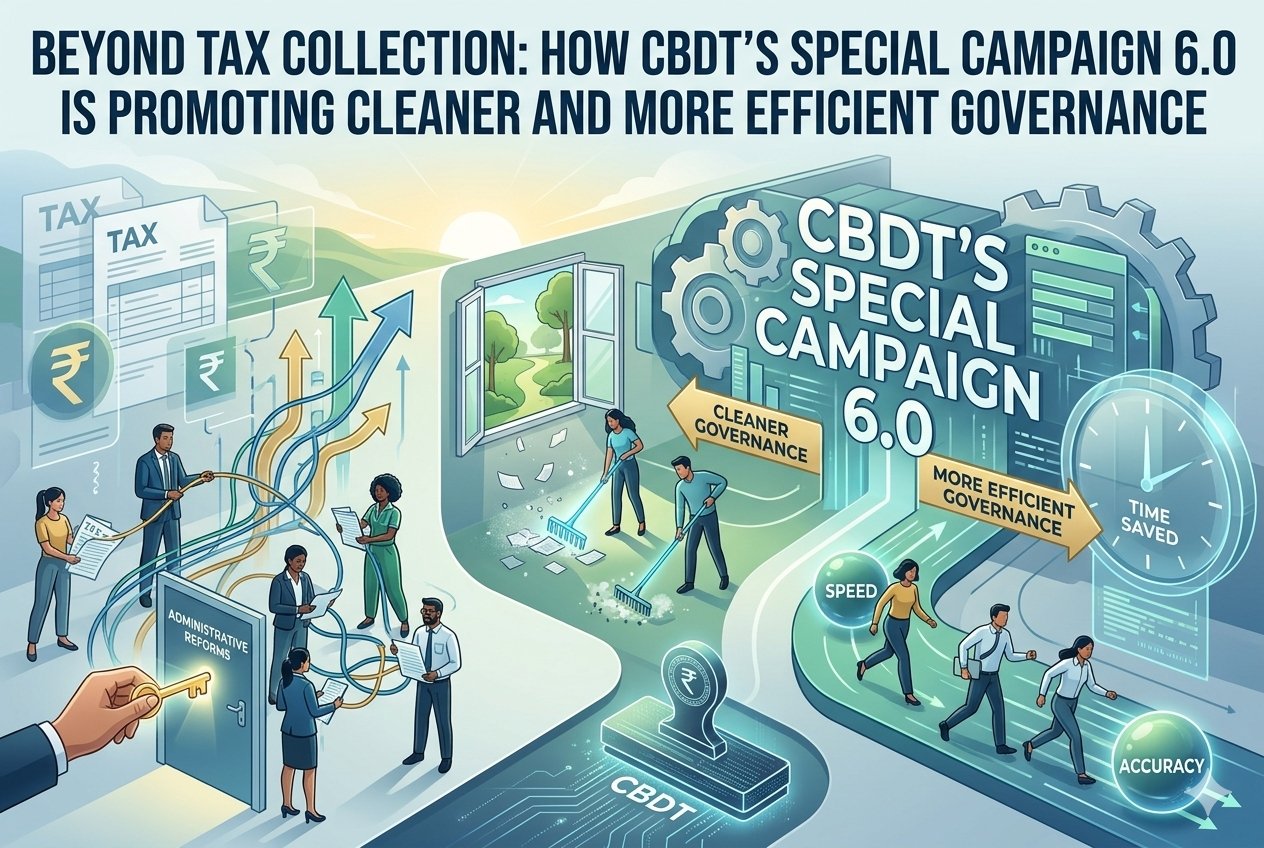
An initiative focused on workplace cleanliness, digital transformation, responsible waste management and faster grievance redressal.
When we think of the Central Board of Direct Taxes (CBDT), our attention usually turns to income tax collection, taxpayer compliance, assessments and tax reforms. However, an efficient tax administration requires more than revenue collection. It also depends on transparent processes, organised records, responsive public services and responsible management of government resources.
Recognising this, the Central Board of Direct Taxes has been actively implementing Special Campaign 6.0, an initiative aimed at institutionalising cleanliness (Swachhata) and improving administrative efficiency across Income Tax Department offices.
1. What is Special Campaign 6.0?
Special Campaign 6.0 is a Government of India initiative led by the Department of Administrative Reforms and Public Grievances (DARPG).
The campaign’s preparatory phase took place from 15–30 September 2026, followed by its implementation phase from 2–31 October 2026.
CBDT and its subordinate offices participated in the campaign with a focus on four major areas:
- Disposal of electronic waste and obsolete materials.
- Better record management and digitisation.
- Office space optimisation and workplace beautification.
- Faster resolution of public grievances and pending references.
2. The Results: Turning Administrative Action into Measurable Outcomes
According to the Ministry of Finance’s update dated 22 October 2026, the campaign had already delivered encouraging results during its first two weeks of implementation:
- Cleanliness drives conducted at more than 1,200 locations.
- More than 14,000 redundant files weeded out.
- Nearly 55,000 square feet of office space freed.
- More than 13,000 public grievances resolved.
- Scrap and e-waste disposal undertaken to support responsible waste management and generate revenue.
These figures demonstrate how administrative reforms can create measurable improvements in the functioning of public institutions.
3. From Waste to Wealth: The Sustainability Connection
One of the notable aspects of the campaign is its focus on responsible disposal of scrap and electronic waste.
Government offices generate significant quantities of obsolete equipment, discarded electronic items and unused materials. Their systematic disposal can help reduce waste, improve resource utilisation and support environmental sustainability.
Initiatives such as the ‘Waste to Art’ exhibition in Kolkata also demonstrated how discarded materials can be transformed into creative and useful products.
This reflects an important principle: sustainability is not limited to corporate boardrooms; it must also become part of everyday public administration.
4. Digitisation and Better Record Management
The removal of redundant physical files and promotion of digitisation are important steps towards a more efficient administrative system.
A well-organised digital record-management framework can help government departments:
- Retrieve information more efficiently.
- Reduce dependence on physical storage.
- Improve document accessibility.
- Strengthen accountability and workflow management.
- Create a more paper-efficient working environment.
For a department handling extensive financial and taxpayer information, effective record management is particularly important.
5. Why Does This Matter to Taxpayers?
The success of a tax administration should not be measured only by the amount of revenue collected.
It should also be assessed through the quality of services delivered to taxpayers.
Faster grievance resolution, better organised offices and efficient record management can contribute to a more responsive and citizen-friendly tax ecosystem.
The campaign also builds on the achievements of Special Campaign 5.0, during which CBDT reported the disposal of 2.30 lakh physical files, more than 10,000 e-files and resolution of over 21,251 public grievances.
6. The Bigger Picture: Governance Is Also About Efficiency
Special Campaign 6.0 highlights an important dimension of institutional reform: small administrative improvements, when implemented systematically, can create significant public value.
However, the real test lies in sustaining these practices beyond the campaign period. Clean offices, timely grievance redressal, responsible e-waste disposal and effective digital record management must become continuous administrative practices rather than one-time activities.
Conclusion
A modern tax administration is not defined merely by its ability to collect taxes, but also by how efficiently, transparently and responsibly it serves citizens.
CBDT’s Special Campaign 6.0 is a reminder that good governance begins with efficient systems, accountable institutions and a citizen-first approach.
The larger message is simple: a cleaner workplace, organised records and faster public services are not just administrative achievements; they are building blocks of a more efficient India.