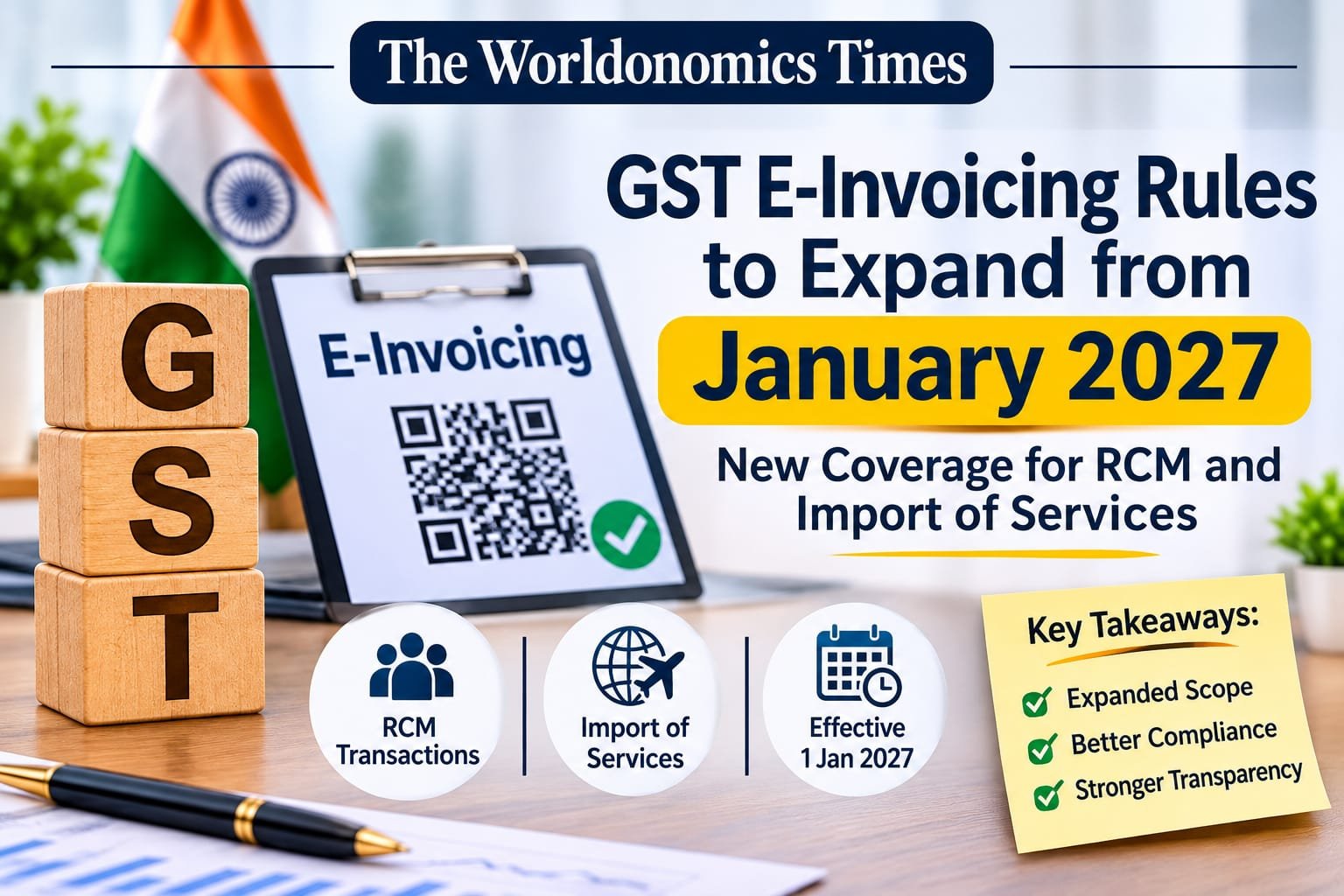
The Central Board of Indirect Taxes and Customs (CBIC), under the Ministry of Finance, has announced an important amendment to India’s Goods and Services Tax (GST) e-invoicing framework through Notification No. 04/2026–Central Tax dated 26 October 2026. The amendment is scheduled to come into force from 1 January 2027 and expands the categories of transactions covered under the existing e-invoicing notification.
The development is significant for businesses, tax professionals and finance departments, particularly those dealing with transactions under the Reverse Charge Mechanism (RCM) and the import of services.
Background of GST E-Invoicing
E-invoicing was introduced under India’s GST system to improve transparency, reduce tax evasion and standardise the reporting of business-to-business transactions. It requires applicable taxpayers to report specified invoice details to an Invoice Registration Portal (IRP), which generates an Invoice Reference Number (IRN) and a digitally signed QR code.
The framework operates under Rule 48(4) of the Central Goods and Services Tax (CGST) Rules, 2017. The Government initially notified the applicable categories through Notification No. 13/2020–Central Tax dated 21 March 2020.
Over time, the e-invoicing system has become an important part of GST compliance. It helps businesses maintain consistent invoice information and supports the tax administration in monitoring transactions and reconciling reported data.
What Has Changed Under Notification No. 04/2026?
Through Notification No. 04/2026–Central Tax, the Government has amended the first paragraph of Notification No. 13/2020–Central Tax.
Earlier, the notification referred to supplies of goods or services or both made to a registered person or for exports.
The amended provision now specifies four categories:
- Supply of goods or services or both to a registered person.
- Supply of goods or services or both for exports.
- Supply of goods or services or both received from an unregistered person where tax is payable by the recipient under the Reverse Charge Mechanism.
- Import of services.
The inclusion of the third and fourth categories is the key development. It brings specified RCM-related transactions and imports of services within the wording of the amended notification.
Understanding the Impact on Reverse Charge Mechanism
Under the Reverse Charge Mechanism, the responsibility to pay GST shifts from the supplier to the recipient in specified transactions.
Under the normal forward charge mechanism, the supplier collects GST from the customer and deposits it with the Government. Under RCM, the recipient is responsible for paying the applicable tax directly to the Government.
For example, when a registered business receives a service from an unregistered supplier and the transaction falls under the applicable reverse charge provisions, the recipient may be required to pay GST.
The inclusion of such transactions in the amended e-invoicing notification is therefore an important compliance development.
Businesses dealing with these transactions should review their accounting systems, supporting documents and invoice-related procedures. They should also examine how the amended requirements will apply to their particular transactions.
Import of Services: An Important Addition
The notification also specifically includes the import of services.
An import of services generally refers to a supply of services where the supplier is located outside India, the recipient is located in India and the place of supply is in India, subject to the relevant statutory provisions.
In specified cases, GST on imported services is payable by the Indian recipient under the Reverse Charge Mechanism.
For businesses receiving services from foreign service providers, this amendment makes it important to review existing documentation and compliance practices.
Companies should maintain appropriate agreements, invoices, payment records and other supporting documents to establish the nature and value of imported services and the applicable GST treatment.
What Should Businesses and Tax Professionals Do?
With the implementation date approaching, businesses should begin reviewing their existing GST compliance processes.
The following steps may help:
- Review RCM transactions: Identify transactions involving unregistered suppliers where GST is payable under reverse charge.
- Examine imported services: Review agreements and invoices received from overseas service providers.
- Update accounting systems: Check whether existing software and internal reporting processes can accommodate the applicable requirements.
- Maintain documentation: Ensure that supporting records are properly maintained for GST reporting and reconciliation.
- Coordinate with tax professionals: Seek clarification on the applicability of the amended provisions to specific business transactions.
- Monitor GST portal updates: Follow further instructions or technical guidance issued by CBIC and GSTN before implementation.
Businesses should also distinguish between the categories specified in the notification and the conditions governing actual applicability. The amendment does not mean that every transaction involving an unregistered supplier or every foreign service automatically becomes subject to the same compliance treatment.
Effective Date and Legal Reference
Notification No. 04/2026–Central Tax was issued on 26 October 2026 under Rule 48(4) of the CGST Rules, 2017.
The amendment to Notification No. 13/2020–Central Tax will come into force on 1 January 2027.
Businesses should refer to the original notification and any subsequent official clarification to understand the precise scope and operational requirements.
Conclusion
The expansion of the GST e-invoicing notification marks an important development in India’s digital tax compliance framework. By specifically including supplies received from unregistered persons under the Reverse Charge Mechanism and the import of services, the Government has widened the categories addressed by the existing notification.
For businesses, the immediate priority should be to understand the amendment, review relevant transactions and prepare their compliance systems ahead of the effective date.
As GST regulations continue to evolve, staying informed about official notifications and timely implementation will remain essential for businesses and tax professionals.