What if buying a corporate bond, recording its ownership, settling the payment and receiving interest could become part of one integrated digital process? India is taking a step towards exploring exactly that possibility.
India’s financial markets are entering an interesting phase of technological transformation. In September 2026, the Securities and Exchange Board of India (SEBI), together with the Reserve Bank of India (RBI), launched Demat 2.0, a pilot project to test the tokenisation of corporate bonds using Distributed Ledger Technology (DLT).
This initiative could reshape how securities are issued, held, transferred and settled in the future.
What is Demat 2.0?
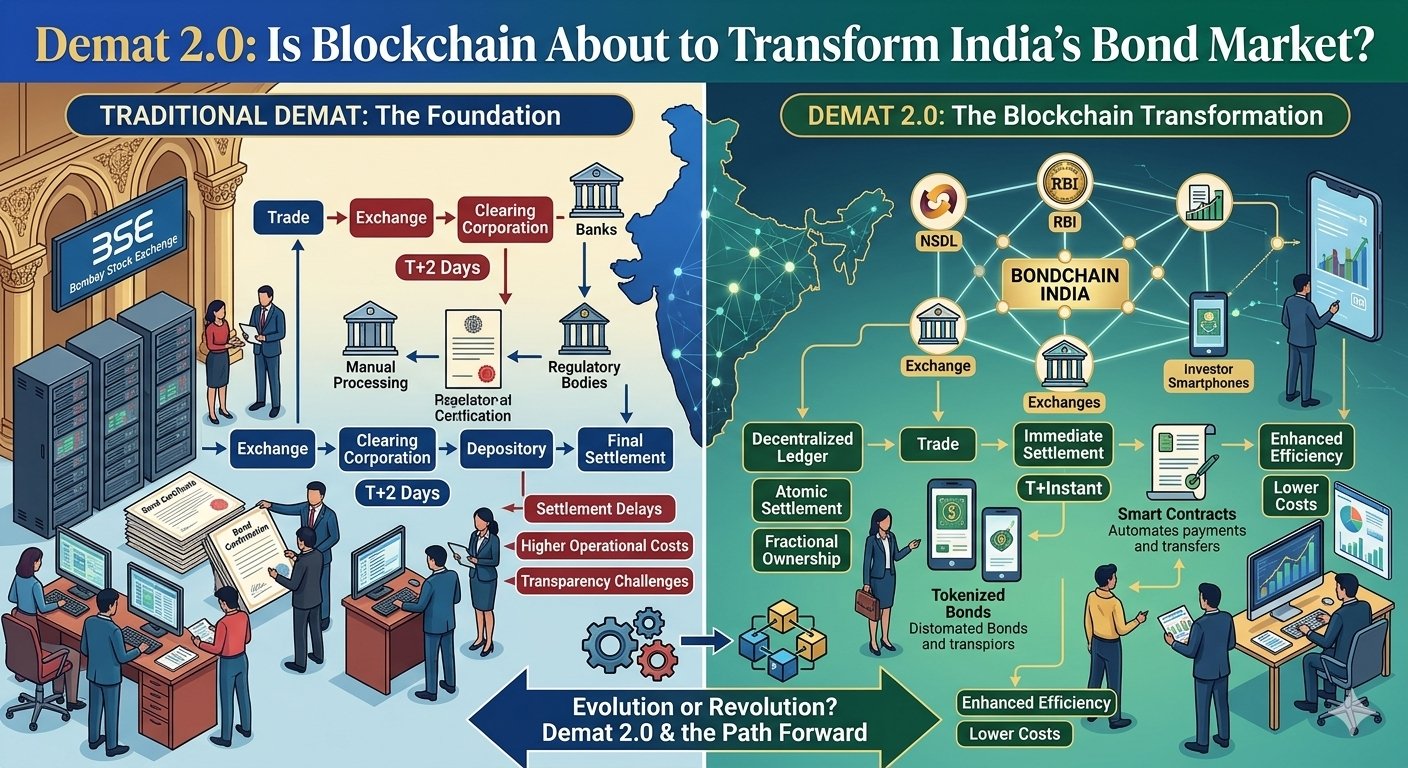
Traditional dematerialised securities are held electronically in investors’ demat accounts. Demat 2.0 takes this concept further by recording corporate bond ownership as digital tokens on a permissioned distributed ledger.
In simple terms, tokenisation represents a financial asset through a digital record that can be securely tracked and transferred.
The initiative connects the securities ledger with the RBI’s wholesale Central Bank Digital Currency (CBDC), the digital rupee, through its Unified Market Interface.
The objective is to bring the securities and payment legs of a transaction closer together.
How does it work?
Under the pilot, corporate bonds are represented as digital tokens on a shared ledger maintained by market infrastructure institutions.
The system introduces an important concept known as Atomic Settlement.
In a conventional transaction, the transfer of securities and the movement of money involve separate processes. Atomic settlement aims to ensure that both happen together: the bond is transferred when the payment is completed.
This can reduce settlement risk and improve transaction efficiency.
Another important feature is the use of Smart Contracts. These are programmable instructions that can automate certain processes, such as interest payments and bond redemption, when specified conditions are met.
India’s first tokenised corporate bond issuances
The initiative has already moved beyond the conceptual stage.
According to SEBI’s September 2026 announcement, three issuers had raised a combined ₹1,025 crore through tokenised corporate bonds:
- REC Limited: ₹500 crore, issued on September 7, 2026.
- Larsen & Toubro: ₹500 crore, issued on September 9, 2026.
- IIFL: ₹25 crore, issued on September 9, 2026.
REC’s first pilot issue received bids worth ₹796 crore against its ₹100 crore base issue and ₹400 crore green-shoe option.
These transactions demonstrate that tokenisation is beginning to enter India’s regulated corporate debt market.
Why does this matter for businesses and investors?
The potential benefits extend across the financial ecosystem.
1. Faster settlement
The integration of securities and payment infrastructure can reduce the time required to complete transactions.
2. Lower operational complexity
Automating processes may reduce manual reconciliation, file sharing and administrative work for market intermediaries.
3. Reduced settlement risk
Atomic settlement can help ensure that securities and funds move together rather than leaving one side exposed while waiting for the other.
4. More efficient bond servicing
Smart contracts could automate interest payments and redemption, reducing repetitive operational processes.
5. Improved capital efficiency
Faster access to funds can allow issuers and investors to deploy capital more efficiently.
Does tokenisation change investor protection?
An important point is that tokenisation does not change the fundamental legal nature of a corporate bond.
SEBI has clarified that the bond remains the same instrument in law, the issuer’s repayment obligation remains unchanged, and investors’ rights continue to be protected.
Existing requirements relating to credit ratings, debenture trustees, listing and disclosures continue to apply.
The technology changes how ownership and settlement are recorded and processed—not the underlying contractual obligations.
What comes next?
Demat 2.0 is being implemented in phases.
The initial phase focuses on tokenised bond issuance. Subsequent phases are expected to explore secondary-market buying and selling through existing request-for-quote platforms, followed by the possibility of retail investor participation.
For now, this remains a pilot rather than a full replacement of India’s existing securities infrastructure.
Its long-term success will depend on interoperability, cybersecurity, operational resilience, investor awareness and regulatory oversight.
The role of finance professionals
This development is not just relevant to technology companies.
For Chartered Accountants, Cost Accountants, auditors, compliance professionals and finance managers, tokenisation creates new areas of professional relevance.
Understanding digital ownership records, settlement processes, internal controls, smart-contract risks, audit trails and regulatory compliance will become increasingly important as financial infrastructure evolves.
The future finance professional may need to understand not only how a transaction is accounted for, but also how technology executes, records and verifies it.
The bigger picture
India’s financial markets have already undergone major transformations—from physical share certificates to dematerialisation, online trading and electronic settlement.
Demat 2.0 represents another possible step in that journey.
The real opportunity lies not in replacing traditional finance with technology, but in making financial markets faster, more transparent and more efficient while preserving investor confidence.
The next revolution in financial markets may not be about creating new financial products. It may be about transforming the infrastructure through which existing products move.
The future of finance will not just be digital. It will be increasingly programmable.