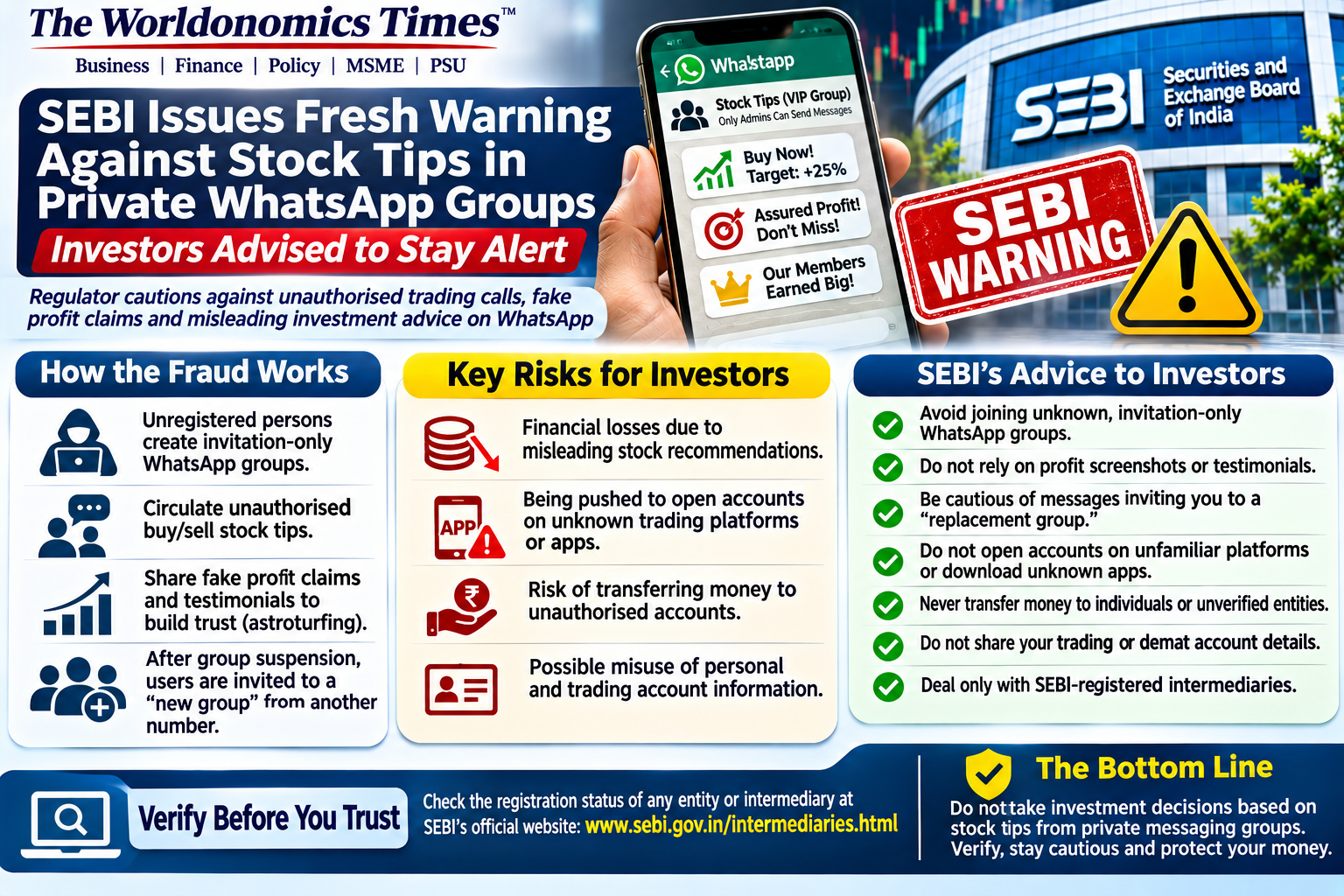
Regulator flags fake profit claims, misleading testimonials and unauthorised trading calls circulated through invitation-only groups
New Delhi | 4 November 2026
The Securities and Exchange Board of India (SEBI) has issued a fresh caution to investors against stock tips and trading recommendations circulated through invitation-only WhatsApp groups, warning that such platforms are increasingly being used by unregistered persons to mislead investors. The regulator’s advisory, issued through Press Release No. 65/2026 on 22 October 2026, highlights the risks of digital investment fraud, fabricated profit claims and unauthorised trading advice.
The warning is particularly relevant at a time when retail investors increasingly rely on social media platforms and messaging applications for market-related information. While digital platforms have made financial information easily accessible, they have also created opportunities for fraudsters to impersonate market experts, manufacture credibility and persuade unsuspecting individuals to act on unverified stock recommendations.
SEBI has urged investors to remain cautious, avoid acting on tips shared in suspicious private groups and deal only with SEBI-registered intermediaries. <Link ref=”turn941347view0″ title=”SEBI Press Release No. 65/2026″/>.
How fraudulent WhatsApp groups operate
According to SEBI, certain unregistered individuals operate invitation-only WhatsApp groups, often using overseas mobile numbers, while presenting themselves as stock market experts. They circulate unauthorised buy and sell recommendations, sometimes under the guise of providing free investor education.
One of the tactics identified by the regulator involves creating an artificial impression of credibility through fabricated profit claims and positive testimonials.
Certain members of these groups allegedly act in coordination with the operators and post messages claiming that they have earned substantial profits by following the recommendations. They may also praise the supposed market expert and share trade confirmations to convince other members that the advice is reliable.
SEBI has described this practice as astroturfing—the creation of a false impression of genuine public support through coordinated or misleading messages.
For an inexperienced investor, repeated testimonials and apparent success stories can create a sense of trust. However, such messages may be deliberately planted to influence investment decisions rather than represent genuine trading experiences.
New groups may emerge after suspension
SEBI has also highlighted a tactic through which operators attempt to continue their activities after a fraudulent WhatsApp group is suspended following action by enforcement agencies or regulatory bodies.
Members may receive messages from a new mobile number claiming that the earlier group was banned because of the social media platform’s risk-control measures. They are then invited to join a replacement group that promises daily stock recommendations, quality market information and trading guidance.
Such messages may create the impression that the group is merely shifting to a new platform or number. In reality, they could be part of an attempt to retain access to potential victims and continue circulating unauthorised trading calls.
SEBI has advised investors to treat these replacement-group invitations as warning signs and leave such groups rather than follow the operators to another channel.
Risks beyond misleading stock recommendations
The danger associated with fraudulent investment groups may extend beyond losses arising from poor stock recommendations.
Investors could be encouraged to open accounts on unknown trading platforms or download applications recommended by group operators. They may also be persuaded to transfer money to unauthorised accounts or disclose sensitive information relating to their investment holdings and trading accounts.
These activities can expose investors to financial loss, misuse of personal information and possible unauthorised access to their trading accounts.
A trading recommendation shared in a private group should therefore never be treated as reliable merely because several members claim to have earned profits from it.
SEBI’s key advice to investors
The regulator has outlined several precautions for investors dealing with stock recommendations circulated through private messaging groups:
1. Avoid unknown invitation-only groups: Investors should not join private WhatsApp groups run by unknown individuals or persons claiming to be stock market experts, particularly those operating through overseas numbers.
2. Do not rely on profit testimonials: Messages showing impressive returns, trade confirmations or praise for a supposed market expert may be fabricated or planted.
3. Be cautious of replacement-group invitations: Messages claiming that an earlier group was banned or suspended, followed by an invitation to join a new group, should be treated as potential red flags.
4. Avoid unauthorised trading platforms: Investors should not open accounts on unfamiliar platforms or applications recommended through suspicious groups.
5. Do not transfer money: Funds should never be transferred to individuals or accounts suggested by unverified stock-tip operators.
6. Protect trading account information: Investors should not disclose their holdings, account credentials or other sensitive trading information to unknown persons.
7. Verify registration: Investors should deal only with SEBI-registered intermediaries and use authentic trading applications.
Verify before trusting investment advice
SEBI’s warning reinforces the importance of checking the registration status of entities offering investment-related services.
Investors can use SEBI’s official intermediary registration directory to verify whether an entity is registered:
The regulator also provides investor support information to help users identify authentic trading applications offered by registered intermediaries:
Registration verification is an important first step. Investors should also understand the nature of the service being offered and avoid assuming that a person is authorised to provide investment advice simply because they share market updates or display screenshots of successful trades.
Digital investment fraud requires greater investor awareness
The growing use of WhatsApp, Telegram, social media platforms and online communities has changed how investors access financial information. Market discussions and educational content can be useful, but investors need to distinguish general information from regulated investment advice and unauthorised trading calls.
Fraudulent operators often exploit the fear of missing out, the attraction of quick profits and the trust created through group interactions. They may use urgency, artificial testimonials and claims of exclusive market knowledge to encourage investors to make decisions without independent verification.
For retail investors, a disciplined approach remains essential. Investment decisions should be based on an understanding of the company, its financial performance, market risks and the investor’s own financial objectives—not on anonymous messages or unverified promises of returns.
A clear message for India’s retail investors
SEBI’s 22 October advisory is a reminder that digital convenience must be accompanied by financial awareness and caution. Private messaging groups can make it easy for fraudulent operators to reach large numbers of people, but investors can reduce their exposure by verifying credentials, protecting account information and refusing to act on unverified recommendations.
The regulator’s warning also underlines the importance of investor education as India’s securities market continues to expand its retail participation.
The essential message is simple: do not trust a stock tip merely because it appears in a private group, is supported by multiple profit screenshots or comes from someone claiming to be a market expert. Verify the source, check registration and protect your money before making an investment decision.