Electricity is one of the most essential services in our lives, but the infrastructure that measures and distributes it is undergoing a major transformation. A recent ₹3,050 crore acquisition by Adani Energy Solutions highlights how India’s power sector is becoming increasingly technology-driven.
A major acquisition in India’s energy sector
On November 12, 2026, Adani Energy Solutions Limited (AESL) completed its acquisition of 100% of IntelliSmart Infrastructure Private Limited from the National Investment and Infrastructure Fund (NIIF) and Energy Efficiency Services Limited (EESL).
The transaction, valued at approximately ₹3,050 crore, also included the redemption of optionally convertible debentures held by NIIF.
The acquisition followed approval from the Competition Commission of India (CCI).
But why would an energy infrastructure company invest such a significant amount in a smart metering business?
The answer lies in the changing economics of India’s electricity distribution sector.
What exactly is a smart meter?
Traditional electricity meters generally require manual readings and periodic billing processes.
Smart meters take this process further.
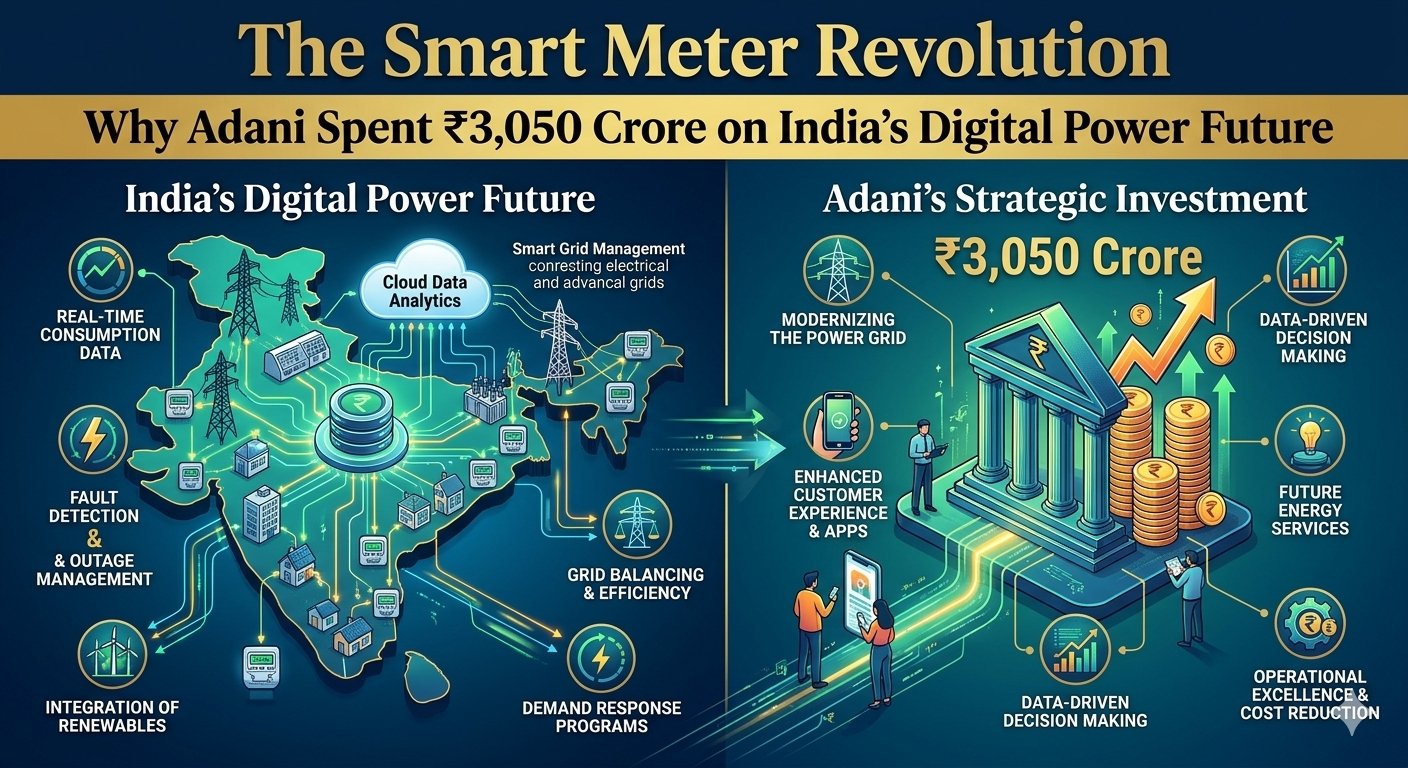
They digitally record electricity consumption and communicate readings to the relevant utility through communication networks. This enables more frequent data collection, remote monitoring and improved billing processes.
For electricity distribution companies, smart meters can help:
- Reduce dependence on manual meter readings.
- Improve billing accuracy and transparency.
- Identify potential electricity losses and irregular consumption patterns.
- Enable remote monitoring and certain operational functions.
- Improve demand forecasting and consumer service.
In simple terms, smart meters help transform electricity distribution from a largely manual system into a data-driven infrastructure network.
Why IntelliSmart matters
IntelliSmart is a smart metering infrastructure company established as a joint venture between NIIF and EESL.
Its business involves procuring, deploying and operating advanced metering infrastructure for electricity distribution, along with certain smart gas metering activities.
Its portfolio includes more than 2.2 crore smart meters across five states: Uttar Pradesh, Gujarat, Madhya Pradesh, Bihar and Assam.
With this acquisition, Adani Energy Solutions is strengthening its position in India’s smart metering industry.
The company had indicated that its combined smart metering portfolio could exceed 4.7 crore meters following the transaction.
This is not merely an acquisition of assets. It is an investment in the infrastructure that could support India’s future electricity distribution system.
The business opportunity behind smart meters
India’s electricity distribution sector faces several long-standing challenges, including technical and commercial losses, billing inefficiencies, collection gaps and the need for modern infrastructure.
Smart metering offers an opportunity to address some of these challenges.
For distribution companies, better consumption data can improve billing and collection efficiency.
For consumers, digital readings can provide greater visibility into electricity usage.
For infrastructure companies, the deployment and operation of smart meters can create long-term business opportunities through project execution, technology integration and maintenance services.
This makes smart metering an important intersection of infrastructure, technology and financial investment.
Understanding the financial strategy
From a corporate finance perspective, the acquisition offers several interesting insights.
1. Inorganic expansion
Instead of building an entirely new smart metering platform, Adani Energy Solutions acquired an established business with an existing portfolio and operational presence.
2. Economies of scale
A larger portfolio can create opportunities to optimise procurement, technology integration, operations and maintenance costs.
3. Long-term infrastructure opportunity
Smart metering projects involve deployment as well as ongoing operations and maintenance. This can create business opportunities beyond the initial installation phase.
4. Strategic diversification
The acquisition strengthens AESL’s presence in advanced metering infrastructure alongside its electricity transmission and distribution activities.
However, the financial success of the acquisition will depend on execution, project economics, financing costs and the ability to generate sustainable returns.
What are the challenges?
Despite its potential, smart metering is not without risks.
High capital requirements: Large-scale deployment requires significant investment in equipment, communication systems and supporting infrastructure.
Execution risks: Delays in installation, integration and project implementation can affect financial performance.
Technology and cybersecurity: Connected infrastructure requires robust data protection and cybersecurity systems.
Utility payment cycles: Delays in payments from distribution companies can create working-capital pressure for project operators.
Consumer adoption: Successful implementation also requires consumer awareness, effective communication and reliable grievance redressal.
The success of the smart meter ecosystem will depend on addressing these challenges alongside technological advancement.
What does this mean for India’s economy?
The smart meter revolution is closely connected with India’s broader power sector modernisation.
A more efficient electricity distribution system can support industrial growth, improve energy management and strengthen the financial health of distribution utilities.
It can also create opportunities for technology providers, manufacturers, infrastructure developers and skilled professionals.
For investors, the sector presents an interesting combination of long-term infrastructure demand and technology-led business opportunities.
The finance professional’s perspective
This acquisition provides an excellent case study for finance professionals.
It raises important questions about:
- Valuation of infrastructure businesses.
- Due diligence in mergers and acquisitions.
- Capital structure and acquisition financing.
- Long-term project cash flows.
- Working-capital management.
- Risk assessment and return on investment.
Behind every large acquisition is a financial decision that must balance strategic opportunity with the cost of capital and execution risk.
Conclusion: The future of electricity is intelligent
India’s energy transition is not limited to renewable power generation. Modernising the systems that distribute and measure electricity is equally important.
Adani Energy Solutions’ acquisition of IntelliSmart reflects the growing strategic value of digital infrastructure in the power sector.
The real opportunity lies in converting technology into measurable improvements in efficiency, reliability and financial performance.
The next big transformation in India’s electricity sector may not be visible at a power plant. It may be happening quietly inside the meter installed in every home and business.
Because the future of energy will depend not only on how electricity is generated, but also on how intelligently it is measured, managed and delivered.