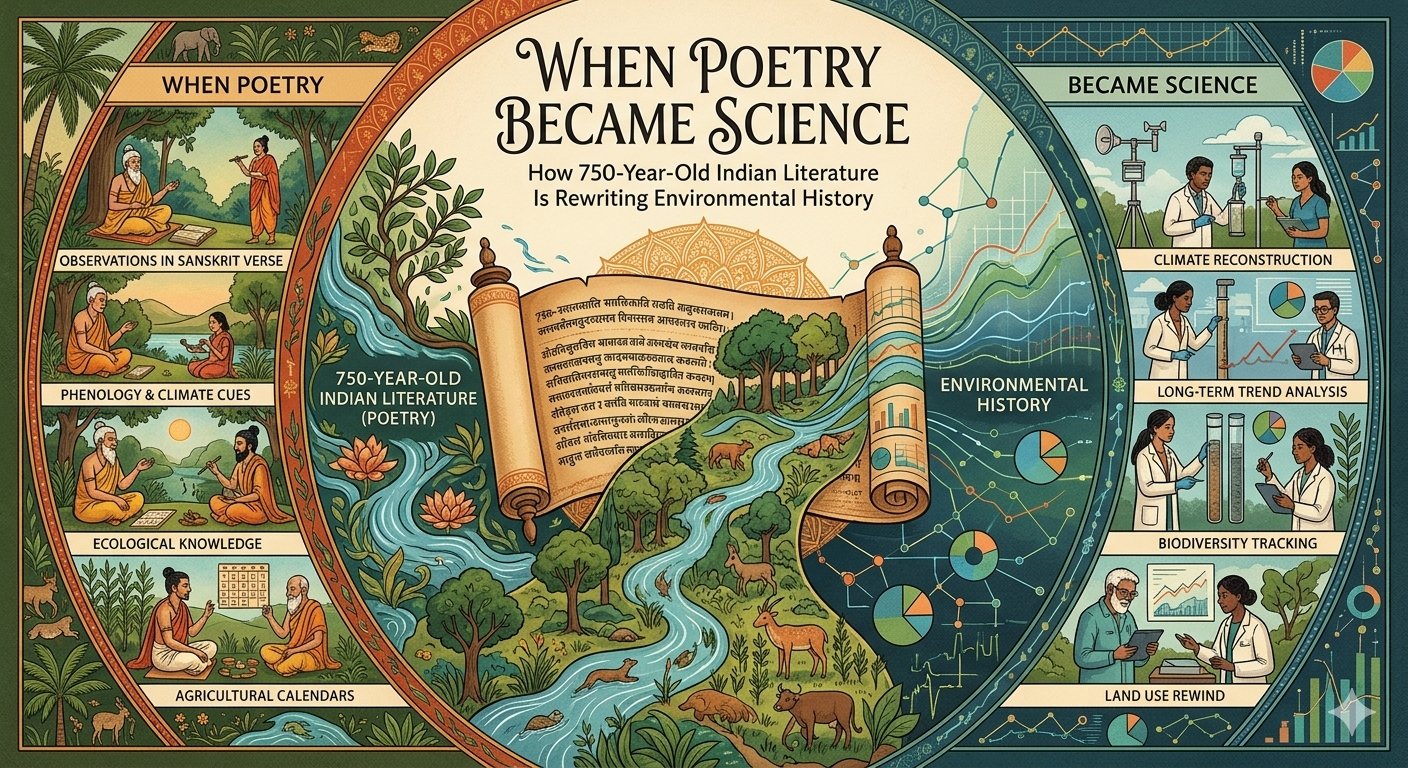
Can a poem written centuries ago reveal something that modern science has misunderstood about nature? Surprisingly, yes.
Sometimes, the most valuable scientific clues are not found in laboratories or satellites. They are hidden in stories, songs and literature passed down through generations.
A fascinating discovery involving 13th-century Indian poetry is showing how historical literature can help scientists understand the natural world.
A discovery hidden in medieval poetry
Researchers studying old Indian literary texts found descriptions of thorny trees, open grasslands and distinctive landscapes in western India.
These descriptions closely resemble the savanna ecosystems that exist in parts of the region today.
The interesting part? Modern scientific discussions have often treated such open landscapes as degraded forests—areas that once had more trees but lost them because of human activity.
However, historical descriptions suggest that some of these grassland and savanna ecosystems may have existed naturally for centuries.
Why does this matter?
The distinction between a natural grassland and a degraded forest is extremely important.
If an ecosystem is mistakenly classified as a damaged forest, restoration programmes may focus on planting more trees.
But naturally occurring grasslands and savannas support their own unique biodiversity. Excessive tree planting in these habitats can disturb the ecological balance and threaten species adapted to open landscapes.
Understanding the original character of an ecosystem is therefore essential before deciding how to conserve it.
Literature as a scientific archive
Historical literature is usually appreciated for its cultural, artistic and linguistic value.
But it can also preserve information about:
- Historical climate and rainfall patterns.
- Native plants and animal species.
- Traditional agricultural practices.
- Changes in land use.
- Human relationships with nature.
Poetry and folklore can therefore complement scientific evidence, particularly when modern environmental records are limited.
Of course, literary descriptions are not substitutes for ecological surveys. They become valuable when examined alongside historical, archaeological and scientific evidence.
The bigger lesson
This discovery reminds us that knowledge does not always move in one direction—from modern science towards the past.
Sometimes, the past helps science ask better questions about the present.
India’s literary heritage may contain clues not only about its culture and civilisation, but also about its geography, biodiversity and environmental history.
The next scientific breakthrough may not always come from a new invention. Sometimes, it begins with reading an old story differently.