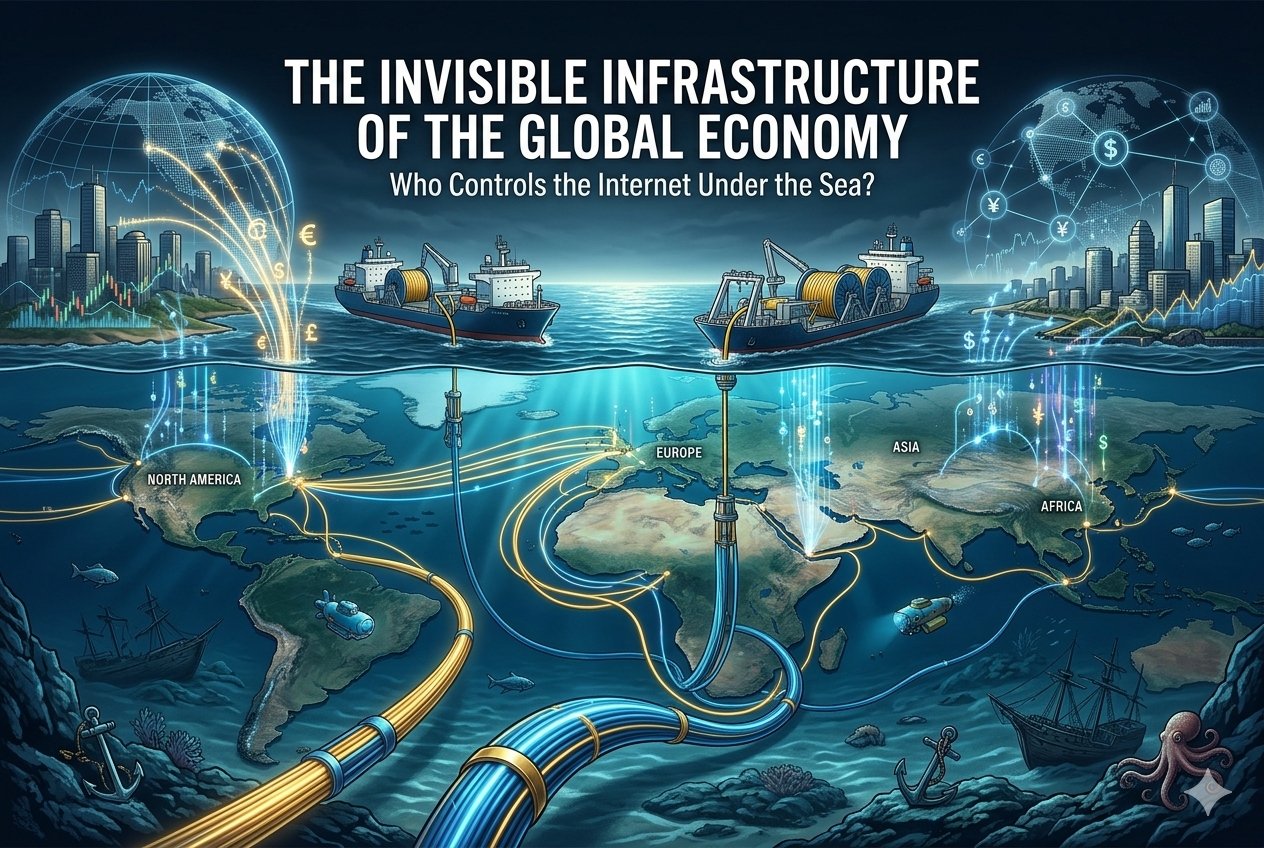
The hidden submarine cable network powering global finance, international trade and the digital economy.
Imagine waking up one morning to discover that international banking transactions are delayed, cloud services are unavailable, global businesses cannot communicate efficiently and financial markets are experiencing connectivity disruptions.
The reason might not be a stock market crash, a banking crisis or a cyberattack.
It could be something much less visible: a damaged cable lying thousands of metres beneath the ocean.
Welcome to the world of submarine internet cables — one of the most important and least discussed infrastructures of the global economy.
1. The Internet Has an Underwater Backbone
Most people associate the internet with satellites, mobile towers and data centres. However, a significant portion of international digital connectivity depends on fibre-optic cables installed across the ocean floor.
According to the International Telecommunication Union (ITU), submarine cables carry approximately 99% of the world’s internet traffic.
These cables connect continents and enable the movement of enormous volumes of information across international borders.
From online banking and international stock trading to cloud computing, video conferencing and e-commerce, the modern digital economy depends heavily on this infrastructure.
2. Why Are These Cables So Important to Global Finance?
Consider an international financial transaction between two countries.
Banks need secure and reliable communication networks to exchange transaction instructions, verify information and coordinate settlements.
Similarly, global financial institutions depend on low-latency connectivity to communicate with international markets.
Submarine cables support this digital ecosystem by enabling:
- International banking and payment communication.
- Cross-border financial transactions.
- Global stock market connectivity.
- Cloud-based accounting and financial reporting.
- International trade documentation.
- Data exchange between multinational corporations.
In simple terms, these cables are not merely internet infrastructure; they are part of the foundation supporting modern international commerce.
3. Who Owns the World’s Underwater Internet?
Interestingly, the submarine cable industry is not controlled exclusively by governments or traditional telecom operators.
Large technology companies are increasingly investing in this infrastructure.
Companies such as Google, Meta, Microsoft and Amazon have become important participants in submarine cable ownership and investment.
According to the OECD’s Digital Economy and Society Outlook 2026:
- Large technology companies accounted for nearly 75% of global submarine cable bandwidth demand in 2024.
- They owned or co-owned more than 60% of new cables entering service between 2024 and 2027.
- Investment in submarine cables is expected to exceed $4 billion annually during 2025–2027.
This reflects a major shift: technology companies are increasingly investing in the physical infrastructure behind their digital businesses.
4. What Happens When an Underwater Cable Breaks?
Submarine cables are generally reliable, but they are not immune to damage.
Common causes include:
- Fishing activities and ship anchors.
- Underwater earthquakes and landslides.
- Accidental damage during marine operations.
- Geopolitical tensions and potential deliberate interference.
According to the ITU, more than 170 cable repairs were reported worldwide during 2025.
A cable disruption does not necessarily shut down an entire country’s internet because traffic can often be rerouted through alternative systems.
However, when several cables serving the same region are damaged, the consequences can be significant.
Businesses may experience connectivity problems, financial institutions may face communication delays and digital services may become less reliable.
Repairing damaged cables can also be complicated because it requires specialised vessels, technical expertise and regulatory approvals.
5. The Geopolitical Battle Beneath the Ocean
Submarine cables are increasingly becoming a matter of national security and economic sovereignty.
Their routes pass through strategically important maritime regions, including the Red Sea, the Indian Ocean and the Strait of Malacca.
These locations are important because disruptions along critical routes can affect connectivity between major economic regions.
Governments are therefore paying greater attention to cable protection, diversified routes and international cooperation.
The issue is no longer simply about telecommunications. It is also about who controls, finances, protects and maintains the infrastructure supporting the global digital economy.
6. India’s Position in the Global Submarine Cable Network
India’s digital economy is growing rapidly, increasing its dependence on reliable international connectivity.
International submarine cable connections are essential for India’s IT services industry, financial institutions, cloud infrastructure, data centres and global business operations.
However, India also faces strategic questions concerning ownership, route diversity, maintenance capabilities and participation in the global cable ecosystem.
Strengthening domestic capabilities and developing resilient international connections could become important priorities for India’s digital future.
For a country aspiring to become a major global technology and financial services hub, reliable digital infrastructure is not optional.
7. The Financial Opportunity Behind Underwater Cables
An interesting aspect of this industry is its investment structure.
Building submarine cable infrastructure requires significant capital expenditure, specialised technology and international coordination.
This creates opportunities for:
- Infrastructure investment funds.
- Telecommunications companies.
- Technology corporations.
- Private equity investors.
- Project financing institutions.
- Specialist insurance providers.
From a financial perspective, submarine cables represent long-term infrastructure assets that require careful evaluation of construction costs, expected useful life, maintenance expenditure, utilisation and investment returns.
They also create important accounting and risk-management considerations, particularly regarding asset valuation, depreciation, impairment and business continuity.
Conclusion: The Global Economy Runs on More Than Roads and Railways
For centuries, economic power was associated with control over trade routes, ports, railways and energy infrastructure.
Today, another critical infrastructure lies beneath the oceans.
Submarine cables connect financial markets, businesses, governments and billions of people.
Their importance will only increase as artificial intelligence, cloud computing, digital banking and international commerce expand.
The next time we make an international payment, attend an online meeting or access a website hosted overseas, we should remember that an invisible network beneath the ocean may be making it possible.
In the modern global economy, power is not determined only by who controls natural resources or financial capital. It is also influenced by who builds, owns and protects the infrastructure through which the world’s information flows.
— Ankita Nag