New Delhi | November 14, 2026
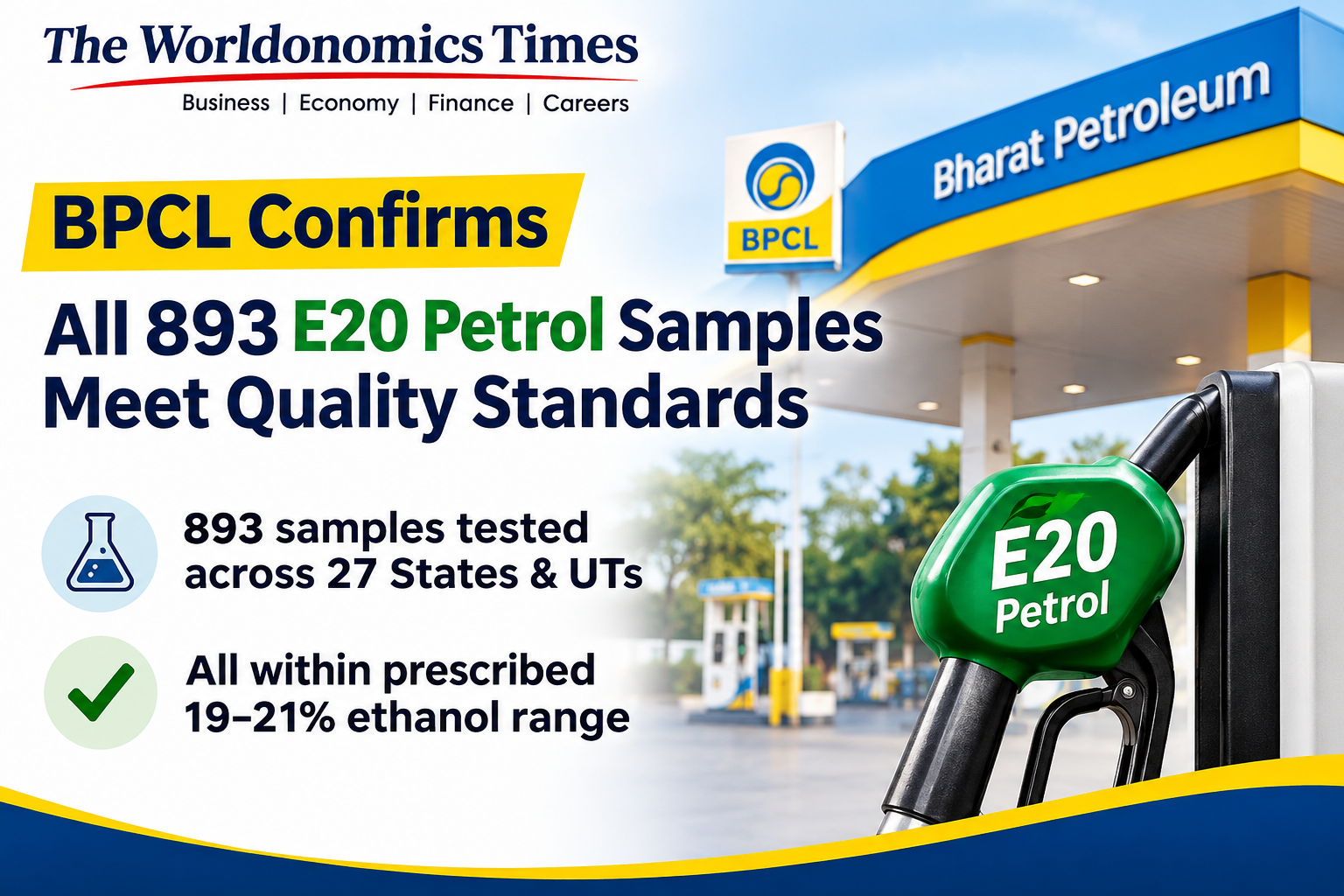
Bharat Petroleum Corporation Limited (BPCL) has reaffirmed the quality and compliance of E20 petrol supplied through public sector oil marketing companies (OMCs), stating that all 893 samples tested across 27 States and Union Territories were found within the prescribed ethanol content range of 19–21 per cent.
The clarification comes amid growing public discussion and social media concerns regarding the ethanol content of petrol, particularly following reports from Karnataka alleging that certain petrol samples contained ethanol levels between 26 per cent and 31 per cent.
According to BPCL, the nationwide quality-monitoring exercise was conducted by oil marketing companies in coordination with the Centre for High Technology (CHT), under the Ministry of Petroleum and Natural Gas. The findings indicate that the tested samples complied with the applicable Bureau of Indian Standards (BIS) specification, IS 17021.
893 Samples Tested Across 27 States and Union Territories
The nationwide monitoring exercise covered 893 samples of E20 Ethanol Blended Motor Spirit (EBMS), collected from depots and retail outlets across 27 States and Union Territories.
The sample distribution among the three major public sector oil marketing companies was as follows:
| Oil Marketing Company | Samples Tested |
|---|---|
| Indian Oil Corporation Limited (IOCL) | 330 |
| Bharat Petroleum Corporation Limited (BPCL) | 280 |
| Hindustan Petroleum Corporation Limited (HPCL) | 283 |
| Total | 893 |
All 893 samples were found to contain ethanol within the prescribed range of 19–21 per cent.
The results were obtained through testing conducted at refinery and OMC quality-control laboratories in accordance with IS 17021, Annex C. The findings provide an important update on the monitoring of ethanol-blended petrol supplied through the country’s public sector fuel distribution network.
Karnataka Samples Also Meet Prescribed Standards
The issue attracted particular attention after the Karnataka Government’s Department of Food, Civil Supplies, Consumer Affairs and Legal Metrology reported that certain petrol samples collected from retail outlets contained ethanol levels ranging between 26 per cent and 31 per cent.
In response, the three public sector oil marketing companies questioned whether the reported results had been obtained through the prescribed statutory sampling and technical testing procedures.
The nationwide quality-monitoring exercise also covered Karnataka, where 56 samples collected from different locations and across all three OMCs were tested.
According to the Ministry of Petroleum and Natural Gas, all 56 samples complied with the prescribed specifications. Their ethanol content ranged between 19 per cent and 20 per cent, with an average of 19.30 per cent.
The oil marketing companies have called for a transparent, jointly verifiable testing exercise to examine the differences between the reported findings and their own quality-monitoring results.
BPCL Clarifies Viral Photograph of Ethanol Separation Test
BPCL’s clarification also follows public concerns generated by a photograph circulating on social media from a consumer awareness demonstration conducted at one of its Energy Stations in Karnataka.
The photograph appeared to show an incomplete ethanol separation test, leading to questions about the quality and ethanol concentration of the petrol sample.
Explaining the procedure, BPCL stated that its officers had been conducting demonstrations to address consumer queries about E20 petrol.
The demonstration involves mixing 100 ml of E20 petrol with 30 ml of water to facilitate the separation of ethanol from petrol. During the initial stage, the mixture may appear hazy or milky. This is a normal part of the process, and sufficient time is required for the two layers to separate completely.
BPCL clarified that the photograph was inadvertently captured and shared before the separation process had been completed. It therefore represented an intermediate stage rather than the final test result.
The company stated that the concerned officer promptly removed the post after recognising the possibility of misinterpretation. BPCL further confirmed that the sample tested was within the prescribed specifications.
E20 Petrol and India’s Ethanol Blending Programme
E20 petrol is motor spirit blended with 20 per cent ethanol. India’s ethanol blending programme is an important component of the country’s energy transition and efforts to reduce dependence on imported crude oil.
The programme has several strategic objectives:
- Reducing dependence on imported petroleum products.
- Supporting domestic ethanol production, particularly from agricultural feedstocks.
- Providing additional economic opportunities for farmers and the sugar and biofuel industries.
- Supporting India’s energy security objectives.
- Contributing to efforts to reduce greenhouse gas emissions over the fuel lifecycle.
The expansion of ethanol blending also requires strong quality-control systems, appropriate fuel specifications and consumer awareness.
The applicable BIS specification, IS 17021, provides the technical framework for ensuring that ethanol-blended motor spirit meets prescribed quality requirements.
Quality Monitoring and Testing Procedures
The Centre for High Technology, operating under the Ministry of Petroleum and Natural Gas, has been monitoring ethanol blending and fuel quality across OMC retail outlets.
The companies have emphasised that ethanol blending at refineries and depots takes place through calibrated and automated systems involving controlled proportioning arrangements.
The oil marketing companies have also highlighted the importance of following prescribed sampling and testing procedures under the Motor Spirit and High Speed Diesel (Regulation of Supply, Distribution and Prevention of Malpractices) Order, 2005, and the Marketing Discipline Guidelines, 2024.
They have sought joint sampling and independent testing to ensure that any differences in reported results can be examined through technically appropriate and verifiable methods.
Implications for Consumers and the Oil Marketing Sector
The latest findings are significant for India’s fuel retail sector, particularly at a time when ethanol-blended petrol is being supplied through an extensive network of public sector oil marketing companies.
For consumers, consistent fuel quality and transparent testing are essential to maintaining confidence in the fuel distribution system.
For BPCL, Indian Oil and HPCL, the findings underline the importance of maintaining robust quality assurance mechanisms across refineries, depots and retail outlets.
The controversy also highlights the need for accurate communication of fuel-testing results. Public demonstrations and technical explanations can help consumers understand ethanol blending, provided that testing procedures are completed and results are communicated clearly.
Conclusion
BPCL’s clarification, supported by the nationwide testing exercise covering 893 samples, reinforces the reported compliance of E20 petrol supplied by public sector oil marketing companies with prescribed ethanol content standards.
With all 893 samples across 27 States and Union Territories meeting the 19–21 per cent range, and all 56 samples tested in Karnataka also complying, the findings provide an important update on fuel-quality monitoring in India.
Going forward, transparent testing, independent verification and effective consumer communication will remain essential to strengthening public confidence in India’s ethanol blending programme and its expanding clean-energy initiatives.
Source: Ministry of Petroleum and Natural Gas, Press Information Bureau (PIB); Bharat Petroleum Corporation Limited (BPCL) clarification dated November 13, 2026.
Published by: The Worldonomics Times
Business | Economy | Finance | Careers | Professional Knowledge