How India’s deep-rooted relationship with gold influences household savings, imports, the rupee and economic stability.
In India, gold is more than a precious metal. It is a wedding tradition, a symbol of prosperity, a family heirloom and, for millions of households, a form of financial security.
From buying jewellery during festivals to investing in gold coins, bars and digital gold, Indians have maintained a strong connection with the yellow metal across generations.
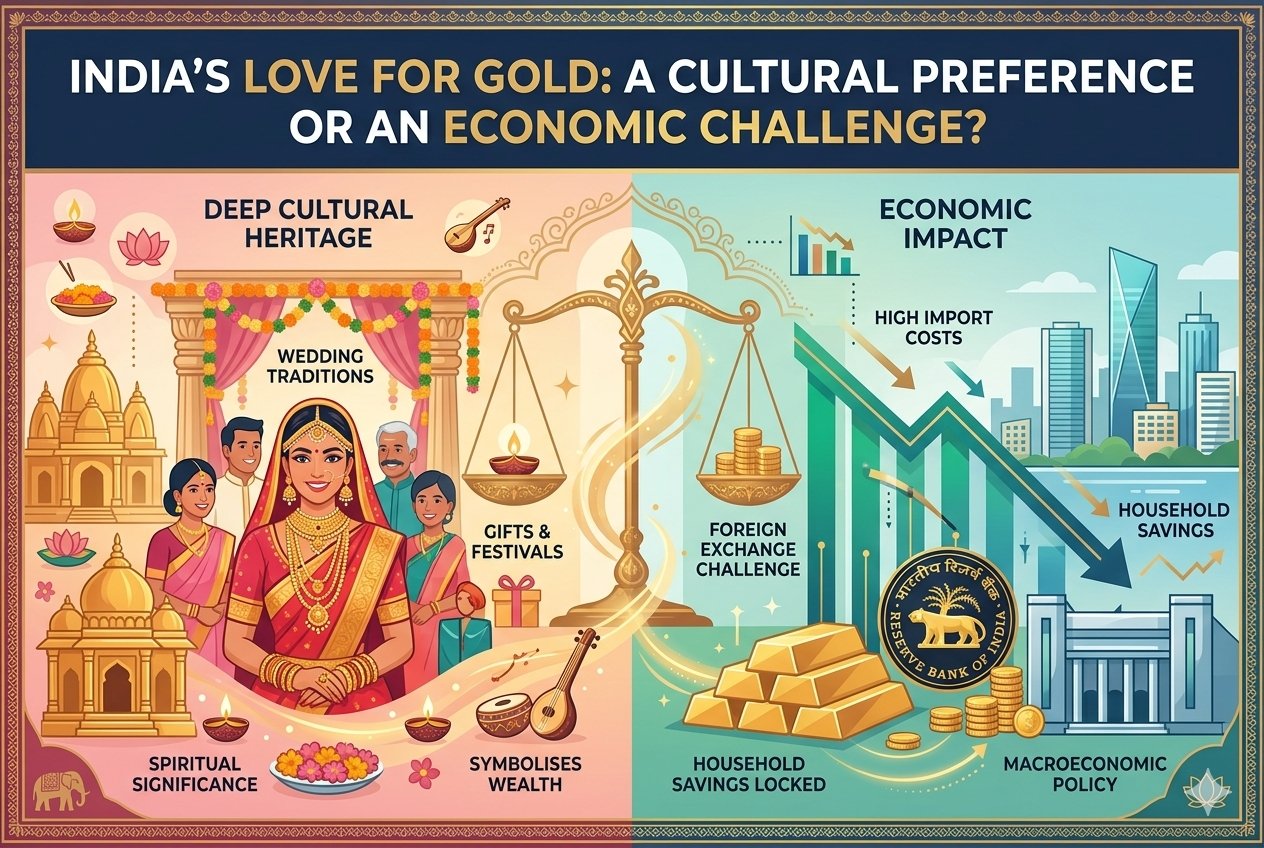
But behind this cultural preference lies an important economic question: Can India’s love for gold become a challenge for its economic growth?
1. Gold: More Than an Ornament
For Indian households, gold serves multiple purposes:
- Cultural significance: Weddings, festivals and religious occasions traditionally involve gold purchases.
- Financial security: Families often view gold as a reliable store of wealth during uncertain times.
- Investment diversification: Gold is considered a hedge against inflation, currency depreciation and market volatility.
- Liquidity: Jewellery and gold assets can be sold or pledged to raise funds when required.
Unlike many financial investments, gold also carries emotional and social value. This makes its demand less responsive to conventional investment logic.
2. The Economic Cost of India’s Gold Appetite
India has limited domestic gold production and relies heavily on imports to meet its demand.
Gold imports have an important impact on the country’s external sector:
- They increase the merchandise import bill.
- They contribute to the trade deficit.
- They create demand for foreign currency, particularly US dollars.
- They can add pressure to the Indian rupee when import demand is high.
The Reserve Bank of India’s import data show that the value of gold imports rose from approximately ₹4.90 lakh crore in FY 2024–25 to ₹6.40 lakh crore in FY 2025–26 (provisional).
This makes gold an important consideration in India’s foreign trade and balance-of-payments management.
3. A Surprising Trend: Spending More, Buying Less
Rising gold prices have changed consumer behaviour.
According to the World Gold Council’s Q3 2026 India report, gold demand stood at approximately 162.5 tonnes, down 29% year-on-year. Yet the value of demand increased by 3%.
During the first nine months of 2026, gold demand declined 12% in volume terms, while its value increased 38%.
This highlights an interesting economic reality: Indian consumers are spending more money even when they purchase fewer grams of gold.
In other words, the value of the gold market is increasingly being driven by prices rather than physical quantities.
4. Gold and the Indian Rupee: An Indirect Connection
Gold is internationally traded and largely priced in US dollars.
When India imports more gold, importers need additional foreign currency to pay overseas suppliers. This adds to dollar demand.
If other factors remain unchanged, sustained higher import demand can put pressure on the rupee.
A weaker rupee can make imported gold even more expensive, creating a cycle in which currency depreciation and higher international prices increase the domestic cost of gold.
However, exchange rates are influenced by several factors, including crude oil imports, capital flows, interest rates and global economic conditions. Gold is one part of this larger picture.
5. Can Policy Reduce Gold Import Dependence?
The government faces a delicate balancing act: managing import dependence without ignoring the cultural and financial importance of gold.
Some possible measures include:
- Gold recycling: Encouraging households to bring idle gold into the formal financial system.
- Gold monetisation: Making schemes that allow people to earn returns on deposited gold more attractive and accessible.
- Domestic refining: Strengthening India’s gold refining and recycling ecosystem.
- Financial awareness: Promoting diversified investment options such as mutual funds, bonds and other regulated financial instruments.
- Stable import policies: Ensuring that customs and import regulations do not unintentionally encourage unofficial gold inflows.
The objective should not be to discourage every gold purchase, but to reduce excessive dependence on imported gold and improve the productive use of household wealth.
6. The Rise of Digital Gold and Gold ETFs
The relationship between Indians and gold is also changing.
Traditional jewellery is increasingly accompanied by modern investment avenues such as Gold Exchange Traded Funds (ETFs), gold mutual funds and digital gold.
These instruments offer different levels of convenience, liquidity and regulation. Investors should understand their structure, costs, storage arrangements and regulatory protections before investing.
The World Gold Council reported that Indian digital gold purchases reached 16.3 tonnes in the first nine months of 2026, a 76% increase over the corresponding period of 2025.
This reflects how technology is changing the way Indians access gold as an investment.
Conclusion: A Tradition That Needs an Economic Balance
India’s love for gold is unlikely to disappear. It is deeply connected with our culture, traditions and household financial behaviour.
But in an economy aspiring to become a global manufacturing and investment hub, the composition of savings and imports matters.
Gold can preserve wealth, diversify portfolios and provide financial security. Yet excessive dependence on imported gold can create external-sector vulnerabilities and divert household savings away from productive financial assets.
The real question is not whether Indians should buy gold. It is whether India can transform its relationship with gold from one driven primarily by consumption and imports into one supported by recycling, financial innovation and responsible investment.
Gold may be timeless, but the way India manages its gold economy must evolve with time.