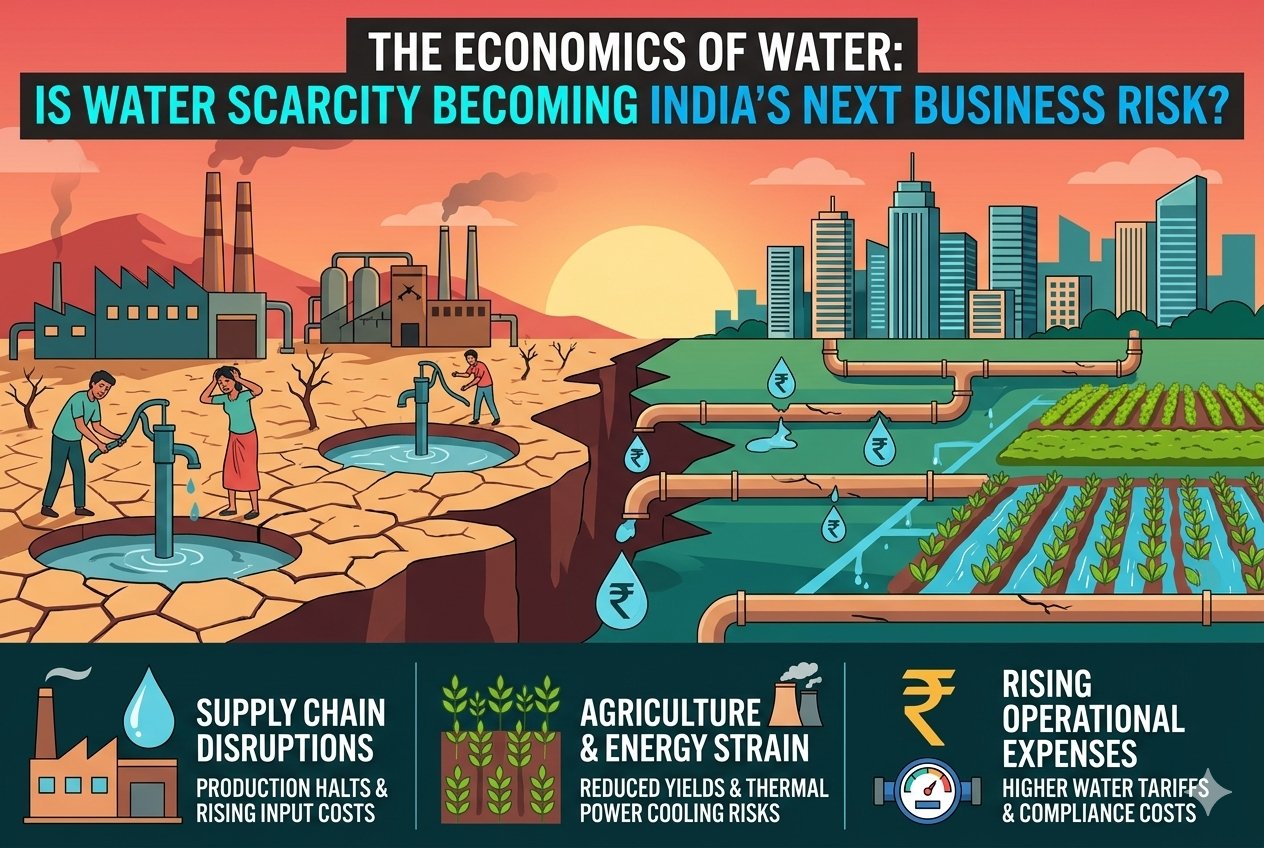
From agricultural production to corporate profitability, why water may become one of India’s most valuable economic resources.
Introduction: When Water Becomes an Economic Asset
We often discuss oil, gold, electricity and technology as strategic resources. But there is another resource without which almost every industry would struggle to survive: water.
Water is essential for agriculture, manufacturing, power generation, food processing, construction and countless other economic activities. Yet, its economic importance is frequently underestimated because it is often treated as an easily available natural resource rather than a critical business input.
As India continues to industrialise and urbanise, water scarcity is emerging as more than an environmental concern. It is becoming an economic challenge that could influence production costs, investment decisions, business continuity and long-term profitability.
1. The Hidden Economic Value of Water
Water contributes directly and indirectly to economic output.
Consider a few examples:
- Agriculture: Irrigation determines crop productivity, food supply and farmers’ incomes.
- Manufacturing: Industries such as textiles, steel, chemicals and automobiles require significant quantities of water.
- Power Generation: Thermal power plants depend on water for cooling and other operational requirements.
- Food Processing: Water availability influences production capacity, quality and operating costs.
- Technology: Semiconductor manufacturing and data centres require reliable water management systems.
A disruption in water availability can therefore affect entire supply chains rather than just individual businesses.
2. Water Scarcity Can Become a Corporate Financial Risk
For businesses, water scarcity can translate into measurable financial consequences.
Imagine a manufacturing company operating in a water-stressed region. If groundwater availability declines or restrictions are imposed on industrial water usage, the company may face:
- Higher water procurement costs.
- Additional investment in treatment and recycling facilities.
- Reduced production capacity.
- Operational interruptions.
- Increased regulatory and compliance expenditure.
These costs can affect operating margins, cash flows and return on investment.
Water risk is therefore not merely an environmental issue. It can become a material financial risk.
3. Which Industries Could Face Greater Pressure?
Certain industries are particularly dependent on consistent water availability.
Textiles and Apparel: Dyeing, washing and finishing processes require substantial water.
Steel and Cement: Water is used in cooling, processing and other industrial operations.
Pharmaceuticals: Water quality is critical for manufacturing processes and regulatory compliance.
Food and Beverages: Agricultural sourcing, processing and cleaning operations depend heavily on water.
Data Centres: The expansion of digital infrastructure and AI computing also raises questions about water consumption in cooling systems.
For these sectors, water availability could increasingly influence where companies establish factories and how they plan future investments.
4. Water Management: From Environmental Responsibility to Business Strategy
Businesses can no longer approach water conservation only as a corporate social responsibility activity.
It needs to become part of operational and financial planning.
Companies can adopt several measures:
- Invest in wastewater treatment and recycling.
- Introduce rainwater harvesting systems.
- Monitor water consumption across production facilities.
- Adopt water-efficient manufacturing technologies.
- Assess water-related risks before selecting industrial locations.
- Develop responsible water management policies across supply chains.
These investments may involve initial costs, but they can reduce long-term operational risks and improve resource efficiency.
5. The Role of Government and Public Policy
Addressing water scarcity requires coordinated action between governments, industries, farmers and communities.
Policy priorities should include:
- Improving irrigation efficiency.
- Strengthening groundwater regulation.
- Encouraging wastewater reuse.
- Promoting sustainable urban water infrastructure.
- Supporting water-efficient industrial technologies.
- Improving transparency in water consumption and reporting.
Government initiatives such as the Jal Jeevan Mission and Atal Bhujal Yojana highlight the importance of water security and sustainable water management.
However, long-term success will depend on effective implementation, local participation and responsible resource utilisation.
6. Can Water Become an Investment and Innovation Opportunity?
Water scarcity also creates opportunities for innovation and entrepreneurship.
Businesses working in water purification, wastewater treatment, smart metering, desalination, industrial recycling and water-efficient agricultural technologies could play an increasingly important role.
Investors may also begin examining water-related risks when evaluating companies, particularly those operating in water-intensive industries.
This creates an emerging opportunity for businesses that can combine profitability with efficient resource management.
Conclusion: The Future of Business May Depend on Water Security
Economic growth requires more than capital, infrastructure and technology. It also requires reliable access to essential natural resources.
India’s industrial ambitions, agricultural productivity and urban development will increasingly depend on how effectively water resources are managed.
For businesses, the question should no longer be simply how much water they consume, but how efficiently they use it and whether their operations can remain sustainable in a water-constrained future.
Water may not appear as prominently as financial capital on a company’s balance sheet, but its absence can create losses that no balance sheet can ignore.
Perhaps the next major competitive advantage for businesses will not come from using more resources, but from learning to produce more with less.