By The Worldonomics Times
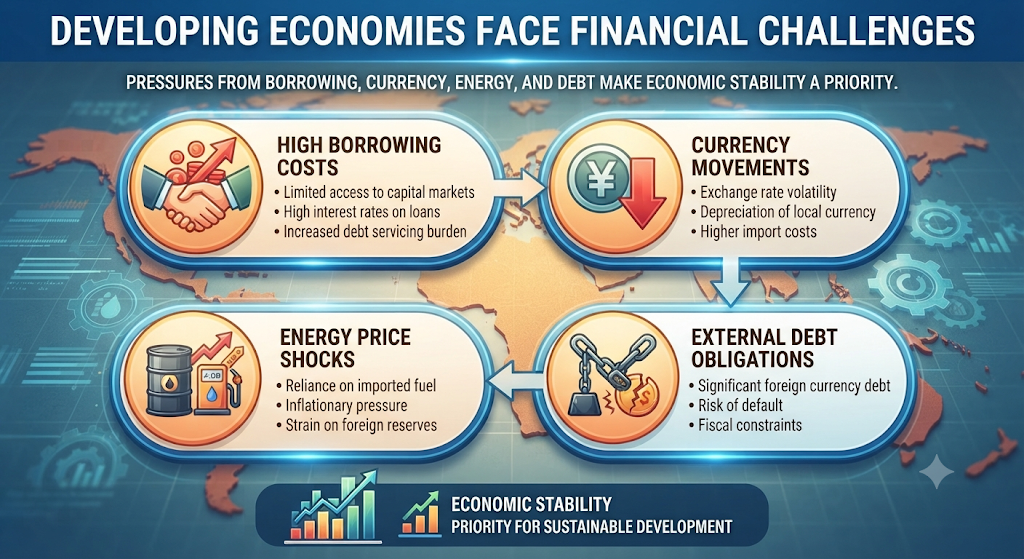
Developing economies continue to face significant financial challenges as rising borrowing costs, currency movements, higher energy prices and external debt obligations place pressure on government budgets and economic stability. Although international financial markets have reopened to several emerging economies, access to capital remains expensive, particularly for countries with weaker credit ratings and limited foreign exchange reserves.
The growing burden of debt repayment is reducing the resources available for infrastructure, healthcare, education and other development priorities. Governments must therefore balance immediate financial requirements with the need to maintain long-term economic growth and protect vulnerable populations.
Rising External Debt Creates Pressure
External borrowing remains an important source of financing for developing countries. Governments use international loans and bond markets to fund infrastructure, support public services and manage budget deficits. However, excessive borrowing can create difficulties when economic conditions become less favourable.
According to the World Bank’s International Debt Report 2026, the external debt of low- and middle-income countries increased by 5.5% in 2025, reaching a record $9.4 trillion. Their combined principal and interest payments rose to $1.4 trillion, marking the fifth consecutive annual increase.
Between 2022 and 2025, these countries paid approximately $436 billion more in debt service than they received in new financing. This indicates that substantial financial resources are being directed towards existing obligations rather than new development investment.
The situation is particularly difficult for poorer countries that depend on external assistance and concessional financing. When debt repayments consume a large share of government revenue, authorities have less flexibility to respond to economic shocks or invest in essential services.
Higher Borrowing Costs Limit Financial Flexibility
The cost of international borrowing remains a major concern for developing economies. Investors generally demand higher interest rates from countries perceived to have greater economic, political or repayment risks.
The World Bank reported that countries eligible for concessional financing through the International Development Association paid an average interest rate of 8.2% on new private-creditor commitments in 2025. Their average rate on new bonds reached 9.4%, the highest level since 1989.
By comparison, countries eligible for financing through the World Bank’s International Bank for Reconstruction and Development paid an average of 5.5% on new bonds. This difference demonstrates how access to international finance varies according to a country’s creditworthiness and economic position.
Higher borrowing costs also make refinancing more expensive. Governments approaching repayment deadlines may need to issue new debt at less favourable rates, increasing future interest obligations and extending financial pressure.
Currency Movements Increase Debt Vulnerability
Exchange-rate fluctuations can create additional challenges for countries with significant foreign-currency debt. When a country’s currency depreciates against the US dollar, the domestic-currency cost of repaying dollar-denominated loans increases.
This can place pressure on government budgets, businesses and financial institutions that earn revenue in local currency but have international borrowing obligations. Currency depreciation can also increase the cost of imported fuel, machinery, food and industrial materials.
The International Monetary Fund’s October 2026 Regional Economic Outlook for Asia and the Pacific highlighted the relationship between currency depreciation, energy prices and inflation. Several emerging Asian economies experienced exchange-rate pressure and capital-flow volatility following the energy shock and geopolitical developments.
Developing countries with limited foreign exchange reserves are particularly vulnerable because they have less capacity to manage sudden market movements. Maintaining adequate reserves, credible monetary policies and stable external accounts is therefore essential.
Energy Prices Add to Economic Difficulties
Higher energy prices create another layer of financial pressure for developing economies, particularly those dependent on imported oil and natural gas.
When international fuel prices increase, governments face higher import bills and may need to spend more on fuel subsidies or financial assistance for households. Businesses also experience increased transportation, electricity and production expenses.
The OECD’s 2026 Economic Outlook highlighted how the Middle East conflict and higher energy costs have affected emerging markets. It noted that many developing economies are net energy importers and face additional pressure on their external balances and domestic prices.
Countries with limited fiscal resources may find it difficult to protect consumers from higher fuel costs without increasing public borrowing. This creates a difficult policy choice between supporting households in the short term and preserving long-term budget stability.
Energy diversification, improved efficiency and investment in renewable power can help reduce exposure to international price fluctuations over time.
Debt Repayments Compete with Development Spending
One of the most serious consequences of rising debt obligations is the reduction in resources available for development.
Governments facing large interest payments may need to reduce public investment or delay important infrastructure projects. Spending on schools, hospitals, transportation networks and electricity systems can become difficult to maintain when debt servicing absorbs a significant share of revenue.
UN Trade and Development’s 2026 report on external debt sustainability found that developing countries’ external debt reached $12.3 trillion in 2025. It also reported that interest costs on long-term external debt increased by almost 14% during the year.
The report highlighted the pressure on least developed countries, which spent 18.2% of their export earnings on external debt service in 2025. Such obligations can limit the financial resources available for essential development priorities.
The World Bank and UN Trade and Development figures use different country coverage and debt measures, but both indicate the scale of the financing challenge facing developing economies.
International Support and Financial Reforms Become Important
Addressing debt vulnerabilities requires cooperation between national governments, international financial institutions and private creditors.
The International Monetary Fund and World Bank provide financial assistance, policy advice and technical support to countries facing external financing difficulties. Debt restructuring can also help governments facing unsustainable obligations by extending repayment periods or reducing the financial burden.
However, long-term stability requires more than emergency assistance. Governments need stronger revenue collection, transparent public spending, effective debt management and policies that encourage productive investment.
The IMF’s October 2026 financial stability assessment recommended rebuilding external buffers, improving debt transparency and strengthening medium-term fiscal frameworks. These measures can help countries manage capital-flow volatility and reduce refinancing risks.
International cooperation is also important to ensure that developing countries can access affordable long-term financing for infrastructure, energy security and climate resilience.
Implications for India
India remains relatively well positioned compared with several highly indebted developing economies, although global financial uncertainty continues to create external risks.
According to the Reserve Bank of India, the country’s external debt stood at approximately $778.2 billion at the end of June 2026. The external debt-to-GDP ratio moderated to 20.8%, compared with 20.9% at the end of March 2026.
The RBI also reported that foreign exchange reserves covered 92.7% of India’s external debt at the end of June 2026. These indicators suggest that India retains important external buffers, although the country’s exposure to international energy prices and currency movements remains relevant.
For India, maintaining adequate foreign exchange reserves, strengthening domestic manufacturing and diversifying energy supplies can help reduce vulnerability to external shocks. Continued investment in infrastructure, renewable energy and export competitiveness can also improve the country’s long-term financial position.
India’s experience demonstrates the importance of balancing access to international capital with prudent borrowing, stable macroeconomic policies and sustainable development priorities.
The Worldonomics Times View
Developing economies are operating in an environment where access to finance alone is no longer sufficient to guarantee economic progress. High interest payments, exchange-rate volatility and rising energy costs are making it increasingly difficult for governments to finance development while meeting existing debt obligations.
The immediate priority should be to strengthen debt management, maintain adequate foreign exchange reserves and protect essential public investment. Governments must also improve fiscal discipline and ensure that borrowed funds support productive activities capable of generating future economic returns.
International financial institutions and private creditors have an important role in providing affordable financing and supporting responsible debt restructuring where necessary. Greater transparency and cooperation can help prevent temporary financial difficulties from becoming prolonged economic crises.
For India and other emerging economies, the challenge is to maintain financial stability while continuing to invest in growth and development.
Ultimately, sustainable economic progress depends not simply on how much a country can borrow, but on how effectively it uses financial resources. Responsible borrowing, productive investment and sound economic management are essential for building resilient economies.