By The Worldonomics Times
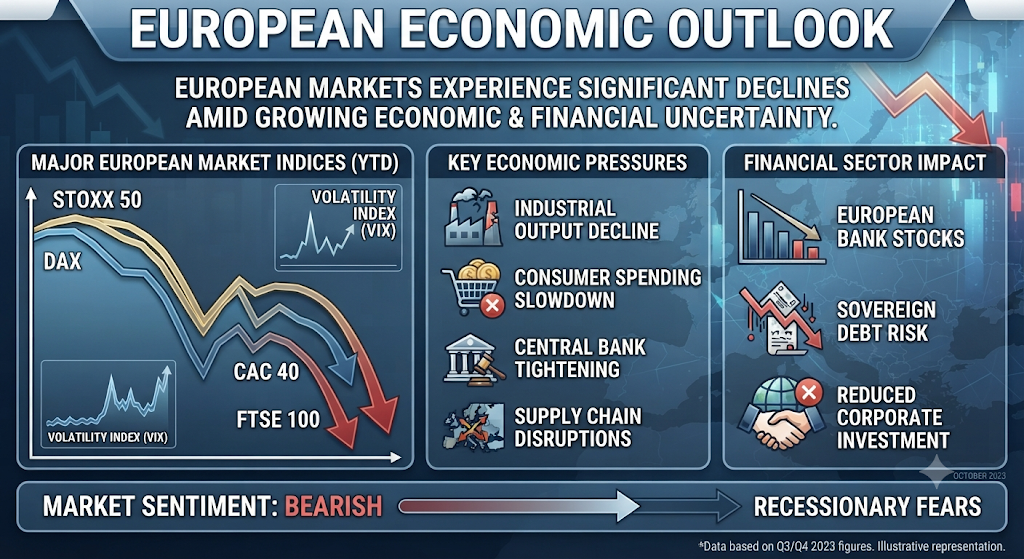
European financial markets have come under significant pressure as investors respond to growing economic uncertainty, geopolitical tensions and concerns about the global financial environment. Stock markets across the region recorded sharp declines on November 17, 2026, with technology, banking and industrial shares leading the losses.
The benchmark STOXX Europe 600 fell 1.75% to 650.72 points, marking its steepest single-day decline in eight months. Germany’s DAX dropped by more than 2%, while European technology shares declined 3.9%. The sell-off reflected growing caution among investors ahead of major corporate earnings announcements and concerns about the sustainability of investment in artificial intelligence.
The decline highlights the challenges facing European markets as they navigate higher energy costs, inflationary pressures, government debt concerns and uncertainty surrounding international trade.
European Stock Markets Face Broad Selling Pressure
European equity markets experienced widespread declines as investors reduced their exposure to riskier assets.
Technology companies were among the biggest losers. Semiconductor equipment manufacturer ASML fell 5.3%, while other companies connected to artificial intelligence infrastructure, including Siemens Energy and Legrand, also recorded losses.
Banking shares faced additional pressure. Deutsche Bank declined approximately 6% following media reports concerning its dealings with several prominent clients. The broader financial sector was also affected by concerns about government borrowing costs and the potential impact of market volatility on banks.
The STOXX 600 had reached a record level during the previous week, making the latest decline particularly significant for investors who had benefited from the earlier rally. Nevertheless, the correction followed a period of strong market performance and does not necessarily indicate a sustained downturn across the European economy.
Artificial Intelligence Concerns Affect Technology Stocks
One of the major factors behind the recent market decline is growing uncertainty about the global artificial intelligence investment boom.
Technology companies have attracted substantial investor interest because of expectations that AI will transform industries, increase productivity and generate significant future revenue. However, the scale of investment in data centres, advanced processors and computing infrastructure has also raised questions about valuations and the time required to achieve commercial returns.
Investors have become more cautious about companies whose market valuations depend heavily on continued growth in AI-related spending.
The upcoming earnings announcement from Nvidia has also attracted considerable attention because the company’s performance is viewed as an important indicator of demand for advanced AI processors.
For European markets, developments in the US technology sector are particularly important. European semiconductor equipment manufacturers and industrial technology companies are closely connected to global investment in computing infrastructure.
The European Central Bank has also warned that elevated AI valuations, concentrated market exposures and increasing debt financing for technology infrastructure could create financial stability risks.
Inflation and Energy Prices Create Economic Pressure
Inflation remains another major challenge for the European economy.
Higher energy costs have increased pressure on businesses and households, affecting transportation, manufacturing, electricity and food production. The ongoing Middle East conflict and disruptions to energy supply routes have contributed to uncertainty in international oil and gas markets.
The European Commission’s Autumn 2026 Economic Forecast, published on November 17, projected euro area inflation at 3.2% for 2026 and 3.1% for 2027, before easing to 2.1% in 2028.
The Commission also expects inflation in the euro area to have reached approximately 4% in October, reflecting the impact of higher energy prices. This creates difficulties for policymakers attempting to balance price stability with economic growth.
Persistent inflation could reduce household purchasing power and increase operating expenses for businesses. If energy costs remain elevated, companies may face pressure on profit margins, while consumers could reduce discretionary spending.
Government Debt and Bond Markets Raise Financial Concerns
Rising government borrowing costs have become another important source of uncertainty for European financial markets.
Several European countries are managing high public debt levels and substantial financing requirements. France has attracted particular attention because of its fiscal deficit and concerns about the sustainability of public finances.
Higher government bond yields can increase borrowing costs for governments, businesses and households. They can also affect banks that hold significant amounts of government debt.
The European Central Bank has identified sovereign debt sustainability as an important financial stability risk. In its November 16 assessment, ECB Vice-President Boris Vujčić highlighted elevated government debt, increasing financing requirements and a more price-sensitive investor base as factors that could contribute to market volatility.
The ECB has also warned that financial risks can spread between government bond markets, investment funds and banks, particularly when investors become concerned about the value of their assets.
Although European banks have strengthened their capital and liquidity positions over recent years, prolonged financial market stress could still increase funding costs and affect investor confidence.
European Economic Growth Remains Moderate
Despite the recent stock market decline, the broader European economic outlook remains one of moderate growth rather than an immediate recession.
The European Commission’s Autumn 2026 forecast expects the European Union economy to grow by 1.4% in 2026 and 2027, increasing to 1.5% in 2028. For the euro area, GDP growth is projected at 1.2% in both 2026 and 2027, followed by 1.3% in 2028.
Steady household consumption and stronger exports have helped support economic activity. However, investment has been weaker than expected in some areas, while higher energy costs and tighter financing conditions continue to create obstacles.
The Commission also expects the euro area’s unemployment rate to increase gradually from 6.4% in 2026 to 6.6% in 2028. This suggests that employment conditions may become less supportive of consumer spending over the coming years.
The outlook therefore reflects a combination of economic resilience and significant structural challenges.
Implications for International Trade and Investment
European market weakness can have consequences beyond the region because Europe remains an important centre of international trade, investment and industrial production.
A decline in investor confidence could affect capital flows, corporate investment decisions and international business activity. Companies operating across multiple countries may delay expansion plans if financing becomes more expensive or demand expectations weaken.
European manufacturers also face pressure from international competition, particularly in automobiles, renewable energy, advanced technology and industrial machinery.
Trade uncertainty and geopolitical tensions may further complicate investment decisions. Businesses are increasingly required to consider supply-chain diversification, energy security and changing international trade regulations.
For emerging economies, weaker European demand could affect exports of manufactured goods, raw materials and services. However, opportunities may also emerge for countries able to provide competitive manufacturing alternatives and reliable supply-chain partnerships.
Implications for India
Developments in European financial markets are important for India because Europe is a significant trading and investment partner.
A prolonged slowdown in European economic activity could affect Indian exporters in sectors such as textiles, engineering goods, pharmaceuticals, automobiles, chemicals and information technology services.
If European consumers reduce spending, demand for imported products may weaken. Indian businesses with significant exposure to European markets could therefore face pressure on export orders and revenue growth.
Financial market volatility can also influence foreign investment flows into emerging economies. A shift towards safer assets in developed markets may affect capital flows into Indian equities and other financial instruments.
However, the changing economic environment also creates opportunities for India. European companies seeking diversified manufacturing locations may consider expanding operations in India, particularly in electronics, renewable energy, pharmaceuticals, engineering and automotive components.
Strengthening trade relations, improving infrastructure and maintaining competitive production costs will be important for India to benefit from these developments.
The Worldonomics Times View
The recent decline in European markets reflects the growing complexity of the global economic environment. Concerns about artificial intelligence valuations, higher energy costs, government borrowing and geopolitical tensions have encouraged investors to reassess financial risks.
Although the STOXX Europe 600 experienced its steepest daily decline in eight months, the broader economic outlook remains moderately positive. The European Commission continues to project economic growth, supported by household consumption and exports.
However, persistent inflation and higher financing costs could limit the pace of recovery. European governments and financial institutions will need to manage fiscal pressures while maintaining confidence in the banking system and investment markets.
For international businesses, the situation highlights the importance of monitoring economic indicators, managing financial exposure and maintaining flexible supply chains.
India must also remain attentive to European market developments because changes in European demand and investment sentiment can influence Indian exports and financial markets.
Ultimately, the future performance of European markets will depend on the direction of inflation, energy prices, government borrowing costs and corporate earnings. A stable economic environment and predictable policy decisions will be essential to restoring investor confidence and supporting sustainable growth across Europe.