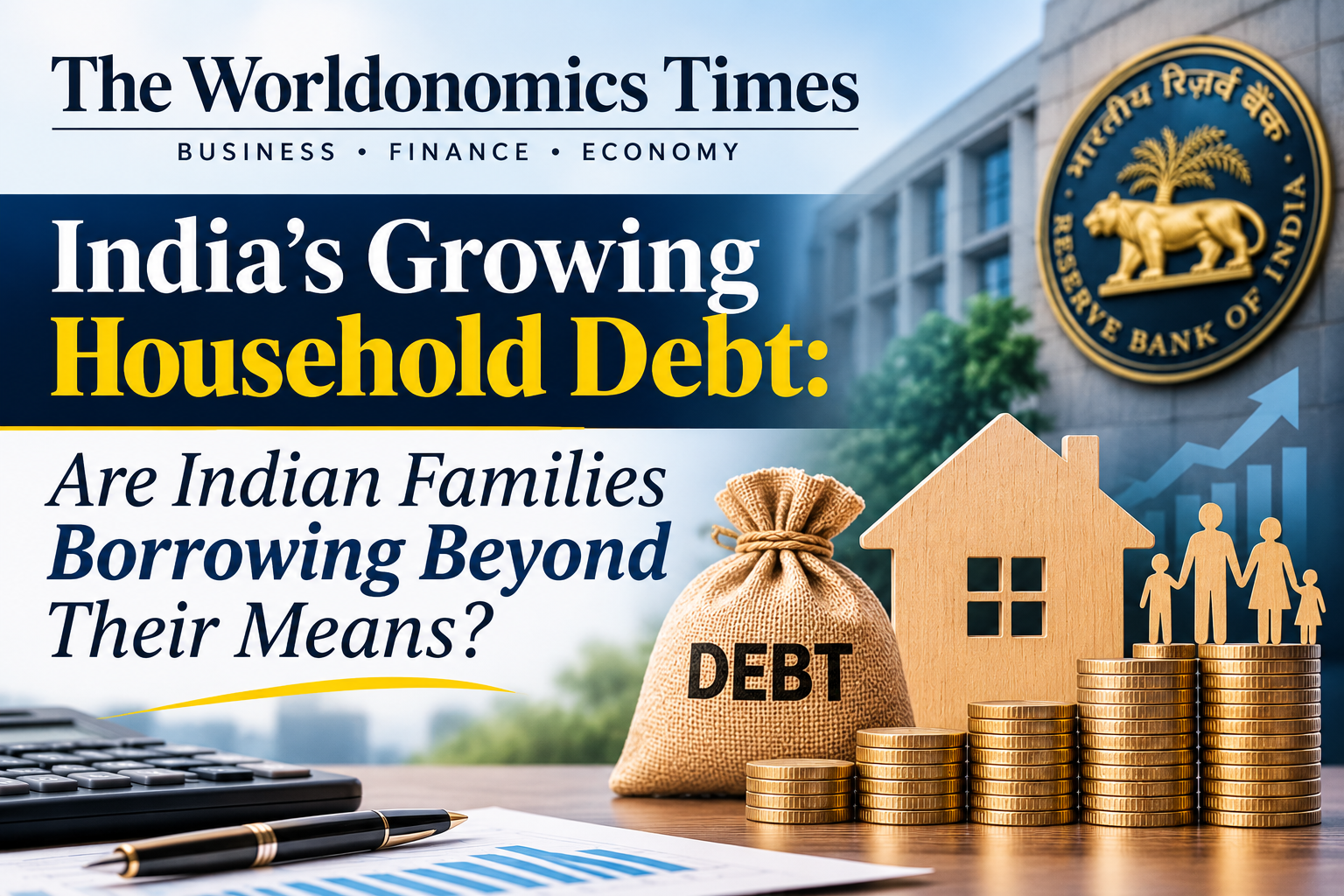
India’s expanding credit market is changing the financial behaviour of millions of households. From home loans and personal loans to credit cards and Buy Now Pay Later (BNPL) services, borrowing has become an increasingly accessible part of everyday life. While easy credit supports consumption, investment and financial inclusion, the growing dependence on loans raises an important question: Are Indian families using credit to build financial security or borrowing to sustain their lifestyles?
India’s Household Debt: What Do the Numbers Reveal?
According to the Reserve Bank of India’s (RBI) Financial Stability Report, June 2026, household debt reached 45.5% of GDP by September 2025, remaining above its five-year average of 42.9%.
An important development is the changing composition of household borrowing. Non-housing retail loans accounted for 58.4% of total household borrowings as of March 2026, indicating that borrowing is increasingly extending beyond traditional housing finance.
The RBI’s Annual Basic Statistical Return also reported that household-sector borrowings increased by 14.3% year-on-year in March 2026. The household sector accounted for approximately three-fifths of incremental bank credit during FY 2025–26.
These figures reflect expanding access to formal credit. However, the growing share of non-housing loans makes it important to examine whether borrowing is supporting productive financial goals or financing short-term consumption.
Why Are Indian Families Borrowing More?
Several economic and behavioural factors are contributing to the increasing dependence on credit.
1. Easy Access to Digital Lending
Digital lending platforms, instant personal loans and credit card facilities have significantly simplified the borrowing process. Consumers can access credit through mobile applications with fewer procedural barriers than traditional lending channels.
However, the convenience of instant borrowing can sometimes encourage individuals to make financial commitments without fully evaluating their repayment capacity.
2. Rising Household Expenses
Expenditure on housing, education, healthcare, transportation and everyday necessities can put pressure on household budgets. When income growth fails to keep pace with expenses, families may increasingly depend on personal loans and credit cards to manage financial gaps.
3. Lifestyle-Driven Consumption
Consumer financing has made smartphones, electronics, vehicles, holidays and other lifestyle purchases more accessible. Monthly instalments can make expensive purchases appear affordable, even when their cumulative financial impact is substantial.
4. Changing Borrowing Behaviour Among Young Consumers
Credit cards, BNPL services and short-term personal loans are becoming increasingly familiar among younger borrowers.
An August 2026 report by The Indian Express, examining RBI and credit bureau data, highlighted the growing participation of younger Indians in consumption-oriented borrowing. It also reported that the share of over-leveraged consumers had increased substantially before easing to 15% in FY2026. s
The Hidden Risk: Borrowing to Maintain a Lifestyle
The biggest financial concern is not borrowing itself, but borrowing without adequate repayment capacity.
A home loan may help a family acquire a long-term asset, while an education loan can support future earning potential. In contrast, repeatedly using high-interest credit to finance routine consumption can create financial pressure without building corresponding assets.
Consider a middle-income household managing several financial commitments:
- Home loan EMI
- Personal loan instalments
- Credit card outstanding balances
- Vehicle loan repayments
- Buy Now Pay Later obligations
Individually, these payments may appear manageable. Collectively, however, they can consume a significant portion of monthly income.
This creates an increasing debt-servicing burden, leaving less money for savings, investments and emergencies.
The situation becomes more challenging when borrowers take fresh loans to repay existing obligations, creating a cycle of debt dependency.
Household Debt and the Savings Challenge
Rising borrowing also brings attention to India’s household savings position.
According to the RBI Annual Report 2025–26, gross household financial savings moderated to 11.8% of Gross National Disposable Income (GNDI) in FY2024–25, compared with 12.1% in the previous year. However, household financial liabilities also declined from 6.4% to 4.8% of GNDI during the same period.
This distinction is important. Rising household debt does not automatically mean that every Indian family is experiencing financial distress. Some households have substantial assets, stable incomes and manageable repayment obligations, while others have limited savings and greater exposure to expensive credit.
The real challenge is maintaining a healthy balance between income, expenditure, savings and debt repayment.
Is Rising Household Debt a Threat to India’s Economy?
Household credit plays an important role in economic development. It supports housing demand, consumer spending, entrepreneurship and access to financial services.
However, excessive consumption-led borrowing can create vulnerabilities. If employment conditions weaken or household incomes decline, borrowers may struggle to meet their repayment obligations. Rising defaults could affect lending institutions, restrict credit availability and eventually weaken consumer demand.
The RBI’s assessment also provides an important counterpoint: the share of better-rated borrowers has increased, suggesting resilience in the overall household credit profile. Nevertheless, unsecured lending and lower-rated borrower segments require continued monitoring.
Therefore, the concern is not simply how much Indian households borrow, but whether their debt remains sustainable relative to their income and financial resources.
Conclusion: Credit Should Build Financial Security, Not Replace It
India’s expanding credit market reflects greater financial access and changing consumer behaviour. However, easy borrowing should not be confused with financial prosperity.
Households need to evaluate repayment capacity, understand the actual cost of borrowing, avoid unnecessary credit card balances and maintain adequate emergency savings. Financial institutions must also strengthen responsible lending practices and ensure transparent communication of loan terms.
Ultimately, financial freedom is not measured by how much a family can borrow, but by how comfortably it can manage its income, savings and financial obligations.
India’s next financial challenge is not merely expanding access to credit, but ensuring that credit contributes to sustainable household wealth rather than long-term financial pressure.