The Worldonomics Times | November 2026
Inflation remains one of the most closely monitored indicators of the United States economy, influencing monetary policy decisions, consumer purchasing power, business investment and financial market sentiment. As the US economy navigates changing economic conditions, inflation data continues to play a crucial role in determining the Federal Reserve’s policy direction. Investors, businesses and policymakers are closely examining price movements to understand whether inflation is moving towards a sustainable level or creating renewed economic challenges.
The direction of inflation has implications far beyond household expenses. It affects borrowing costs, employment conditions, corporate profitability, currency movements and international capital flows. Consequently, every major inflation report attracts considerable attention from financial markets, as it can influence expectations surrounding future interest-rate decisions.
Understanding the Current Inflation Landscape
Inflation in the United States is influenced by several interconnected factors, including consumer demand, energy prices, housing costs, wages, supply-chain conditions and international trade developments. Although improvements in supply conditions can ease certain price pressures, persistent costs in essential sectors may continue to influence overall inflation.
Housing and shelter expenses remain particularly important components of consumer inflation. Changes in rental costs, housing availability and mortgage affordability can affect household budgets and broader economic conditions. Similarly, energy and transportation prices can influence production expenses and the cost of goods and services.
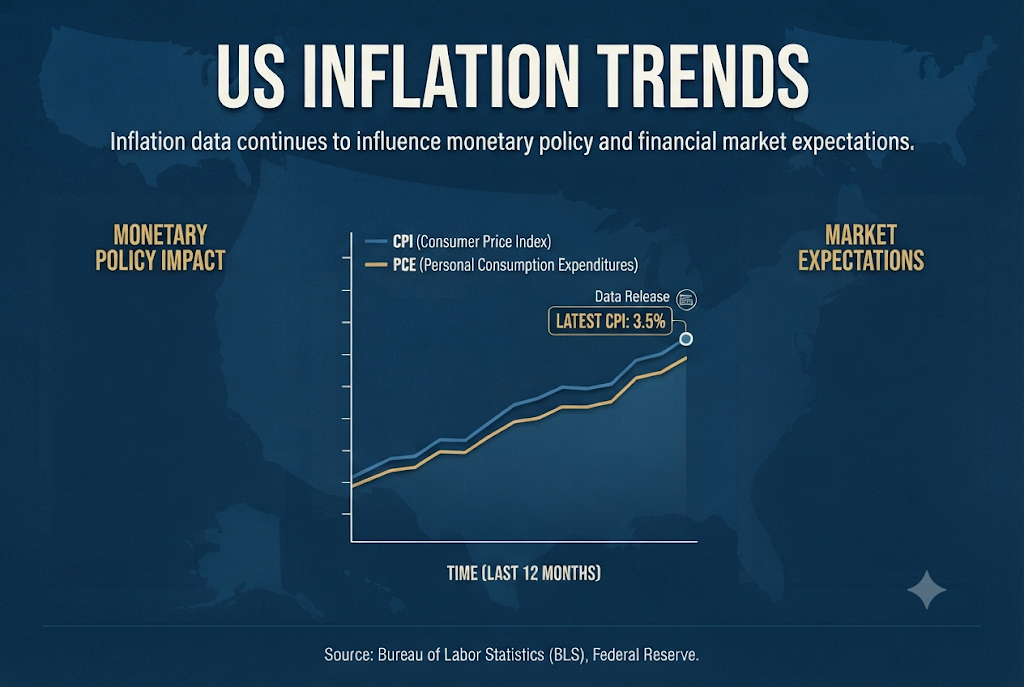
The Consumer Price Index (CPI) and Personal Consumption Expenditures (PCE) Price Index are two important indicators used to assess inflation trends. While CPI provides insight into changes in consumer prices, the PCE index is particularly important to the Federal Reserve’s inflation assessment.
Federal Reserve Policy and Interest-Rate Expectations
The Federal Reserve plays a central role in managing inflation through monetary policy. Its primary objectives include maintaining price stability and supporting maximum sustainable employment. When inflation remains elevated, policymakers may maintain restrictive interest rates to moderate borrowing, spending and investment.
Conversely, when inflation shows sustained signs of easing, the Federal Reserve may consider reducing interest rates, depending on employment conditions and the broader economic outlook.
Interest-rate expectations are especially important for financial markets. Investors closely analyse inflation reports, employment statistics and Federal Reserve communications to anticipate changes in monetary policy. Even a relatively small difference between expected and actual inflation figures can influence market sentiment.
The challenge for policymakers is to reduce inflation without unnecessarily weakening economic activity. Tight monetary policy can help control price pressures, but prolonged high borrowing costs may affect businesses, housing demand and consumer spending.
Impact on Financial Markets and Investors
Inflation data has a direct influence on financial market expectations. Bond yields, equity valuations, currency movements and commodity prices can all respond to changes in inflation forecasts and interest-rate expectations.
When inflation exceeds market expectations, investors may anticipate higher interest rates for a longer period. This can place pressure on growth-oriented stocks, increase borrowing costs and strengthen demand for relatively attractive fixed-income investments.
On the other hand, lower-than-expected inflation may improve expectations of monetary easing, potentially supporting equity markets and encouraging investment activity. However, markets also consider the reasons behind falling inflation. A decline driven by weaker economic demand may create concerns about corporate earnings and future growth.
The US dollar can also experience fluctuations as investors reassess the relative attractiveness of dollar-denominated assets and the expected direction of Federal Reserve policy.
Consumer Spending and Business Confidence
Inflation continues to influence the everyday financial decisions of American households. Higher prices for groceries, housing, healthcare, transportation and other essential services can reduce disposable income and affect consumer confidence.
When household purchasing power weakens, consumers may become more selective about discretionary spending. This can affect businesses operating in retail, hospitality, entertainment and other consumer-facing industries.
For companies, inflation creates additional challenges related to wages, raw materials, transportation and operating expenses. Businesses must decide whether to absorb higher costs, improve operational efficiency or pass some of the additional expenses on to customers.
Small and medium-sized businesses may face particular pressure because they often have less financial flexibility and limited bargaining power compared with larger corporations.
Global Implications of US Inflation
Developments in US inflation have significant international consequences because the United States remains a major participant in global trade and financial markets. Changes in Federal Reserve policy can influence capital flows, exchange rates and borrowing conditions across emerging and developed economies.
Higher US interest rates can encourage international investors to favour dollar-denominated assets, potentially putting pressure on emerging-market currencies. Countries with substantial dollar-denominated debt may also face increased repayment costs.
For global businesses and investors, monitoring US inflation is therefore essential for understanding international financial conditions and assessing potential economic risks.
The Worldonomics Times View
The Worldonomics Times believes that inflation management remains one of the defining economic challenges for the United States. While controlling rising prices is essential for protecting purchasing power and maintaining economic stability, policymakers must also consider employment, investment and sustainable growth.
A balanced monetary policy approach will be critical. Decisions based on consistent economic evidence, rather than short-term market reactions, can help strengthen confidence in the financial system.
Businesses must also prepare for changing interest-rate conditions by managing costs, improving productivity and adopting disciplined investment strategies. For investors, understanding the relationship between inflation, monetary policy and market valuations will remain essential to making informed financial decisions.
Outlook: Inflation Data Will Remain in Focus
Looking ahead, US inflation trends will continue to influence the Federal Reserve’s decisions and financial market expectations. Developments in housing, energy, wages, consumer demand and global trade will be important indicators to watch.
The broader economic challenge will be to achieve price stability while preserving employment opportunities, business confidence and long-term investment growth. As new economic data emerges, policymakers, investors and businesses will need to remain attentive to changing conditions.
Ultimately, inflation is more than a measure of rising prices; it is a key indicator of economic stability and financial confidence. The direction of US inflation will therefore remain an important influence on both domestic economic performance and the wider global financial landscape.
The Worldonomics Times | Bringing global economic developments, financial insights and business perspectives into focus.