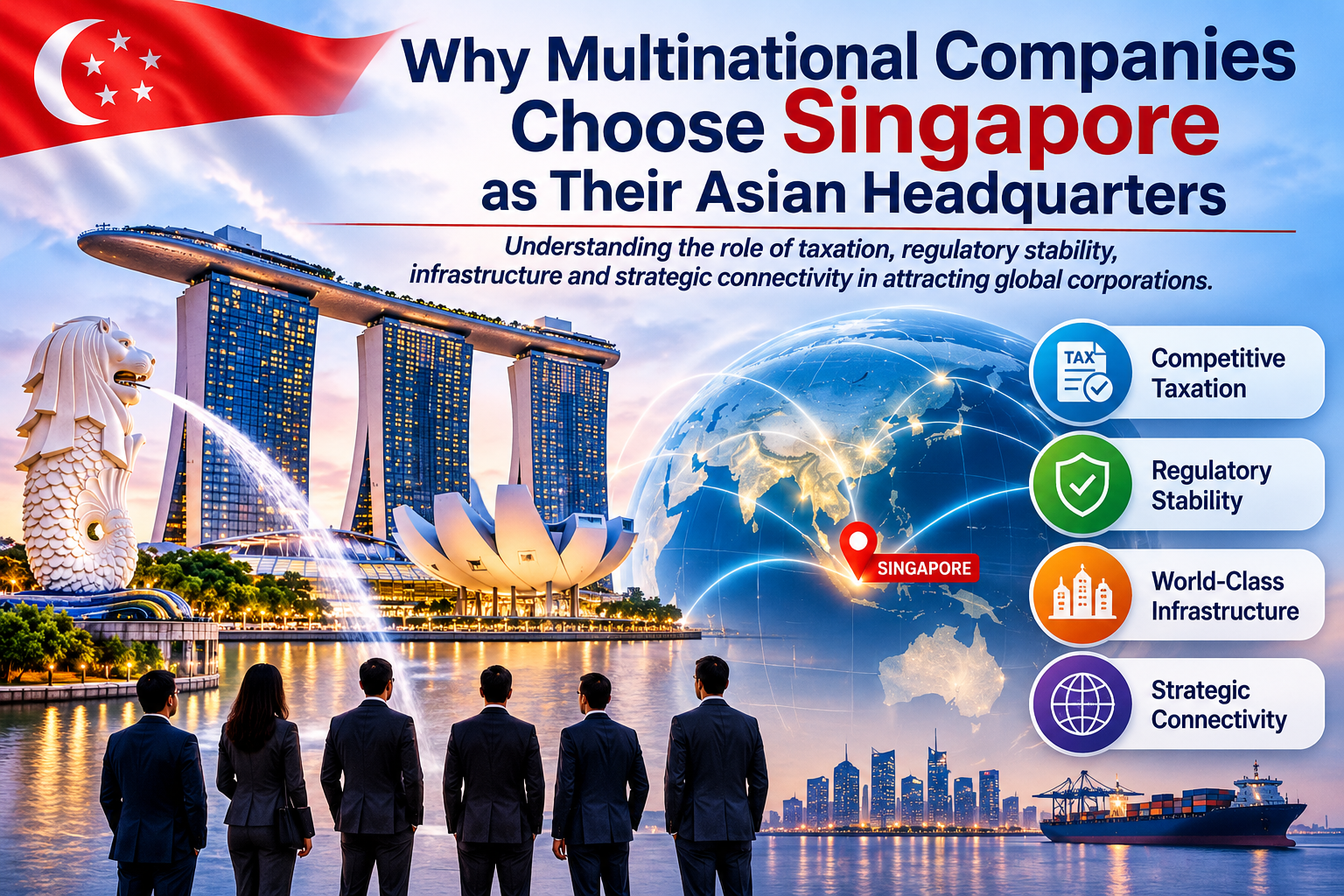
Understanding the role of taxation, regulatory stability, infrastructure and strategic connectivity in attracting global corporations.
Introduction
In an increasingly interconnected global economy, multinational corporations must carefully select locations from which to manage their international operations. The choice of a regional headquarters affects taxation, operational costs, supply-chain efficiency, access to talent, regulatory compliance and long-term business strategy.
Singapore has established itself as one of Asia’s most attractive destinations for multinational companies seeking to manage their regional operations. Global businesses across technology, manufacturing, finance, logistics and professional services have established significant operations in the country.
Its success demonstrates that a country’s attractiveness to international businesses depends not only on tax rates but also on the overall quality of its business environment.
Singapore as a regional business headquarters
A regional headquarters generally coordinates business activities across several countries. Its functions may include financial management, strategic planning, marketing, procurement, human resources, treasury operations and regional risk management.
Singapore provides access to Southeast Asian markets while maintaining strong international connectivity.
Companies such as Amazon, Dyson and Unilever have used Singapore as a base for regional or international business functions. Singapore’s Economic Development Board identifies its infrastructure, talent pool and business environment as important advantages for headquarters operations. EDB Singapore
1. Strategic geographical location
Singapore is situated along important international shipping and aviation routes.
Its location enables companies to coordinate operations across Southeast Asia, India, China and other Asian markets.
For businesses involved in international trade, this connectivity can reduce logistical complexity and improve coordination between suppliers, manufacturers, distributors and customers.
Changi Airport and Singapore’s maritime infrastructure also support the movement of employees, products and business information.
2. Stable regulatory and legal environment
Multinational companies require predictable laws and transparent administrative systems.
Singapore’s regulatory institutions, established legal framework and emphasis on contractual certainty provide a favourable environment for long-term investment.
Companies must comply with corporate, employment, taxation, accounting and industry-specific requirements. A predictable regulatory system helps businesses plan their operations and manage compliance risks.
For corporate finance departments, this also makes financial planning, reporting and internal control systems easier to standardise across regional entities.
3. Competitive tax environment
Taxation is an important consideration when selecting a regional headquarters.
Singapore’s headline corporate income tax rate is 17%, subject to applicable rules, exemptions and incentives.
The country also provides certain tax incentive frameworks for qualifying activities and businesses.
However, companies should not consider the headline tax rate in isolation. Effective taxation depends on the nature of income, deductions, incentive eligibility, transfer pricing, withholding taxes and international tax rules.
The implementation of the OECD/G20 Pillar Two global minimum tax framework has also changed international tax planning for large multinational groups.
Consequently, Singapore’s competitiveness increasingly depends on its skilled workforce, infrastructure, connectivity and regulatory quality rather than simply low taxation.
4. Skilled workforce and professional services
Singapore has a diverse workforce and a developed professional services industry.
Multinational corporations require accountants, finance managers, auditors, lawyers, tax advisers, compliance officers, engineers and technology professionals.
The availability of such talent helps companies manage complex regional operations.
A headquarters can also coordinate financial reporting across subsidiaries, implement standard operating procedures and establish consistent internal control frameworks.
5. Advanced infrastructure and digital connectivity
Business infrastructure is another major attraction.
Singapore offers modern office facilities, international transport links, digital connectivity and a developed financial services ecosystem.
For technology businesses, data connectivity and cybersecurity capabilities are important operational considerations.
For manufacturing companies, reliable logistics, industrial infrastructure and access to regional suppliers can influence location decisions.
Financial and accounting implications
The establishment of a regional headquarters creates important accounting and financial management responsibilities.
A multinational group may have subsidiaries operating under different accounting, tax and regulatory systems.
The headquarters must ensure that financial information is consolidated accurately and that intercompany transactions are properly documented.
Transfer pricing is particularly important because transactions between related entities must comply with applicable tax requirements.
Regional finance teams also monitor:
- Foreign exchange exposure.
- Intercompany loans and balances.
- Cash pooling and treasury operations.
- Tax compliance across jurisdictions.
- Consolidated financial reporting.
- Internal audit and risk management.
For finance professionals, Singapore therefore offers opportunities in international accounting, financial control, tax advisory, audit and corporate treasury.
Challenges for multinational companies
Singapore’s advantages do not eliminate all business challenges.
Operating costs, particularly salaries and commercial property expenses, can be significant.
Companies must also navigate immigration and employment requirements, regional tax differences, international data protection obligations and geopolitical uncertainty.
Furthermore, a Singapore headquarters does not automatically make all regional activities subject to Singapore taxation. The actual functions, risks, assets and legal arrangements of each entity remain important.
Lessons for India
India has considerable potential to attract regional headquarters and international investment.
Its large consumer market, skilled workforce, technology sector and manufacturing capabilities provide important advantages.
However, companies also evaluate administrative efficiency, contract enforcement, regulatory predictability, infrastructure and ease of cross-border operations.
Singapore demonstrates the value of integrating these elements into a coherent business environment.
Indian businesses can also use Singapore as a regional platform for international expansion, subject to applicable legal and tax requirements.
Conclusion
Singapore’s success in attracting multinational headquarters reflects a combination of geographical connectivity, institutional strength, skilled talent, business infrastructure and financial services.
Although taxation remains relevant, long-term business confidence depends on a much wider set of factors.
As global companies reassess their international operating models, Singapore is likely to remain an important centre for managing Asian business activities.
About Author:-
CMA Vivek Kumar (ACMA), an Associate Member of ICMAI and B.Com (Accounting Honours) graduate, is an author, finance professional, and Founder of VK Chartered Academy (www.cacmacstestseries.com). He specializes in statutory and tax audits, taxation, financial reporting, GST advisory, and corporate compliance. He also mentors CA, CMA, and CS aspirants through structured academic guidance and exam-oriented test series, bridging practical industry expertise with professional education. Email: cmavivek2026@gmail.com