Stock Market | Singapore | 19 November 2026
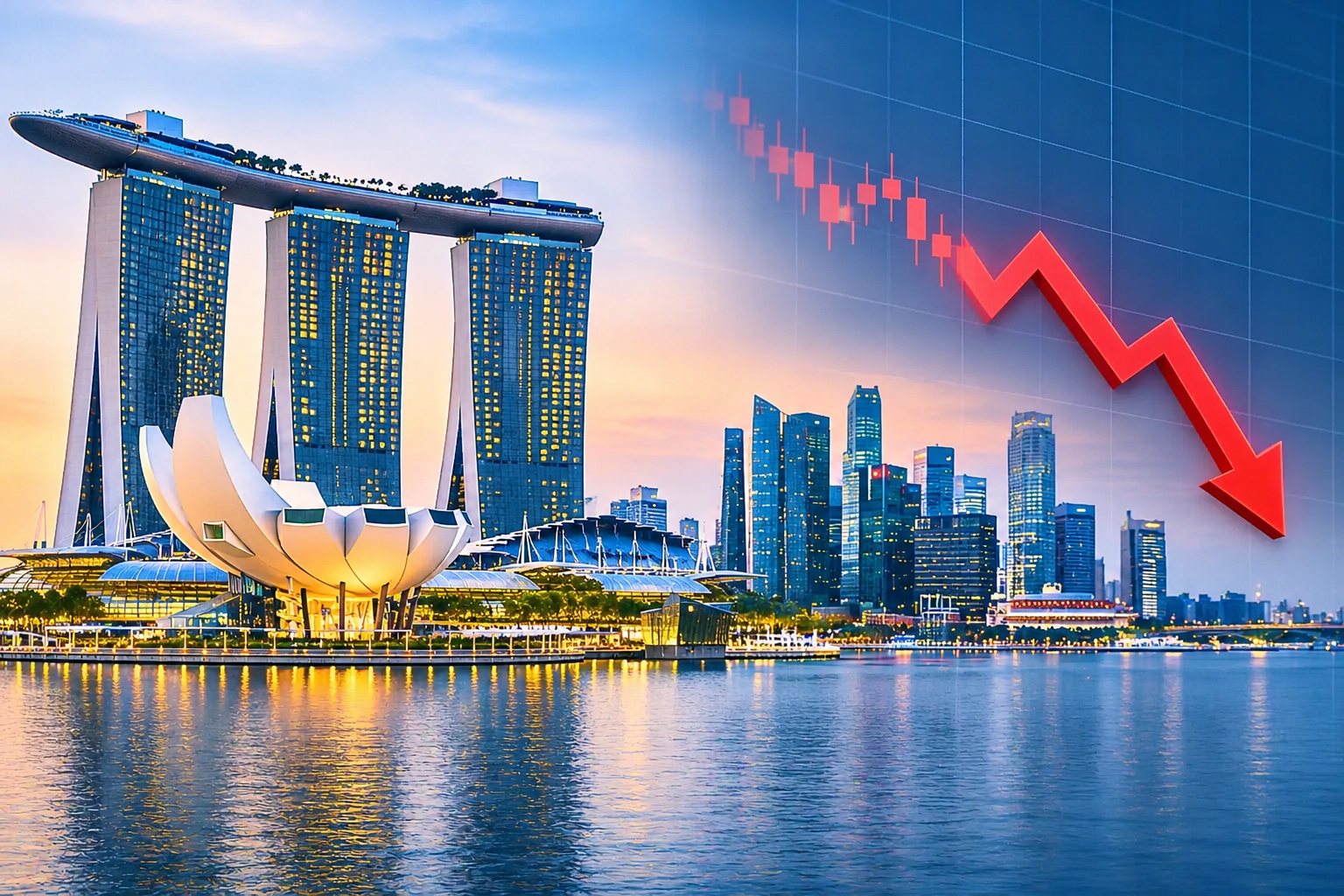
Singapore’s stock market continued its downward movement on Wednesday, 18 November 2026, as the benchmark Straits Times Index (STI) declined for the fifth consecutive trading session. Concerns over global technology stocks, uncertainty surrounding artificial intelligence (AI) investments and expectations of tighter US monetary policy weighed on investor sentiment.
The Straits Times Index closed at 5,054.89 points, falling 54.24 points or 1.06% during the session. The decline reflected continued weakness across several major Singapore-listed companies, particularly banking, real estate investment trust (REIT) and technology-related stocks.
The latest market performance comes despite Singapore reporting an extraordinary 79.8% year-on-year increase in non-oil domestic exports in October 2026, highlighting the difference between strong economic indicators and short-term financial market sentiment.
Banking Stocks Remain Under Pressure
Singapore’s major banking stocks experienced losses during Wednesday’s trading session.
DBS Group Holdings declined 1.1% to S$66.94, while Oversea-Chinese Banking Corporation (OCBC) fell 1% to S$27.40. United Overseas Bank (UOB) recorded a larger decline of 1.6%, closing at S$36.13.
Banking stocks are among the most influential components of the Singapore market, and their movements have a significant impact on the benchmark index.
Investor concerns over global interest rate expectations, international capital flows and the outlook for financial markets have contributed to cautious trading.
Real Estate and Technology Stocks Face Selling Pressure
Frasers Logistics & Commercial Trust was among the weakest performers within the benchmark index, declining 5.1% to S$0.845.
Technology-related stocks also remained sensitive to developments surrounding US restrictions on advanced artificial intelligence chips.
Fresh US export restrictions targeting advanced semiconductor technology and computing services in Southeast Asia have raised concerns about the potential impact on data centre operators, semiconductor suppliers and companies involved in AI infrastructure.
Singapore-listed semiconductor companies have also faced pressure amid uncertainty over future demand and the regulatory environment.
Foreign Investor Selling Adds to Market Weakness
Market sentiment has been affected by sustained selling pressure from overseas investors.
According to market commentary, foreign investors have been net sellers of Singapore equities for several consecutive weeks. This has made it difficult for domestic institutional and retail investors to absorb the selling pressure.
On Wednesday, declining stocks significantly outnumbered advancing stocks. Across the Singapore market, 355 stocks fell compared with 229 gainers.
Approximately 1.12 billion securities changed hands, representing a total trading value of around S$2.29 billion.
The broad-based weakness indicates that market pressure extended beyond a small group of large-cap companies.
Asian Markets Deliver a Mixed Performance
Singapore’s market decline occurred amid mixed movements across major Asian financial markets.
Hong Kong’s Hang Seng Index declined 0.9%, while Japan’s Nikkei 225 advanced 0.3%. South Korea’s Kospi gained 2%, demonstrating different investor responses across regional markets.
The performance of international technology stocks, US monetary policy expectations and developments in semiconductor trade restrictions continue to influence investor decisions throughout Asia.
Market Outlook: Investors Remain Cautious
The near-term outlook for Singapore equities will depend on several factors, including international capital flows, corporate earnings, interest rate expectations and developments in the global technology industry.
Investors will also monitor the performance of Singapore’s banking sector, REITs and major industrial companies for indications of market stability.
Although Singapore’s strong export growth provides a positive signal for the broader economy, equity markets may continue to experience volatility if global uncertainty and foreign selling persist.
The recent decline also highlights the importance of distinguishing between economic growth and stock market performance. Strong trade figures do not automatically translate into immediate gains in equity prices.
Conclusion
Singapore’s Straits Times Index has come under sustained pressure, recording five consecutive sessions of losses and closing at 5,054.89 on 18 November 2026.
Weakness in banking stocks, pressure on REITs, concerns about AI-related technology investments and continued foreign investor selling have contributed to the decline.
Going forward, investors will closely monitor global interest rate developments, semiconductor industry regulations and corporate earnings to assess the direction of Singapore’s equity market.
The Worldonomics Times
Business | Markets | Economy | Global Opportunities