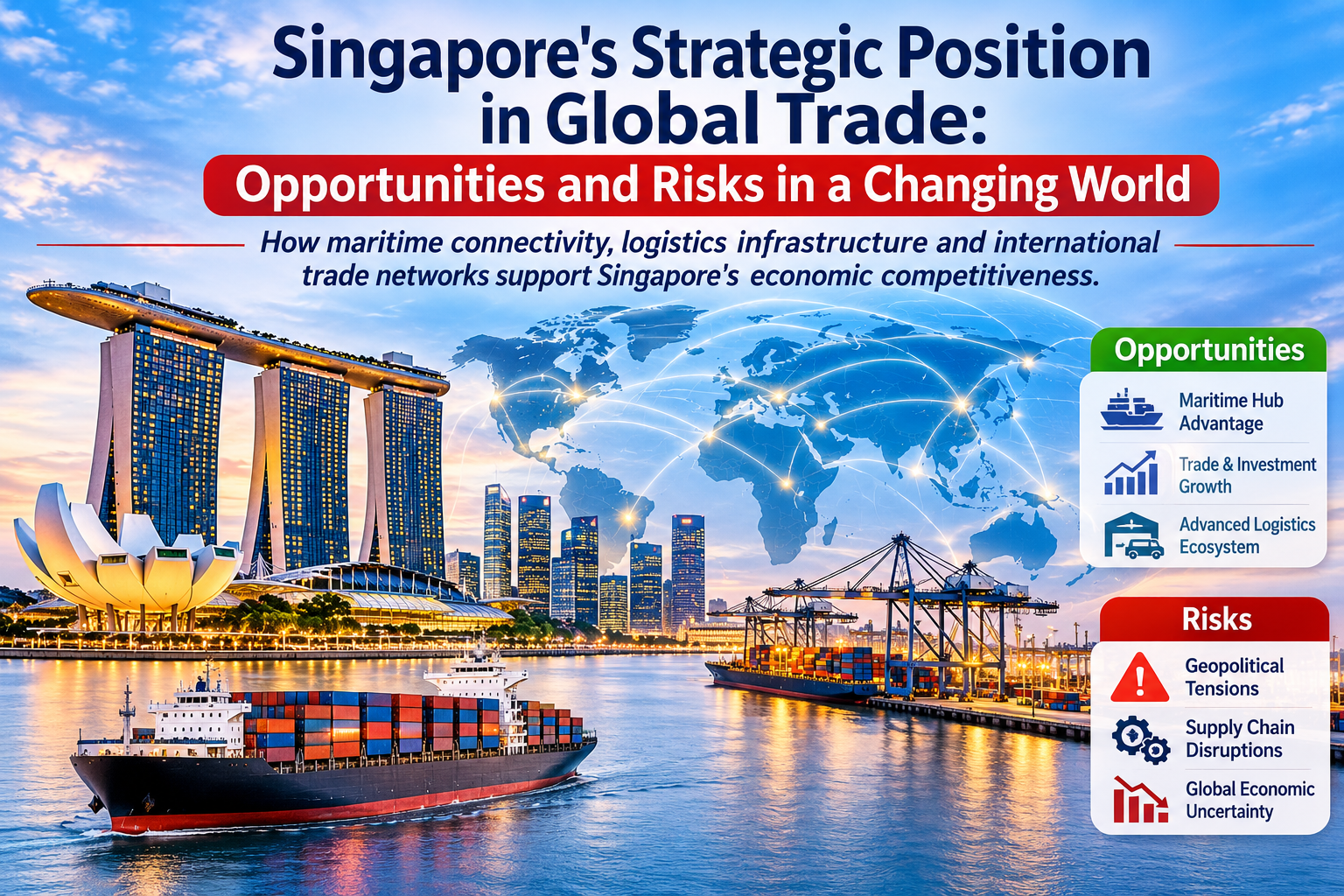
How maritime connectivity, logistics infrastructure and international trade networks support Singapore’s economic competitiveness.
Introduction
International trade is a fundamental driver of economic growth. Countries that can efficiently connect producers, suppliers and consumers across international markets gain significant competitive advantages.
Singapore is an important example of how a small country can establish a major position in global trade through strategic geography, world-class infrastructure and efficient logistics.
Although it has a limited domestic market and few natural resources, Singapore has become one of the world’s leading maritime and logistics centres.
The importance of Singapore’s geographical position
Singapore is located near the Strait of Malacca, one of the world’s most important maritime routes.
This location connects major trading economies in East Asia with markets in Europe, the Middle East and beyond.
The country has developed extensive port facilities, shipping services, warehousing, marine insurance and trade-financing capabilities.
Its port is not merely a location where ships load and unload cargo. It is part of an integrated logistics ecosystem supporting international supply chains.
Record port performance
Singapore’s maritime importance is reflected in its recent performance.
According to the Maritime and Port Authority of Singapore, the country recorded approximately 44.66 million twenty-foot equivalent units (TEUs) of container throughput in 2025, an increase of 8.6% compared with 2024.
Vessel arrivals reached 3.22 billion gross tonnage during the same year. Maritime and Port Authority of Singapore
These figures demonstrate the importance of Singapore’s port infrastructure to international commerce.
How Singapore creates value from global trade
1. Transshipment operations
Transshipment involves transferring cargo from one vessel to another before it reaches its final destination.
Singapore’s connectivity enables shipping companies to consolidate cargo and coordinate shipping routes efficiently.
2. Logistics and warehousing
Efficient logistics infrastructure helps businesses manage inventory, distribution and delivery.
Companies can use Singapore as a regional distribution centre for products moving across Southeast Asia.
3. Trade financing
International trade frequently involves delayed payments, foreign exchange risks and documentary requirements.
Banks and financial institutions in Singapore provide trade-finance services such as letters of credit, guarantees and working-capital facilities.
4. Maritime services
The shipping industry creates demand for marine insurance, ship financing, legal services, vessel management and professional advisory services.
This allows Singapore to generate economic value beyond port charges and cargo handling.
The role of supply-chain resilience
Recent geopolitical developments have highlighted the vulnerability of global supply chains.
Trade restrictions, conflicts, shipping disruptions and changes in international tariffs can affect the availability and cost of goods.
Companies are therefore increasingly focusing on supply-chain resilience.
Singapore can benefit from this trend because businesses require reliable logistics partners and alternative distribution routes.
However, the same global disruptions can also affect its trade-dependent economy.
Digitalisation of maritime trade
Digital technologies are transforming shipping and logistics.
Electronic documentation, cargo tracking, predictive analytics and automated port systems can improve operational efficiency.
Digital trade documentation can reduce paperwork and administrative delays.
For finance professionals, digitalisation also creates better transaction records and opportunities for automated reconciliation between logistics, procurement and accounting systems.
Risks and challenges
Singapore’s dependence on international trade creates several risks.
- Global economic slowdown can reduce cargo volumes.
- Geopolitical tensions can disrupt shipping routes.
- Changes in trade policy can affect export and import demand.
- Higher energy prices can increase transportation costs.
- Cyberattacks can disrupt port and logistics operations.
- Climate change can increase physical and transition risks.
The maritime industry must also manage its environmental impact, particularly emissions from shipping and port operations.
Opportunities in green shipping
The transition towards lower-emission shipping creates opportunities for alternative marine fuels, energy-efficient vessels, green port infrastructure and maritime technology.
Singapore can strengthen its competitive position by supporting cleaner fuels and developing the necessary infrastructure.
This transition also requires new financing models and investment in research and technology.
Implications for India
India and Singapore have complementary strengths in international trade.
India offers a large manufacturing base, consumer market and growing logistics sector, while Singapore offers international connectivity, financial services and maritime expertise.
Greater cooperation can support port development, logistics technology, trade financing and supply-chain integration.
Indian businesses can also benefit from Singapore’s role as a distribution and coordination centre for Southeast Asian markets.
Conclusion
Singapore’s position in global trade demonstrates how strategic geography can be converted into long-term economic value through investment in infrastructure, institutions and technology.
Its record maritime performance in 2025 reinforces the importance of its port and logistics ecosystem.
However, the future of global trade will depend on how effectively countries manage geopolitical risks, supply-chain disruptions, digital threats and environmental challenges.
About Author:-
CMA Vivek Kumar (ACMA), an Associate Member of ICMAI and B.Com (Accounting Honours) graduate, is an author, finance professional, and Founder of VK Chartered Academy (www.cacmacstestseries.com). He specializes in statutory and tax audits, taxation, financial reporting, GST advisory, and corporate compliance. He also mentors CA, CMA, and CS aspirants through structured academic guidance and exam-oriented test series, bridging practical industry expertise with professional education. Email: cmavivek2026@gmail.com