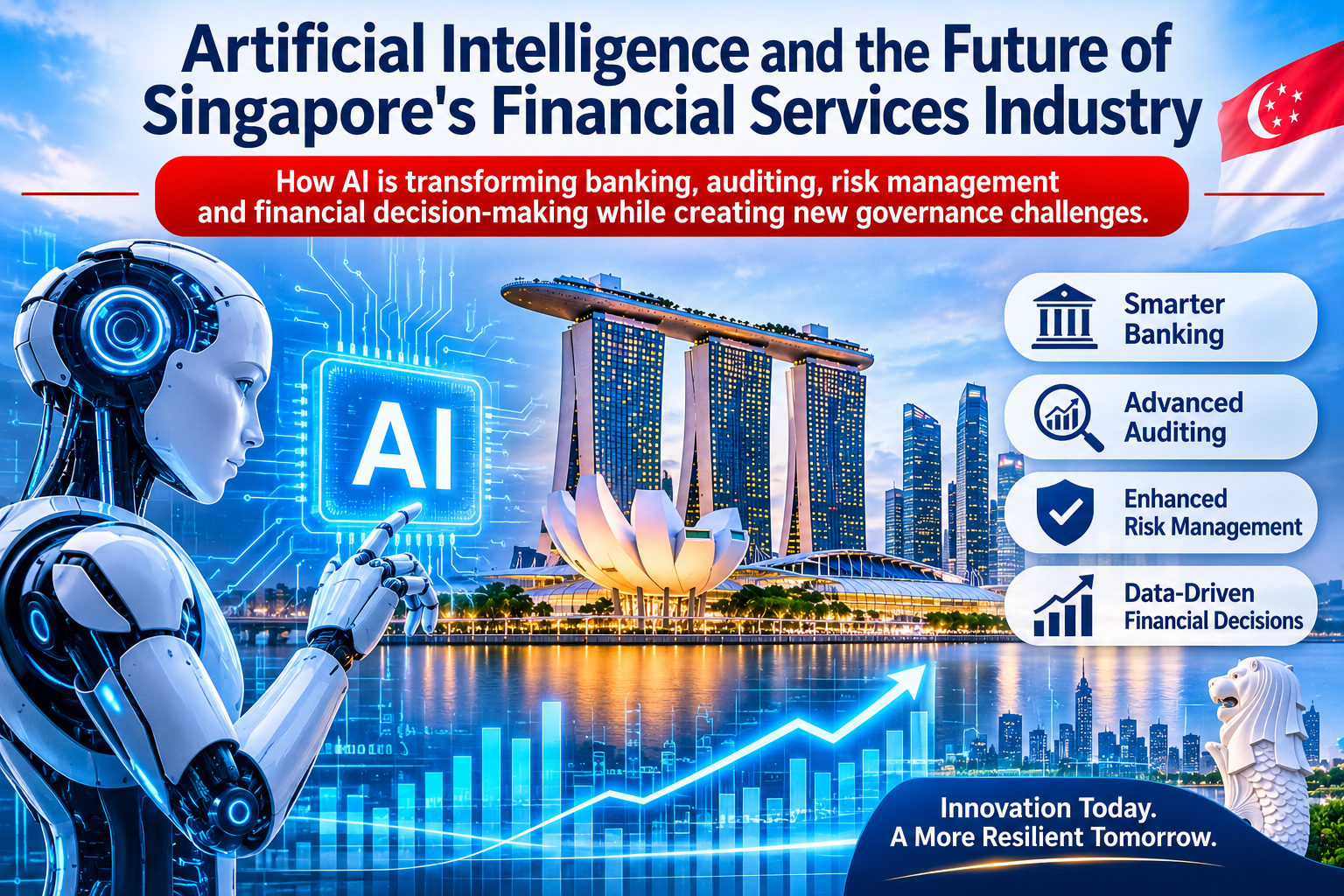
How AI is transforming banking, auditing, risk management and financial decision-making while creating new governance challenges.
Introduction
Artificial intelligence is changing how businesses operate, compete and make decisions. In the financial services industry, its applications range from automated customer service and fraud detection to credit assessment, investment research and regulatory compliance.
Singapore is positioning itself to benefit from this transformation through technology investment, financial innovation and regulatory development.
For a country whose economy depends heavily on international financial services, the responsible adoption of artificial intelligence is becoming a strategic priority.
AI in Singapore’s financial sector
Singapore’s financial institutions are increasingly exploring AI to improve productivity, customer experience and risk management.
Traditional financial operations involve processing large amounts of information. AI systems can analyse this information, identify patterns and support decisions at a speed that may be difficult to achieve through manual processes.
Applications include:
- Automated customer support.
- Fraud and suspicious transaction detection.
- Credit-risk assessment.
- Investment research.
- Financial forecasting.
- Regulatory compliance.
- Document processing.
- Cybersecurity monitoring.
AI can also support operational functions such as reconciliation, financial reporting and management accounting.
AI in banking and lending
Banks can use AI models to analyse customer information and assess credit risk.
Traditional credit assessment may depend heavily on financial statements, credit history and collateral.
AI-supported systems can analyse additional information, identify patterns and assist in evaluating repayment capacity.
However, automated credit decisions must be carefully controlled.
If a model relies on biased or incomplete information, it may produce unfair outcomes.
Financial institutions therefore need to evaluate model accuracy, data quality, fairness and explainability.
AI in auditing and accounting
Artificial intelligence has significant potential in accounting and auditing.
Audit teams can use data analytics and machine-learning tools to examine large transaction populations.
For example, AI-assisted systems may help identify:
- Duplicate payments.
- Unusual journal entries.
- Suspicious vendor transactions.
- Unusual changes in account balances.
- Potential revenue-recognition anomalies.
- Procurement irregularities.
This can improve audit planning and help professionals focus on higher-risk areas.
However, technology does not replace professional judgement. Auditors must still obtain appropriate evidence and evaluate the reliability of automated outputs.
For cost and management accountants, AI can support budget preparation, variance analysis, cost forecasting and performance monitoring.
AI in investment management
Investment managers can use AI to analyse market data, assess risk and support portfolio construction.
Natural-language processing may also help process financial reports, corporate announcements and economic information.
However, financial markets are influenced by unexpected events, human behaviour and geopolitical developments.
AI models trained on historical data may not perform reliably under completely different market conditions.
Investors should therefore avoid treating AI-generated forecasts as guaranteed predictions.
Singapore’s AI regulatory approach
Singapore’s regulatory approach increasingly emphasises responsible AI adoption.
The Monetary Authority of Singapore issued its Guidelines on Artificial Intelligence Risk Management for Financial Institutions on 7 October 2026.
These guidelines establish supervisory expectations concerning AI governance, risk management, policies, procedures and controls across the AI lifecycle.
They apply to financial institutions and are scheduled to take effect on 7 October 2027. mas.gov.sg+1
This is an important development because AI systems can influence financial decisions that affect customers, investors and the wider economy.
Key risks of AI adoption
1. Data privacy
Financial institutions handle sensitive customer information. AI systems must be supported by appropriate data protection and access controls.
2. Model risk
An inaccurate model may produce incorrect credit assessments, forecasts or fraud alerts.
3. Algorithmic bias
Poor-quality training data can lead to unfair decisions affecting certain customer groups.
4. Cybersecurity
AI systems can introduce additional vulnerabilities and may be exposed to sophisticated attacks.
5. Accountability
Financial institutions must clearly establish who is responsible for decisions supported by AI.
6. Overdependence
Employees may accept automated recommendations without sufficiently evaluating their accuracy.
The changing role of finance professionals
AI will change the nature of accounting and finance work.
Routine activities such as data entry, invoice processing, basic reconciliations and standard report preparation may become increasingly automated.
As a result, finance professionals will need to focus more on:
- Financial interpretation.
- Risk assessment.
- Business advisory.
- Internal control evaluation.
- Data analytics.
- Strategic decision-making.
- Technology governance.
Professional qualifications will remain valuable, but technological competence will become increasingly important.
Opportunities for India
India has a large financial services industry and a rapidly expanding technology sector.
Cooperation with Singapore can create opportunities in AI research, financial compliance technology, digital banking and cybersecurity.
Indian accounting firms can also explore AI-assisted audit and financial analysis solutions.
However, businesses must invest in data governance, professional training and appropriate human oversight.
Conclusion
Artificial intelligence has the potential to transform Singapore’s financial services industry by improving efficiency, strengthening risk detection and supporting better decision-making.
Nevertheless, the long-term success of AI will depend on transparency, security, fairness and accountability.
Singapore’s regulatory focus demonstrates that innovation and supervision must develop together.
About Author:-
CMA Vivek Kumar (ACMA), an Associate Member of ICMAI and B.Com (Accounting Honours) graduate, is an author, finance professional, and Founder of VK Chartered Academy (www.cacmacstestseries.com). He specializes in statutory and tax audits, taxation, financial reporting, GST advisory, and corporate compliance. He also mentors CA, CMA, and CS aspirants through structured academic guidance and exam-oriented test series, bridging practical industry expertise with professional education. Email: cmavivek2026@gmail.com