How a small Asian economy became a preferred destination for global capital, family offices and international investors.
Singapore’s rise as a wealth management centre is one of the most interesting developments in modern international finance. Despite having a relatively small domestic economy and limited natural resources, the country has developed a sophisticated financial ecosystem that attracts international investors, wealthy families, institutional funds and global financial institutions.
Its success is not based on a single tax advantage or financial product. Rather, it reflects a combination of political stability, regulatory credibility, strong institutions, international connectivity and a professional services ecosystem.
From trading port to global financial centre
Singapore’s transformation began with its strategic position along major international shipping routes. Over time, the country moved beyond trade and logistics to develop banking, insurance, capital markets and investment management.
Today, Singapore competes with established wealth management centres such as Switzerland, London, Hong Kong and New York. Its location provides access to rapidly growing Asian economies, particularly Southeast Asia, China and India.
The Monetary Authority of Singapore (MAS) plays an important role in this development. As Singapore’s central bank and integrated financial regulator, MAS supervises financial institutions, promotes financial stability and supports responsible innovation.
The scale of Singapore’s wealth management industry
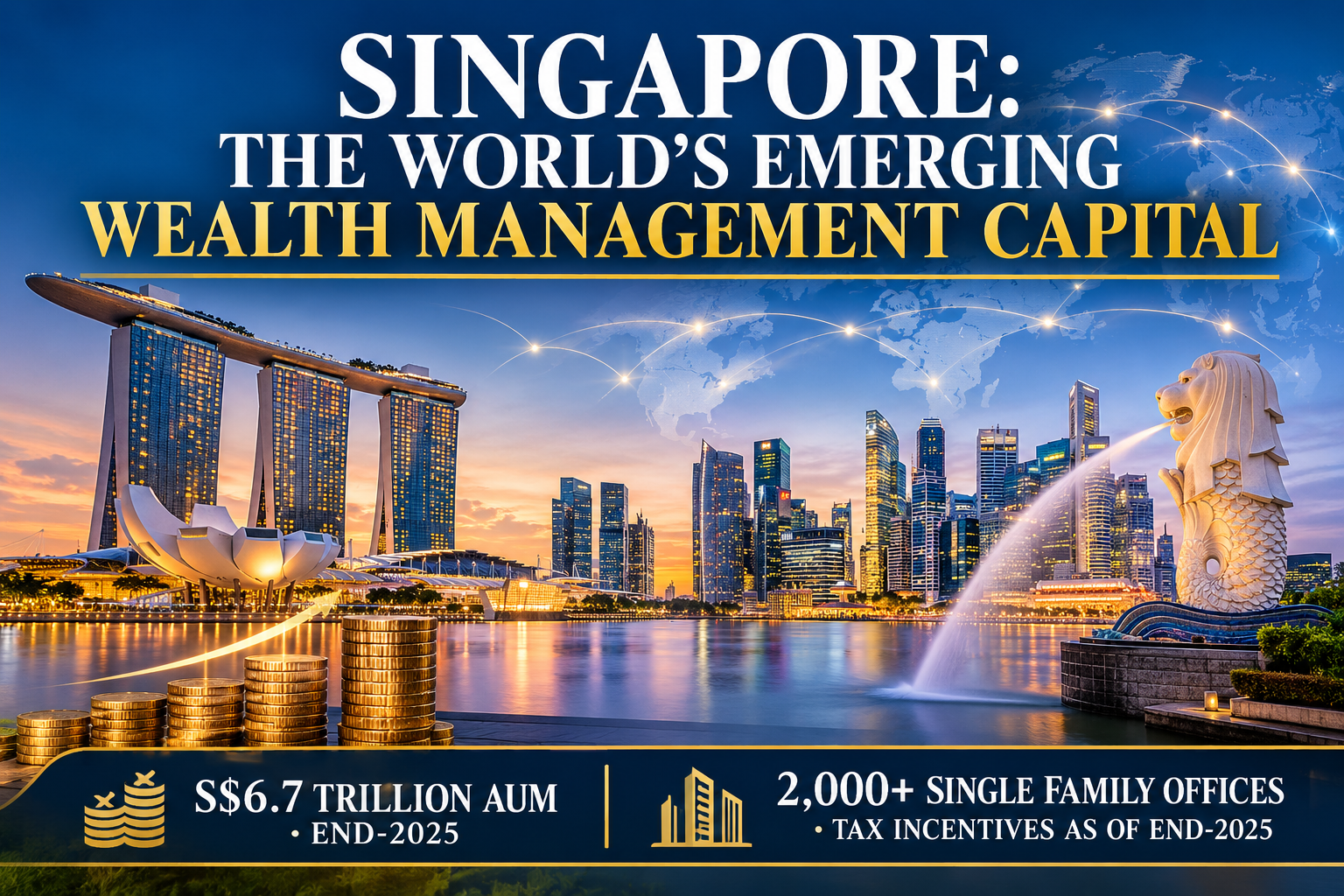
The growth of the sector is reflected in the latest available financial figures. Singapore’s assets under management reached approximately S$6.7 trillion at the end of 2025, representing annual growth of 10.1%.
Furthermore, more than 2,000 single-family offices received tax incentives under Singapore’s relevant fund schemes as of December 2025.
These figures demonstrate that Singapore is not merely attracting wealthy individuals. It is becoming an important location for managing international investment portfolios and family wealth. mas.gov.sg+1
Why international investors choose Singapore
1. Political and regulatory stability
Investors generally prefer jurisdictions where property rights, contractual obligations and regulatory requirements are predictable. Singapore’s established legal framework and regulatory institutions help create confidence among international investors.
2. Access to Asian markets
Singapore provides a convenient base for investors seeking exposure to Southeast Asia and other Asian economies. Fund managers can coordinate investments across multiple countries while operating from a well-connected financial centre.
3. Professional services ecosystem
Wealth management requires more than investment advice. It involves tax planning, accounting, legal structuring, estate planning, compliance, risk management and succession planning.
Singapore has developed an extensive network of banks, asset managers, law firms, accounting firms and specialist service providers to support these requirements.
4. International connectivity
Singapore’s infrastructure, global banking relationships and skilled workforce make it attractive for international financial institutions and investment professionals.
The growing importance of family offices
A family office is an organisation established to manage the financial and administrative affairs of a wealthy family. Its responsibilities can include portfolio management, estate planning, philanthropy, tax coordination and succession planning.
Singapore has become a prominent destination for family offices because it combines investment opportunities with access to professional advisers and established regulatory structures.
The growth of family offices also creates opportunities for accountants, cost and management accountants, auditors, lawyers, compliance professionals and fund administrators.
However, a family office must not be viewed simply as a tax-saving arrangement. It requires appropriate governance, documented investment policies, financial controls and compliance with applicable laws.
Tax incentives and investment structures
Singapore offers fund tax incentive frameworks, including Sections 13O and 13U of its Income Tax Act, subject to qualifying conditions.
These frameworks can support eligible fund structures and encourage investment management activities in Singapore.
The Variable Capital Company (VCC) framework is another important development. It offers a corporate structure designed for investment funds, including umbrella structures with separate sub-funds.
For international investors, the combination of investment structures, professional services and regulatory oversight provides flexibility.
However, eligibility conditions, economic substance requirements, reporting obligations and tax rules must be carefully examined before establishing any structure.
Risks and challenges
Singapore’s wealth management industry also faces significant challenges.
First, international tax transparency and anti-money laundering requirements are becoming increasingly important. Financial institutions must conduct appropriate customer due diligence and monitor transactions.
Second, geopolitical uncertainty and changing global tax regulations can influence the movement of capital.
Third, competition from Hong Kong, Switzerland and other financial centres requires Singapore to continuously improve its financial products, talent pool and regulatory environment.
Finally, the rapid growth of wealth management increases the importance of cybersecurity, investment risk management and protection against financial misconduct.
Opportunities for India
Singapore’s experience offers several lessons for India.
India has a large and growing population of entrepreneurs, wealthy families and institutional investors. As domestic wealth expands, demand for professional wealth management, succession planning, investment governance and financial advisory services is likely to increase.
India can learn from Singapore’s emphasis on regulatory credibility, skilled financial professionals, efficient administration and integrated professional services.
There are also opportunities for Indian accounting and consulting firms to collaborate with Singapore-based institutions in areas such as international taxation, transfer pricing, financial reporting and cross-border investment compliance.
Conclusion
Singapore’s development as a wealth management centre demonstrates how a country can build international financial influence through strong institutions, professional expertise and a business-friendly regulatory environment.
Its approximately S$6.7 trillion in assets under management and growing family-office ecosystem reflect the scale of this transformation.
The next phase of growth will depend on maintaining investor confidence while addressing international tax transparency, financial crime risks, cybersecurity and global economic uncertainty.
For emerging economies such as India, Singapore provides an important example of how financial infrastructure and regulatory credibility can become powerful drivers of economic development.
About Author:-
CMA Vivek Kumar (ACMA), an Associate Member of ICMAI and B.Com (Accounting Honours) graduate, is an author, finance professional, and Founder of VK Chartered Academy (www.cacmacstestseries.com). He specializes in statutory and tax audits, taxation, financial reporting, GST advisory, and corporate compliance. He also mentors CA, CMA, and CS aspirants through structured academic guidance and exam-oriented test series, bridging practical industry expertise with professional education. Email: cmavivek2026@gmail.com