By CMA Manoj Kumar Singh | Fellow Member, ICMAI | Insolvency Professional | Author
Introduction
In today’s competitive business environment, managing costs has become essential for maintaining profitability, improving operational efficiency and ensuring long-term sustainability. Indian businesses, particularly manufacturing companies and Micro, Small and Medium Enterprises (MSMEs), face continuous pressure from rising raw material prices, labour expenses, energy costs, logistics charges and increasing market competition.
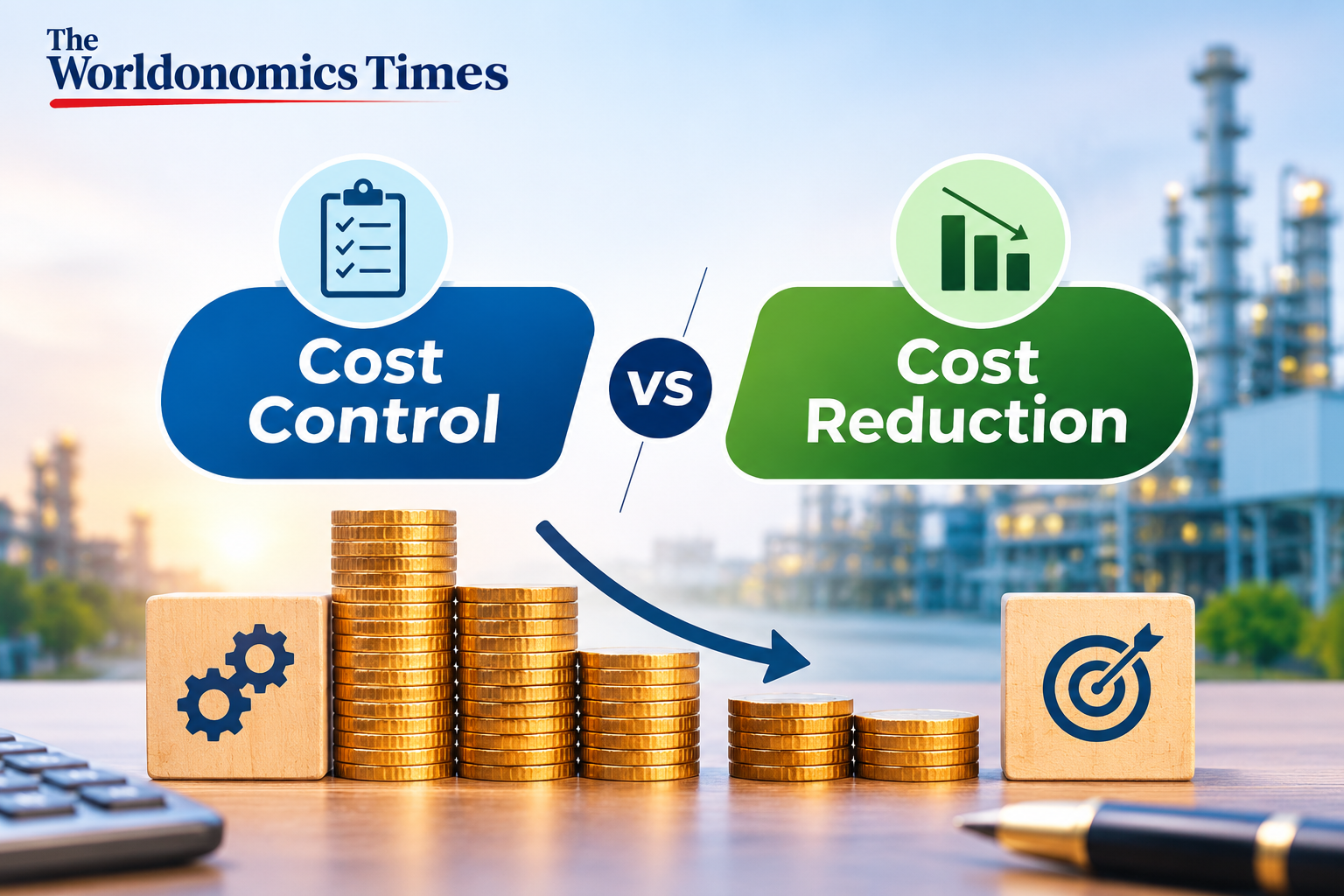
Two important concepts that help organisations manage their expenditure are Cost Control and Cost Reduction. Although these terms are often used interchangeably, they have different objectives, approaches and applications.
Understanding the distinction between cost control and cost reduction enables management to develop effective financial strategies and achieve sustainable business performance.
1. Understanding Cost Control
Cost Control refers to the systematic process of monitoring, regulating and managing business expenditure to ensure that actual costs remain within predetermined budgets or standards.
The primary objective is to prevent unnecessary expenditure and maintain financial discipline without compromising the quality of products or services.
Cost control generally involves establishing cost standards, preparing budgets, monitoring actual expenditure, analysing deviations and taking corrective action.
For example, a manufacturing company may establish a monthly electricity budget of ₹10 lakh. If actual electricity expenditure increases to ₹12 lakh, management investigates the reasons for the additional expenditure and takes corrective measures.
Important techniques of cost control include:
- Budgetary Control
- Standard Costing
- Variance Analysis
- Inventory Control
- Material and Labour Cost Monitoring
- Overhead Cost Control
- Internal Financial Controls
Cost control is therefore a continuous management activity that helps organisations maintain expenditure within acceptable limits.
2. Understanding Cost Reduction
Cost Reduction refers to achieving a genuine and sustainable decrease in the cost of producing goods or delivering services without adversely affecting their quality, utility, performance or suitability.
Unlike cost control, which focuses on maintaining costs within established limits, cost reduction aims to bring down the existing cost structure through improvements in processes, technology, resource utilisation and operational efficiency.
For example, a manufacturing company producing a product at ₹500 per unit may introduce improved production technology, reduce material wastage and optimise machine utilisation. If the production cost decreases to ₹450 per unit while maintaining the required quality, the company achieves cost reduction.
Common cost reduction strategies include:
- Process improvement and automation.
- Reduction of material wastage.
- Energy efficiency initiatives.
- Better procurement and supplier negotiations.
- Improved production planning.
- Optimisation of manpower utilisation.
- Elimination of non-value-added activities.
- Technology adoption and digital transformation.
Cost reduction is not simply about spending less; it is about achieving the same or better output with fewer resources.
3. Key Differences Between Cost Control and Cost Reduction
Both concepts contribute to financial efficiency, but their approaches differ.
| Basis | Cost Control | Cost Reduction |
|---|---|---|
| Objective | Maintain costs within standards | Reduce existing costs |
| Approach | Preventive and corrective | Improvement-oriented |
| Focus | Controlling expenditure | Eliminating unnecessary costs |
| Nature | Continuous monitoring | Continuous improvement |
| Standards | Uses predetermined standards | Challenges existing cost levels |
| Outcome | Cost discipline | Sustainable cost savings |
In simple terms, cost control ensures that expenditure does not exceed acceptable limits, whereas cost reduction focuses on lowering those limits through improved efficiency.
4. Importance for Indian Manufacturing Industries
India’s manufacturing sector plays an important role in employment generation, industrial development and economic growth. Increasing global competition makes efficient cost management essential for domestic manufacturers.
Cost control helps manufacturers monitor material consumption, labour expenses, production overheads and inventory levels.
Cost reduction, on the other hand, encourages businesses to adopt modern manufacturing techniques, improve capacity utilisation, minimise production wastage and invest in energy-efficient equipment.
For example, a manufacturing unit can use standard costing to identify excessive material consumption and subsequently introduce better production technology to reduce material requirements.
The combined application of both techniques improves productivity, protects profit margins and strengthens competitiveness.
5. Role of Cost Management in MSME Development
MSMEs frequently operate with limited financial resources and face challenges relating to working capital, input costs, technology adoption and market competition.
For these enterprises, effective cost control helps prevent unnecessary expenditure and maintain financial stability.
Cost reduction enables MSMEs to improve their production processes, negotiate better procurement terms, optimise inventory and reduce operational inefficiencies.
A properly designed costing system can also help MSMEs determine accurate product prices, identify profitable business segments and make informed investment decisions.
Professional guidance from Cost and Management Accountants can help small businesses establish appropriate costing systems and develop practical cost management strategies.
6. Role of Cost and Management Accountants
Cost and Management Accountants play an important role in designing and implementing cost control and cost reduction strategies.
Their responsibilities extend beyond recording expenditure and preparing cost statements. They analyse cost behaviour, evaluate operational performance, identify inefficiencies and provide management with meaningful financial information.
Through techniques such as marginal costing, standard costing, activity-based costing, budgeting and variance analysis, they help organisations understand the factors affecting profitability.
They can also support management in evaluating capital investment proposals, analysing product profitability and developing long-term cost optimisation strategies.
The growing importance of data analytics, ERP systems and artificial intelligence is further expanding the contribution of Cost and Management Accountants to strategic business management.
7. Building an Integrated Cost Management Strategy
Businesses should not treat cost control and cost reduction as competing approaches. Both are complementary and should form part of an integrated cost management framework.
An effective strategy should include:
- Establishing realistic cost standards and budgets.
- Monitoring actual costs against predetermined standards.
- Investigating significant cost variances.
- Identifying operational inefficiencies and wastage.
- Introducing technology and process improvements.
- Evaluating the financial impact of cost-saving initiatives.
- Regularly reviewing performance and revising cost strategies.
Management must ensure that cost-saving initiatives do not compromise employee safety, product quality, customer satisfaction or statutory compliance.
Conclusion
Cost Control and Cost Reduction are two essential pillars of effective financial and operational management. While cost control ensures expenditure discipline, cost reduction promotes continuous improvement and sustainable efficiency.
For Indian businesses operating in an increasingly competitive economic environment, combining these approaches can improve profitability, strengthen financial stability and enhance industrial competitiveness.
As India advances towards its vision of Viksit Bharat, organisations must recognise that efficient resource utilisation is as important as revenue growth.
Cost control protects profitability by preventing unnecessary expenditure, while cost reduction creates additional value by improving the way resources are utilised. Together, they form the foundation of sustainable business growth.