South Korea Crosses $1 Trillion Export Milestone as AI Boom Drives Semiconductor Demand and Reshapes International Trade
By The Worldonomics Times Editorial Desk
The global trade landscape is witnessing a significant transformation as rising demand for artificial intelligence (AI), advanced computing infrastructure, and semiconductor technology drives international exports. In a major development for global commerce, South Korea has crossed the $1 trillion mark in cumulative exports for the first time in its history, highlighting the growing importance of technology-driven industries in the modern global economy.
According to South Korea’s Ministry of Trade, Industry and Resources, the country achieved this milestone on November 19, 2026, becoming the fourth economy in the world to surpass $1 trillion in annual exports, following China, the United States, and Germany. The achievement reflects the strength of its export-oriented industrial base and the rapidly expanding global semiconductor market. Yonhap News Agency+1
The development also highlights how AI investment is reshaping international trade patterns, creating new opportunities for technology manufacturers while increasing competition among major exporting economies.
Semiconductor Industry Becomes the Driving Force
Semiconductors have emerged as the primary engine behind South Korea’s exceptional export performance.
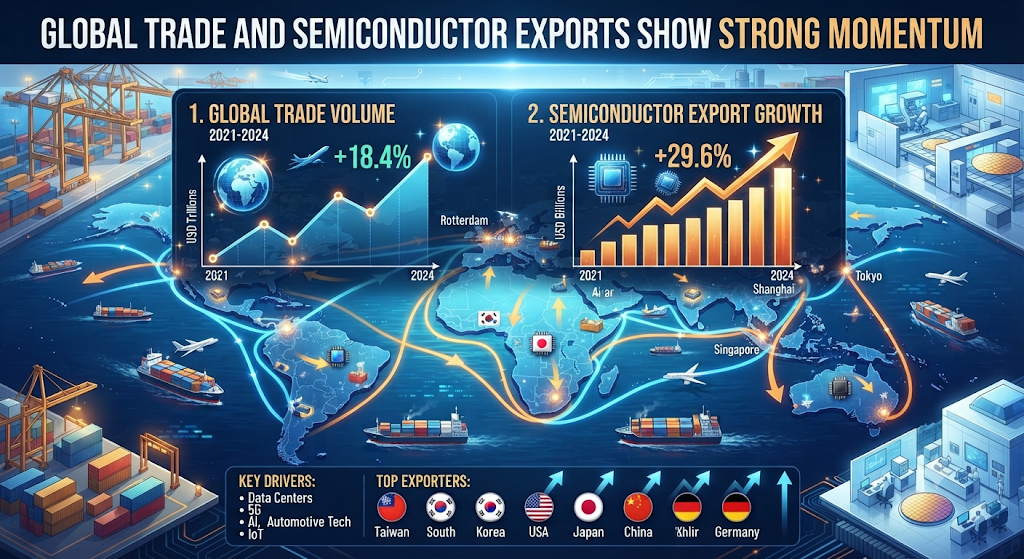
The increasing adoption of artificial intelligence across industries has created substantial demand for advanced chips, high-bandwidth memory, data-centre infrastructure, and computing equipment. Major technology companies are expanding investments in AI infrastructure, creating opportunities for semiconductor manufacturers.
South Korea’s semiconductor exports reached approximately $397.7 billion during January–October 2026, nearly three times the corresponding figure from the previous year. Semiconductors accounted for approximately 42.7% of the country’s total exports during this period. Yonhap News Agency
Leading Korean technology companies, including Samsung Electronics and SK Hynix, play an important role in supplying memory chips and other semiconductor products to international markets.
The growing importance of these products demonstrates that semiconductors are no longer simply components used in electronic devices. They have become essential infrastructure for artificial intelligence, cloud computing, telecommunications, automobiles, defence systems, and advanced manufacturing.
As a result, countries with strong semiconductor manufacturing capabilities are gaining greater influence in international trade and global technology supply chains.
Artificial Intelligence Is Transforming Global Trade
The rapid expansion of artificial intelligence is changing the structure of international commerce.
Technology companies across the United States, China, Europe, and Asia are investing heavily in data centres, AI computing systems, and advanced semiconductor technologies. These developments are increasing demand for specialised chips, memory products, servers, networking equipment, and electronic components.
This growing demand is creating fresh export opportunities for countries that manufacture advanced technological products.
South Korea’s export performance demonstrates how investments in emerging technologies can translate into substantial trade growth. It also reflects a broader shift in global trade, where technology-intensive products are becoming increasingly important alongside traditional commodities and manufactured goods.
Global Supply Chains Face New Opportunities and Challenges
The semiconductor boom is also changing international supply-chain strategies. Countries are increasingly recognising the importance of securing reliable access to advanced chips and electronic components.
The United States, China, Japan, South Korea, Taiwan, and several European economies are investing in semiconductor manufacturing, research, and technological infrastructure to strengthen their domestic capabilities.
However, the industry faces several challenges, including geopolitical tensions, export restrictions, trade protectionism, and competition over access to advanced manufacturing technologies.
The concentration of semiconductor production in a limited number of economies also creates supply-chain vulnerabilities. Any disruption caused by political tensions, natural disasters, or manufacturing difficulties could affect industries across the world.
Consequently, governments and multinational companies are increasingly exploring supply-chain diversification to reduce their dependence on individual markets.
Traditional Industries Also Contribute to Export Growth
Although semiconductors have been the leading contributor to South Korea’s export expansion, other industries continue to play an important role in its international trade performance.
Shipbuilding, petrochemicals, automobiles, display panels, cosmetics, and pharmaceuticals contribute to the country’s diversified manufacturing base.
This industrial diversity provides South Korea with additional opportunities to strengthen its international market position.
Nevertheless, traditional export sectors are facing challenges from international competition, changing trade policies, rising production costs, and geopolitical uncertainty.
The government has emphasised the importance of developing additional growth industries, including artificial intelligence, biotechnology, defence products, and nuclear technology, to reduce excessive dependence on semiconductor exports. Yonhap News Agency
Implications for India and Emerging Economies
South Korea’s export milestone offers important lessons for emerging economies, particularly India.
India has been strengthening its position in electronics manufacturing, semiconductor development, digital infrastructure, and technology services. Growing global demand for electronic components and advanced computing systems could create significant opportunities for Indian manufacturers and exporters.
Government initiatives supporting domestic manufacturing, electronics production, infrastructure development, and semiconductor investment could help India become a stronger participant in international technology supply chains.
However, building a competitive semiconductor ecosystem requires substantial capital investment, skilled professionals, advanced research facilities, reliable infrastructure, and long-term policy support.
Emerging economies must also focus on developing domestic capabilities rather than relying entirely on imported technology.
Expanding international partnerships, encouraging private-sector investment, and strengthening technical education will be important steps towards improving their global competitiveness.
Global Trade Outlook: Technology at the Centre of Economic Growth
The latest developments suggest that technology will remain a major driver of international trade in the coming years.
Artificial intelligence, semiconductor manufacturing, electric vehicles, cloud computing, robotics, and advanced electronics are expected to influence investment decisions and trade relationships across major economies.
Countries that successfully develop competitive technology industries may gain advantages in export markets, employment generation, industrial productivity, and economic growth.
However, the global semiconductor industry must also navigate cyclical demand, price volatility, excess production capacity, and increasing geopolitical competition.
South Korea’s achievement demonstrates the economic potential of technology-led exports, but maintaining this momentum will require continuous innovation, industrial diversification, and stable international trade relationships.
The Worldonomics Times View
The Worldonomics Times believes that South Korea’s achievement of crossing the $1 trillion export milestone represents more than an impressive trade statistic. It reflects a fundamental transformation in the global economy, where technological capabilities, innovation, and advanced manufacturing are becoming central pillars of international competitiveness.
The semiconductor industry has emerged as a strategic economic sector, supporting developments in artificial intelligence, telecommunications, healthcare, transportation, defence, and modern industrial infrastructure.
However, the growing dependence on semiconductor exports also presents risks. Excessive concentration in one industry can expose an economy to market fluctuations, changing technology cycles, and international trade disputes.
South Korea must therefore continue strengthening its traditional manufacturing sectors while expanding investment in emerging industries such as biotechnology, clean energy, robotics, and artificial intelligence.
For India and other developing economies, this development offers an important lesson: long-term export success requires more than competitive labour costs or natural resources. It requires technological innovation, strong manufacturing infrastructure, skilled human capital, and consistent economic policies.
Governments should encourage research and development, support domestic manufacturers, attract international investment, and create favourable conditions for technology-driven businesses.
The Worldonomics Times believes that the future of global trade will increasingly belong to economies that can combine technological innovation with manufacturing excellence and international cooperation.
South Korea’s $1 trillion milestone is a powerful example of this transformation. As artificial intelligence continues to reshape industries, semiconductor manufacturing and advanced technology exports are likely to remain among the most influential forces driving international commerce and economic growth.