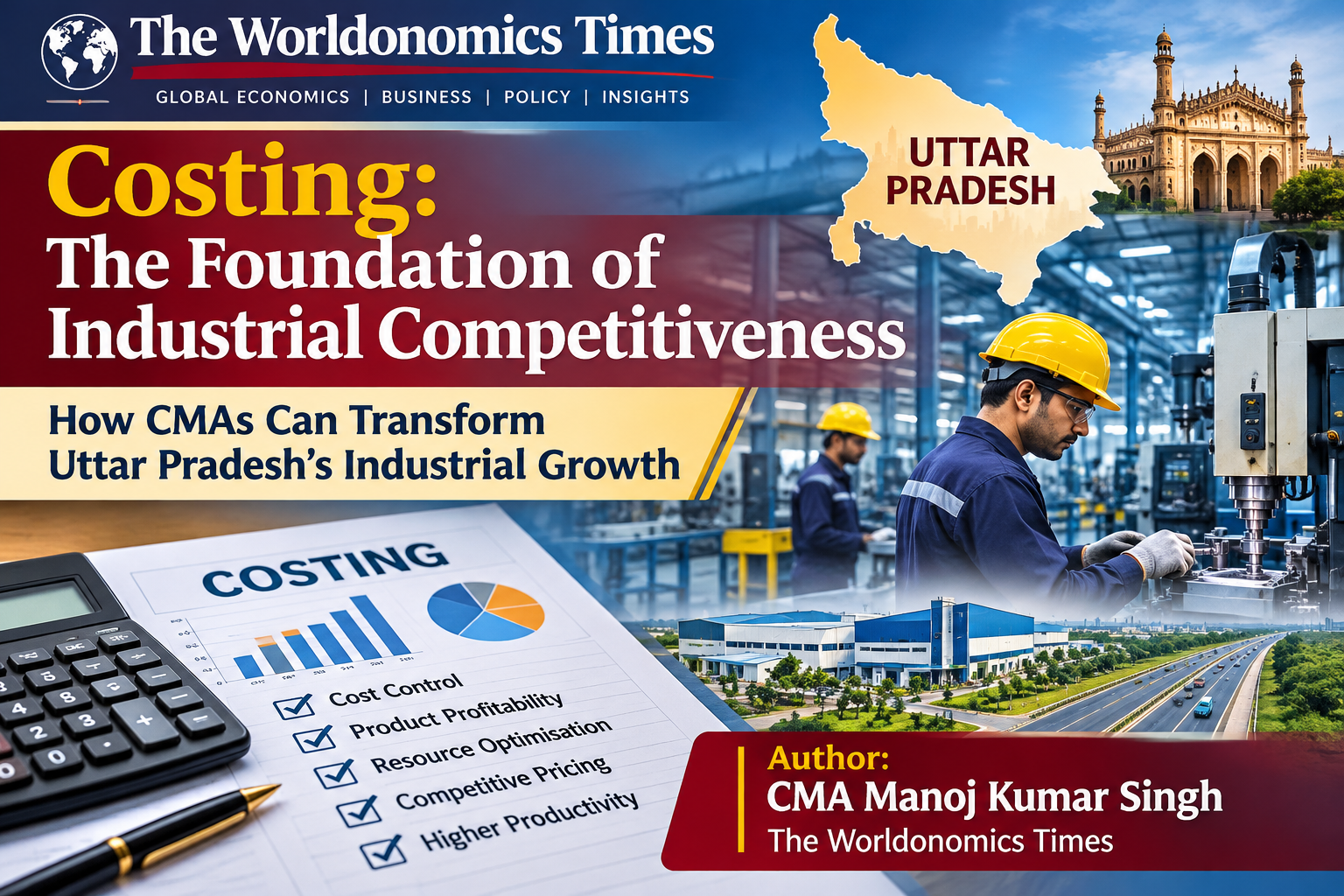
Costing: The Foundation of Industrial Competitiveness – How CMAs Can Transform Uttar Pradesh’s Industrial Growth
By The Worldonomics Times
Introduction
Uttar Pradesh is steadily emerging as one of India’s most promising industrial and investment destinations. With a diverse industrial ecosystem covering manufacturing, textiles, food processing, engineering, electronics, pharmaceuticals, automobiles, handicrafts and emerging technology sectors, the state has significant potential to become a major contributor to India’s economic growth.
Industrial expansion, however, is not determined by investment and production capacity alone. Sustainable competitiveness depends on how efficiently an enterprise manages its resources, controls production costs, improves productivity and generates profitability.
In an increasingly competitive domestic and global marketplace, businesses must understand not only how much they produce but also how much it actually costs to produce each unit.
This makes costing a fundamental pillar of industrial competitiveness and places Cost and Management Accountants (CMAs) at the centre of industrial transformation.
1. Why Costing Matters for Industrial Growth
Every manufacturing enterprise operates with multiple cost components, including raw materials, labour, electricity, machinery, transportation, maintenance, packaging and administrative expenses.
Without a systematic costing mechanism, management may struggle to identify the actual cost of production, product-wise profitability and operational inefficiencies.
Scientific costing enables businesses to answer critical management questions:
- What is the actual cost of manufacturing a product?
- Which product or production line generates the highest profitability?
- Where are resources being wasted?
- How can operational expenses be reduced?
- What should be the competitive selling price?
- How can productivity improve without compromising quality?
Costing transforms financial and operational information into meaningful management decisions. It helps enterprises identify inefficiencies, eliminate unnecessary expenditure and improve resource utilisation.
For Uttar Pradesh, where traditional industries and modern manufacturing facilities operate alongside one another, the adoption of professional costing systems can create significant opportunities for productivity improvement.
2. Uttar Pradesh’s Industrial Ecosystem and the Need for Cost Competitiveness
Uttar Pradesh has several important industrial clusters and sector-specific opportunities.
The state’s One District One Product (ODOP) initiative has created greater visibility for traditional products and local manufacturing capabilities. Industries such as leather, brassware, carpets, textiles, food processing, pottery and handicrafts have the potential to expand their presence in national and international markets.
At the same time, investments in electronics manufacturing, defence production, automobile components, pharmaceuticals and industrial infrastructure are creating opportunities for modern manufacturing.
Each sector faces different cost-management challenges.
For example:
Textile Industry: Raw material costs, labour productivity, power consumption, wastage and inventory management significantly influence profitability.
Food Processing: Procurement prices, processing losses, packaging, storage, transportation and distribution costs determine product competitiveness.
Electronics Manufacturing: Component costs, production efficiency, quality control, technology investments and supply chain management require close monitoring.
Leather Industry: Material utilisation, chemical consumption, labour costs, environmental compliance and production wastage affect manufacturing margins.
Engineering and Automobile Components: Machine utilisation, production cycle time, maintenance, rejection rates and material consumption influence overall manufacturing costs.
A professional costing framework can help enterprises in these sectors identify cost drivers and develop appropriate strategies for sustainable growth.
3. Role of CMAs in Introducing Scientific Costing Systems
Cost and Management Accountants possess specialised knowledge of cost accounting, financial management, budgeting, performance measurement and business strategy.
Their role extends beyond the preparation of cost statements. They can help industrial enterprises establish integrated cost-management systems that support strategic decision-making.
Some important costing techniques include:
A. Standard Costing
Standard costing establishes predetermined costs for materials, labour and overheads.
By comparing actual costs with standard costs, management can identify variances and investigate their causes.
For example, if a manufacturing unit consumes more raw material than the standard quantity, a CMA can analyse the reasons, identify production inefficiencies and recommend corrective measures.
B. Activity-Based Costing
Activity-Based Costing (ABC) assigns costs to products and services based on the activities that consume resources.
This approach is particularly useful for enterprises manufacturing multiple products with different production requirements.
It helps management understand the actual cost of individual products and avoid incorrect pricing decisions.
C. Marginal Costing
Marginal costing helps management understand the relationship between variable costs, fixed costs, contribution and profitability.
It supports decisions relating to product mix, capacity utilisation, special orders, pricing and make-or-buy alternatives.
D. Budgetary Control
Budgetary control enables businesses to establish financial and operational targets.
CMAs can prepare production budgets, material budgets, labour budgets, overhead budgets and cash flow forecasts.
Regular comparison of actual performance with budgets helps management maintain financial discipline.
E. Life-Cycle Costing
Life-cycle costing considers costs throughout the life of a product, including design, manufacturing, distribution, maintenance and disposal.
This approach can support better investment decisions and encourage sustainable manufacturing practices.
4. Cost Reduction Without Compromising Quality
One of the biggest misconceptions in business management is that cost reduction necessarily means reducing product quality.
In reality, effective cost management focuses on eliminating waste, improving processes and optimising resource utilisation.
CMAs can help enterprises identify opportunities through:
- Reduction in material wastage.
- Better inventory planning.
- Improved machine utilisation.
- Energy consumption monitoring.
- Process standardisation.
- Reduction in production rejection rates.
- Efficient manpower deployment.
- Supply chain cost optimisation.
For instance, a manufacturing unit may discover through cost analysis that excessive electricity consumption, idle machinery or inefficient material handling is increasing its production cost.
By introducing appropriate operational controls, the enterprise can improve profitability without compromising product standards.
This is particularly important for Uttar Pradesh’s MSMEs, which often operate with limited financial resources and face intense price competition.
5. Costing and MSME Competitiveness
MSMEs are an important part of Uttar Pradesh’s industrial and entrepreneurial ecosystem.
Many small enterprises possess strong manufacturing capabilities but lack formal cost-accounting systems and professional financial management.
Business owners frequently determine selling prices based on market competition rather than a detailed understanding of product costs.
This can result in underpricing, lower profit margins, cash flow difficulties and financial instability.
CMAs can support MSMEs through:
- Product-wise cost sheets and profitability analysis.
- Working capital and inventory management.
- Identification of avoidable operating expenses.
- Financial budgeting and business forecasting.
- Machinery investment and capacity utilisation analysis.
- Pricing strategies and contribution analysis.
- Management information systems.
- Cost optimisation and productivity improvement.
Professional cost-management support can help small enterprises transition from informal business practices to structured and financially sustainable operations.
It can also strengthen their readiness to participate in government procurement, institutional supply chains and export markets.
6. Cost Competitiveness and Global Markets
For Uttar Pradesh to become a major export-oriented manufacturing destination, its industries must compete with international manufacturers on price, quality, delivery timelines and operational efficiency.
International buyers increasingly evaluate suppliers on product quality, consistency, reliability and total procurement costs.
Scientific costing can help businesses understand their complete cost structure, including:
- Manufacturing costs.
- Packaging and logistics.
- Warehousing and distribution.
- Export documentation and compliance.
- Quality assurance.
- Currency-related financial risks.
- Marketing and distribution margins.
CMAs can help businesses prepare export cost sheets, assess international pricing opportunities and evaluate the financial viability of entering new markets.
Better cost management can therefore strengthen the global competitiveness of Uttar Pradesh’s products, including ODOP products and manufactured goods.
7. Technology, Digitalisation and the Future of Cost Management
The future of industrial costing will increasingly depend on digital technologies.
Enterprise Resource Planning (ERP), Artificial Intelligence (AI), automation, data analytics and real-time production monitoring are changing the way businesses collect and analyse operational information.
Modern costing systems can integrate data from procurement, inventory, production, sales and finance departments.
CMAs can play an important role in implementing these systems and converting business data into actionable management insights.
For example, real-time cost dashboards can help management monitor:
- Material consumption against standards.
- Product-wise profitability.
- Production efficiency.
- Machine downtime.
- Inventory turnover.
- Energy consumption.
- Department-wise expenditure.
This will enable enterprises to move from traditional retrospective accounting towards proactive and data-driven cost management.
8. Building a CMA-Led Industrial Productivity Framework in Uttar Pradesh
To maximise the contribution of CMAs, a structured collaboration between professional institutions, industrial associations, government agencies and MSME organisations can be encouraged.
Some possible initiatives include:
CMA Industrial Cost Clinics: Professional advisory centres to help MSMEs understand production costs, pricing and profitability.
Industrial Cost Benchmarking: Sector-wise studies comparing production costs, resource utilisation and operational efficiency.
MSME Productivity Improvement Programmes: Practical interventions to reduce material wastage, improve inventory management and enhance manufacturing productivity.
Cost Management Awareness Workshops: Programmes for industrial entrepreneurs covering scientific costing, budgeting, financial planning and business performance.
CMA Industry Partnership Network: Connecting qualified CMAs with manufacturing clusters, industrial associations and emerging enterprises.
Such initiatives can create professional opportunities while strengthening the state’s industrial competitiveness.
Conclusion: Making Costing a Strategic Priority
Uttar Pradesh has the opportunity to become one of India’s leading manufacturing and industrial growth centres. However, achieving this ambition requires enterprises to focus not only on increasing production but also on improving the efficiency and profitability of every unit produced.
Scientific costing provides the foundation for better pricing, efficient resource allocation, productivity improvement and sustainable business growth.
Cost and Management Accountants can serve as strategic partners in this transformation by introducing professional costing systems, strengthening financial management and helping enterprises make informed business decisions.
The future of industrial competitiveness will not be determined solely by the size of factories or the volume of investment. It will also depend on how effectively businesses manage their costs, resources and operational performance.
For Uttar Pradesh, the message is clear: Costing is not merely an accounting function; it is a strategic instrument for industrial excellence.