Singapore | November 25, 2026
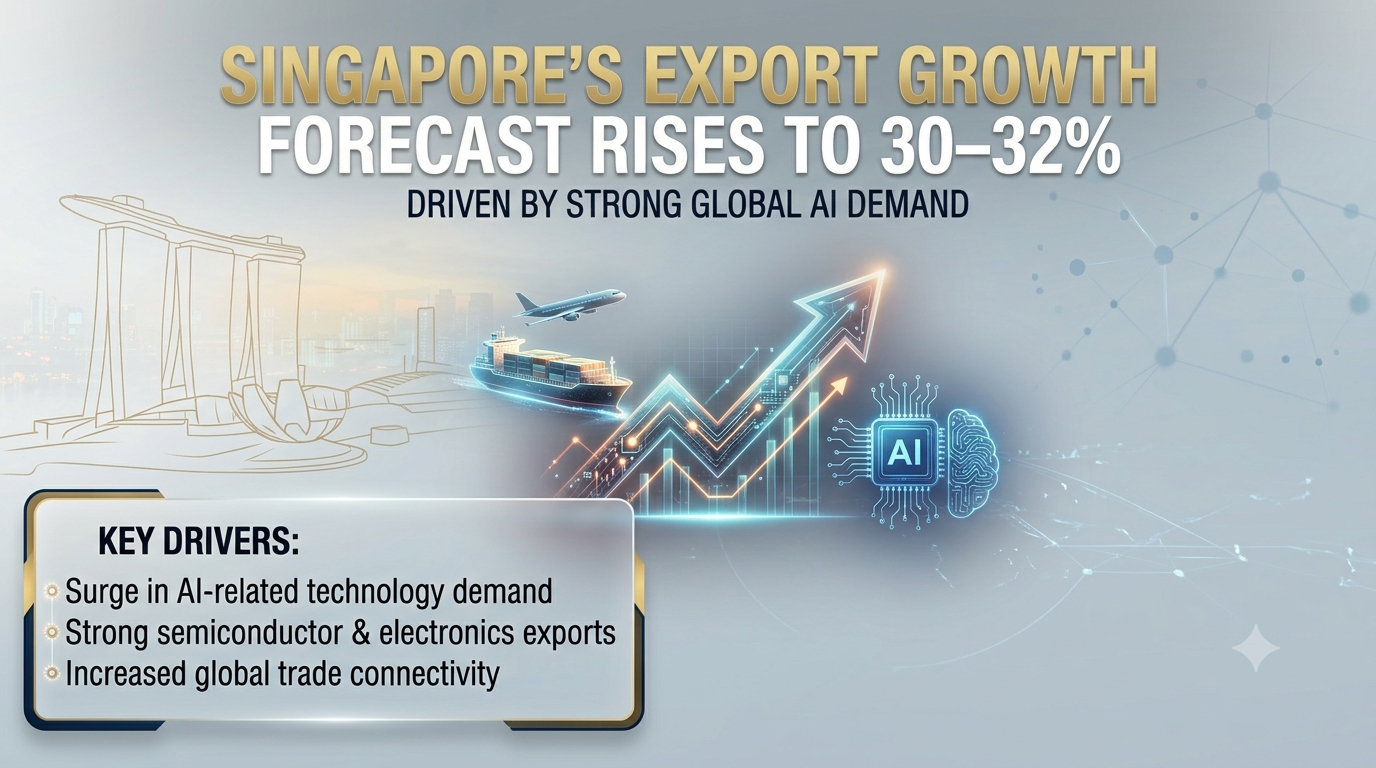
Singapore has significantly upgraded its 2026 non-oil domestic exports (NODX) growth forecast to between 30% and 32%, reflecting exceptional export performance and rising global demand for artificial intelligence (AI)-related products. The revised outlook highlights Singapore’s growing importance in global technology supply chains, particularly in electronics, semiconductors, specialised machinery and pharmaceutical products.
The announcement, made by Enterprise Singapore on November 24, comes after the country recorded remarkable export growth during the first three quarters of 2026. The latest revision represents a substantial increase from the previous forecast of 14% to 16%, demonstrating the strength of Singapore’s external trade performance.
However, authorities expect export growth to moderate considerably in 2027, with NODX projected to expand by 5% to 7% as the global economy adjusts to a higher growth base and the pace of AI-related investment normalises.
Record Export Performance Strengthens Economic Outlook
Singapore’s export sector has experienced an exceptional year in 2026. Non-oil domestic exports increased by 45.8% year-on-year in the third quarter, following growth of 27.4% in the second quarter.
For the first nine months of 2026, NODX expanded by 27.6%, marking a record performance.
The strong results reflect increasing international demand for advanced electronic components, semiconductor products, computer equipment and specialised industrial machinery.
Singapore’s strategic position as a major international trading and manufacturing hub has enabled its businesses to benefit from the rapid expansion of global technology investments.
The United States, China and Taiwan emerged as important contributors to export growth during the third quarter. Exports to the United States increased by 74.4%, while shipments to China and Taiwan grew by 46.6% and 58.5%, respectively. The Straits Times+1
AI Demand Becomes the Biggest Growth Driver
The global artificial intelligence boom has become one of the most important factors supporting Singapore’s export expansion.
As technology companies increase investments in data centres, advanced computing infrastructure and AI applications, demand for semiconductors, integrated circuits, storage equipment and other electronic components has risen significantly.
Singapore’s electronics exports recorded particularly strong growth, increasing by 117% in the third quarter of 2026. Shipments of disk media products surged by 313.7%, personal computers increased by 166.3%, and integrated circuit exports expanded by 83.2%.
These figures demonstrate how the global technology investment cycle is creating substantial opportunities for Singapore’s electronics manufacturers and exporters.
The country also benefits from its established semiconductor ecosystem, advanced production facilities, skilled workforce and strong international business relationships.
With AI infrastructure investments continuing across major economies, Singapore is expected to receive further support from international demand during the final quarter of 2026. CNA+1
Pharmaceutical and Non-Electronics Exports Add Support
Although electronics remain the primary driver of export growth, Singapore’s non-electronics industries are also contributing to the country’s strong trade performance.
Non-electronics NODX increased by 20.8% in the third quarter, compared with 8% growth in the preceding quarter.
Specialised machinery shipments expanded by 40.2%, while non-monetary gold exports increased by 70.1%.
Singapore’s pharmaceutical industry also remains an important component of its export-oriented manufacturing base. The country has developed strong capabilities in pharmaceutical production, biotechnology and advanced healthcare manufacturing, supported by multinational investments and established research infrastructure.
These industries help diversify Singapore’s export portfolio and reduce its dependence on a single manufacturing segment.
The continued development of pharmaceutical manufacturing, precision engineering and specialised industrial production will remain important for maintaining the country’s international competitiveness.
Global Trading Partners Strengthen Export Opportunities
Singapore’s export performance is closely connected to economic conditions in its major international markets.
The United States, China, Taiwan and South Korea remain important destinations for Singapore’s manufactured products and technology-related exports.
Strong demand from these markets has supported electronics shipments and strengthened Singapore’s position within international supply chains.
Total merchandise trade also increased by 44.4% in the third quarter of 2026, while total services trade expanded by 14.6%.
The growth demonstrates that Singapore is benefiting not only from manufacturing and goods exports but also from expanding international demand for financial, transport, business and other professional services. CNA+1
Export Growth Expected to Moderate in 2027
Despite the strong performance in 2026, Singapore’s trade authorities anticipate a slower pace of export expansion next year.
Enterprise Singapore expects non-oil domestic exports to grow by 5% to 7% in 2027, compared with the projected 30% to 32% expansion in 2026.
The moderation is largely expected to reflect a higher comparison base and the possibility that global AI-related investment growth will gradually ease.
There are also concerns about potential corrections in technology markets. If major technology companies reduce their investments in data centres, semiconductor infrastructure or advanced computing equipment, Singapore’s electronics exporters could experience weaker demand.
Geopolitical uncertainty presents another challenge. Prolonged conflict in the Middle East, changing international trade policies and disruptions to global supply chains could affect export activity.
Nevertheless, continued investment in digital infrastructure and the expansion of the global technology industry are expected to provide some support to international trade in 2027. The Business Times+1
Singapore Focuses on Long-Term Trade Competitiveness
Looking beyond the immediate export boom, Singapore is expected to focus on strengthening its manufacturing capabilities, attracting international investment and expanding its role in advanced technology supply chains.
Investment in semiconductor manufacturing, pharmaceutical production, biotechnology, precision engineering and digital infrastructure will remain important to the country’s long-term economic strategy.
The government is also expected to encourage businesses to adopt automation, artificial intelligence and advanced manufacturing technologies to improve productivity and operational efficiency.
For Singapore, the challenge will be to convert the current export momentum into sustainable economic opportunities rather than relying excessively on a temporary surge in global technology spending.
The country’s strong infrastructure, stable business environment, international connectivity and highly developed financial system provide an important foundation for achieving this objective.
As global trade patterns continue to evolve, Singapore’s ability to adapt to technological changes and diversify its export markets will play a crucial role in maintaining its position as one of Asia’s leading trading economies.
The Worldonomics Times View
Singapore’s upgraded export growth forecast is a strong indication of how artificial intelligence is transforming international trade and manufacturing. The country’s impressive export performance demonstrates the economic opportunities created by rising global demand for semiconductors, electronics and advanced technological equipment.
The Worldonomics Times believes that Singapore is benefiting from its strategic investments in manufacturing capabilities, international trade infrastructure and technological innovation. Its position within the global semiconductor and electronics supply chains provides a significant competitive advantage.
However, the projected moderation in 2027 should not be overlooked. An export boom driven heavily by AI investment also creates exposure to fluctuations in global technology spending. Any significant slowdown in data centre construction or semiconductor demand could affect manufacturing output and export revenues.
Singapore must therefore continue diversifying its economic strengths by supporting pharmaceutical manufacturing, biotechnology, precision engineering and high-value services.
The Worldonomics Times believes that the real test for Singapore will be its ability to transform exceptional export growth into long-term economic resilience. Sustainable competitiveness will depend on innovation, productivity, workforce development and a diversified export base.
The 2026 performance is an encouraging milestone, but Singapore’s long-term success will depend on how effectively it prepares for the next phase of global trade and technological transformation.