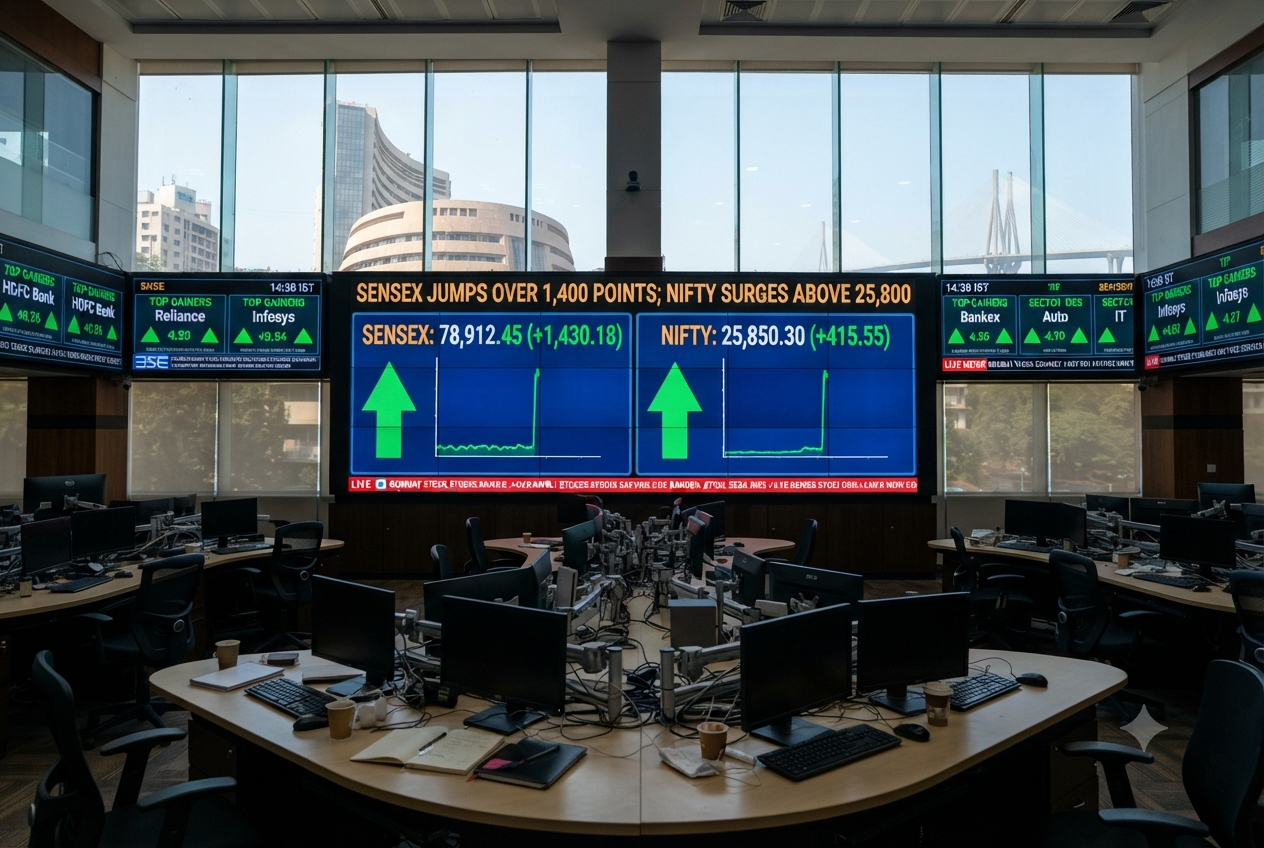
Indian equity markets staged a strong recovery on Wednesday, November 25, as benchmark indices advanced sharply after the previous session’s sell-off. The BSE Sensex surged more than 1,400 points in early trade, while the NSE Nifty 50 moved above the 25,800 mark during the morning session. Renewed foreign investor buying, easing crude oil prices and strong demand for heavyweight banking and information technology stocks supported the rally.
The Sensex was trading at 83,856.78 at 9:55 am, up 1,420.79 points or 1.72%. The Nifty stood at 25,775, gaining 425.35 points or 1.68% at the same time. As buying momentum strengthened, the benchmarks extended their gains. Around 11 am, the Sensex climbed to 84,464.54, up 2,028.05 points, while the Nifty reached 25,919.90, gaining 570.65 points. These were intraday levels, rather than closing figures.
Market Recovery Follows Monday’s Sharp Decline
Wednesday’s positive movement came after a significant decline in the previous trading session. On Monday, November 23, the Sensex dropped 1,483.72 points, or 1.77%, to close at 82,435.99. The Nifty fell 450.95 points, or 1.75%, settling at 25,349.65.
Domestic stock exchanges remained closed on Tuesday, November 24, on account of Prakash Gurpurb Sri Guru Nanak Dev. Trading resumed on Wednesday with a strong upward opening, allowing benchmark indices to recover a substantial part of Monday’s losses.
The sharp rebound indicated renewed buying interest among investors, particularly in large-cap financial and technology companies. The recovery also came despite weakness in several Asian markets, highlighting the influence of domestic investment flows and improving sentiment towards Indian equities.
Foreign Investor Buying Supports Market Sentiment
Renewed foreign institutional investor (FII) participation was one of the key factors behind Wednesday’s market advance.
According to provisional exchange data, foreign institutional investors purchased Indian equities worth approximately ₹5,672.99 crore on Monday. The buying trend forms part of a broader recovery in foreign investment flows during November.
Reuters reported that foreign investors had poured a record $14.28 billion into Indian equities during the month. The renewed interest has been associated partly with a shift in global investment allocations away from concentrated positions in artificial intelligence-linked stocks.
Foreign investment is an important driver of Indian equity markets because large institutional transactions can influence liquidity, valuations and demand for major listed companies.
However, the sustainability of these inflows will depend on global risk appetite, relative market valuations, economic expectations and corporate earnings performance.
Lower Crude Oil Prices Provide Additional Support
Easing international crude oil prices also contributed to the improvement in market sentiment.
Brent crude futures fell below $90 per barrel during Wednesday’s trading, with Reuters reporting a decline of approximately 24% during November. Expectations of rising supplies and a potential market surplus contributed to the downward pressure on prices.
Lower crude oil prices are generally favourable for India, which depends significantly on imported energy to meet domestic demand. A sustained decline can reduce the country’s oil import bill, ease pressure on the current account and help contain imported inflation.
It can also benefit businesses in sectors such as aviation, paints, chemicals and energy-intensive manufacturing, where fuel and raw material costs influence operating expenses.
For investors, lower oil prices can improve expectations around India’s economic stability and corporate profitability. Nevertheless, geopolitical developments, supply disruptions and changes in global demand remain important factors affecting crude oil movements.
Banking and IT Stocks Lead the Market Rally
Banking and financial services stocks were among the strongest contributors to Wednesday’s gains. Heavyweight private lenders attracted buying interest, helping lift the benchmark indices.
HDFC Bank and ICICI Bank gained approximately 3.5% each during the broader rally. Bajaj Finance, Axis Bank and Bajaj Finserv also recorded notable advances.
Information technology shares participated in the recovery, with Infosys, TCS, HCL Technologies and other major companies trading higher. The gains in these large-cap stocks provided additional support to the Nifty and Sensex.
Reuters reported that 14 of the 16 major sectors advanced by midday, with financial stocks leading the sectoral performance. The financial sector gained around 2.5%, while the IT sector rose approximately 1%.
However, the rally was not uniform across the market. The broader small-cap index remained under pressure, while some stocks, including Tata Steel and Mahindra & Mahindra, traded lower. This suggests that buying interest was concentrated more heavily in selected large-cap companies rather than spreading evenly across all market segments.
Rupee Strength and Corporate Earnings Improve Confidence
The recovery in Indian equities has also coincided with improving currency sentiment. The rupee strengthened during November after previously facing pressure against the US dollar, supported by foreign capital inflows and softer crude oil prices.
A stronger domestic currency can help reduce the cost of imported commodities and provide some relief to companies with foreign-currency expenses. It may also reinforce investor confidence when supported by stable capital flows.
Corporate earnings have provided another source of support. Reuters reported that Indian companies recorded their strongest earnings performance in four years during the July-September quarter. Better earnings can strengthen the case for equity investment by supporting company valuations and future growth expectations.
However, investors will continue to assess whether earnings growth can remain consistent across sectors and whether the improvement in foreign investment flows can be sustained.
What the Rally Means for Investors
Wednesday’s recovery provided relief after Monday’s sharp market decline and brought the Nifty back above 25,800 during the morning session. The strength of the advance also reflected renewed confidence in India’s domestic market outlook.
Investors will nevertheless need to monitor several factors, including foreign institutional flows, international crude prices, currency movements, corporate earnings and global equity market trends.
Concerns over international trade policies, geopolitical developments and volatility in technology stocks could continue to influence sentiment. A strong intraday rally does not automatically indicate a sustained market uptrend, making broader market participation and subsequent trading sessions important indicators.
The Worldonomics Times View
Wednesday’s market recovery demonstrates the combined influence of foreign capital flows, commodity prices and heavyweight sector performance on Indian equities. Banking and IT stocks provided important support, while lower crude oil prices improved the broader economic outlook.
The Sensex’s gain of more than 1,400 points and the Nifty’s move above 25,800 reflected a strong improvement in investor sentiment. However, the uneven performance of broader market segments suggests that the recovery was not equally distributed across all stocks.
The sustainability of the rally will depend on continued foreign investment, stable global conditions and consistent corporate earnings. Investors should distinguish between short-term market momentum and long-term business fundamentals when evaluating investment opportunities.
Conclusion: Indian equity markets witnessed a strong recovery on November 25, with the Sensex jumping more than 1,400 points and the Nifty 50 moving above 25,800 during the morning session. Foreign investor buying, easing crude oil prices and gains in banking and IT stocks supported the advance. While the rally restored confidence following Monday’s sell-off, the continuation of positive momentum will depend on institutional investment flows, corporate performance and broader global economic conditions.