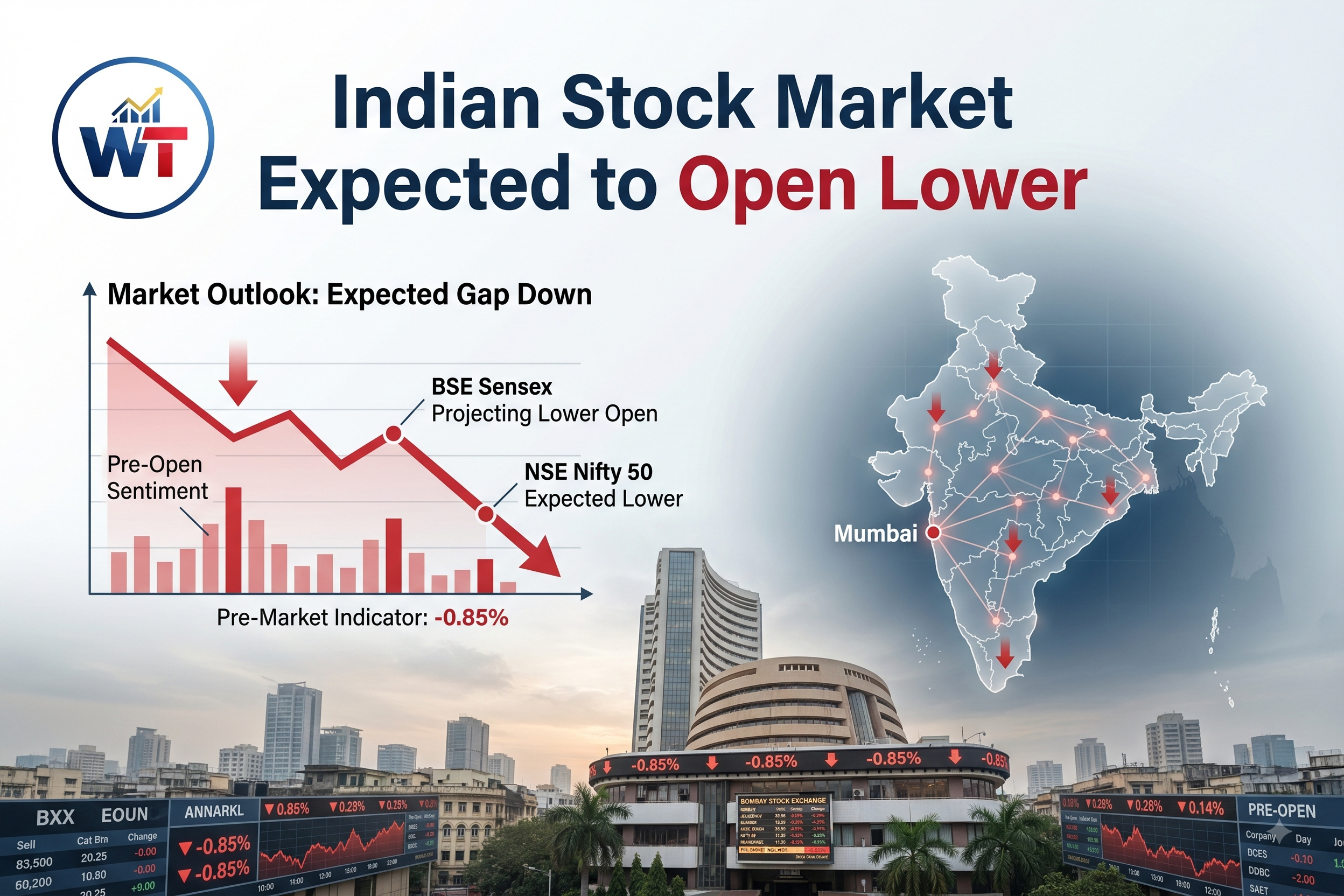
Indian equity markets began Friday, November 27, under cautious investor sentiment, with GIFT Nifty signalling a potentially weaker opening for the benchmark Sensex and Nifty 50. Rising crude oil prices, uncertainty in global markets and concerns surrounding geopolitical developments weighed on sentiment, despite a recovery across several Asian stock markets.
GIFT Nifty was trading below the previous session’s levels during early trading, indicating a possible negative start for domestic benchmark indices. According to market reports, the futures contract was quoted around 25,958.58, approximately 69 points lower, suggesting pressure on the Nifty 50 at the opening bell.
However, the initial indication did not necessarily translate into sustained losses. Early trading data showed that Indian benchmark indices remained relatively close to their previous closing levels, reflecting a mixed market response.
GIFT Nifty Signals Cautious Market Sentiment
GIFT Nifty has become an important indicator for investors tracking the likely opening direction of Indian equity markets. Its movement provides an early indication of sentiment before the domestic exchanges begin regular trading.
The latest weakness in GIFT Nifty suggested that investors were approaching the session cautiously after two consecutive sessions of gains. On Thursday, the Sensex closed at 84,328.59, gaining 390.31 points or 0.46%, while the Nifty 50 advanced 65.25 points or 0.25% to settle at 25,884.50.
The recent gains had provided some support to market sentiment, but investors remained alert to international developments and rising energy prices. Market participants were particularly focused on whether the Nifty could maintain its position near the important 26,000-point level.
Rising Crude Oil Prices Create Fresh Concerns
One of the biggest concerns for Indian markets is the increase in international crude oil prices. Brent crude was trading near $96.50 per barrel during early market updates, with prices gaining amid concerns about potential disruptions to energy supplies in West Asia.
Higher crude oil prices can create economic challenges for India because the country depends heavily on imported petroleum. An increase in oil prices can raise the import bill, put pressure on the current account balance and contribute to inflation.
Oil marketing companies, airlines, transportation businesses and other fuel-intensive industries may face additional cost pressures when crude prices remain elevated. Higher energy costs can also affect household spending and business profitability.
Another concern is the potential impact on the Indian rupee. A larger oil import bill can increase demand for foreign currency, potentially putting pressure on the rupee and influencing foreign investment flows.
The sustainability of crude oil prices will therefore remain an important factor shaping investor sentiment in the coming sessions.
Global Market Volatility Influences Domestic Trading
International market movements continue to play a significant role in determining the direction of Indian equities. Asian stock markets extended their recovery on Friday, supported by renewed interest in technology and artificial intelligence-related shares.
Japan’s Nikkei 225 and South Korea’s Kospi advanced, reflecting improved sentiment toward the technology sector. However, the global outlook remained uncertain as investors continued evaluating technology valuations, trade developments and geopolitical risks.
US markets were closed on Thursday for the Thanksgiving holiday, limiting fresh direction from Wall Street. The shortened US trading session scheduled for Friday also meant that investors could remain cautious while waiting for clearer international market signals.
Despite the positive movement across parts of Asia, higher crude oil prices and uncertainty surrounding global trade conditions continued to create challenges for Indian equities.
Foreign Investment and Domestic Buying in Focus
Foreign institutional investor activity is another important factor influencing the Indian stock market. Overseas investment flows can significantly affect large-cap stocks and benchmark indices, particularly during periods of international uncertainty.
Recent foreign inflows have provided support to Indian equities. Reuters reported that November’s market rally had been supported by substantial foreign investment and improving corporate earnings.
Domestic institutional investors also remain important participants in the market. Their buying activity can help absorb selling pressure from overseas investors and provide stability during volatile trading sessions.
Investors will continue monitoring institutional activity to understand whether the recent market recovery has sufficient support to continue. Strong domestic participation, improving earnings and stable economic conditions could help limit the impact of temporary global concerns.
Stocks and Sectors Investors May Watch
Market participants are likely to monitor banking, information technology, energy, automobile and infrastructure stocks for signs of sector-specific strength or weakness.
Information technology shares may remain sensitive to global technology valuations and developments in international markets. Banking stocks will be watched for their influence on benchmark indices, while energy-related companies could respond to movements in crude oil prices.
Investors may also track individual companies responding to corporate announcements, new business orders and other developments. Such company-specific factors can create opportunities even when the broader market is moving within a narrow range.
However, market participants should distinguish between short-term price movements and changes in the underlying financial performance of companies.
Outlook for Sensex and Nifty 50
The near-term direction of Indian equities is likely to depend on several interconnected factors, including crude oil prices, foreign investment flows, global market performance and domestic economic indicators.
The Nifty 50’s ability to sustain levels around 25,800–26,000 will remain important for market sentiment. A stronger move above the 26,000 mark could improve confidence, while weakness below important support levels may encourage further caution.
The Sensex will also depend on the performance of heavyweight banking, financial services, technology and energy companies.
Investors should avoid interpreting a weak GIFT Nifty indication as a guarantee of a negative trading session. Futures movements provide an early signal, while actual market performance depends on buying and selling activity after the exchanges open.
The Worldonomics Times View
The cautious signal from GIFT Nifty highlights how quickly global developments can influence Indian equity markets. Rising crude oil prices, geopolitical uncertainty and fluctuations in international investor sentiment remain important risks for domestic stocks.
India’s dependence on imported energy makes sustained increases in crude prices particularly significant. Higher oil costs can influence inflation, the currency, corporate margins and the broader economic outlook.
At the same time, domestic institutional participation, corporate earnings and the country’s long-term growth prospects provide important support to the market.
The current environment calls for a balanced investment approach. Rather than reacting to every pre-market movement, investors should focus on company fundamentals, valuation levels and broader economic trends. The ability of Indian markets to withstand external pressures will be an important measure of their strength in the weeks ahead.