By The Worldonomics Times | Global Economy
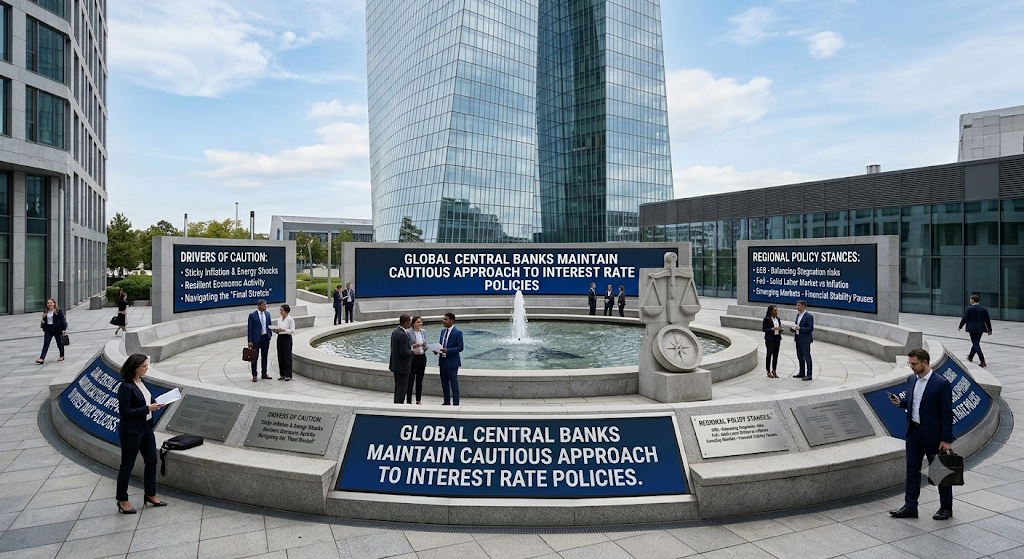
Global central banks are adopting a cautious approach to monetary policy as persistent inflation risks, geopolitical tensions and uncertain economic growth complicate decisions about interest rates. After a period of significant monetary tightening, policymakers are reassessing their strategies to determine whether borrowing costs should remain elevated, increase further or eventually move lower.
The challenge is becoming increasingly complex. While some economies have made progress in controlling inflation, rising energy prices and international supply disruptions are creating renewed price pressures. At the same time, higher borrowing costs are affecting household spending, business investment and government finances.
Recent decisions by major central banks demonstrate that monetary policy is becoming less uniform. Some institutions are maintaining interest rates while monitoring economic developments, whereas others are considering or implementing further increases. This cautious environment reflects the need to balance price stability with sustainable economic growth.
Inflation Remains a Major Concern
Controlling inflation continues to be the primary responsibility of central banks. Although price pressures have moderated in several economies compared with previous years, energy costs, food prices and persistent services inflation remain important concerns.
Geopolitical conflicts and disruptions to international energy supplies have contributed to fluctuations in oil and natural gas prices. Higher energy costs can influence transportation, manufacturing, electricity generation and household expenses, potentially spreading inflation across different sectors.
Central banks are particularly concerned about second-round inflation effects. If businesses continue raising prices and workers demand higher wages to compensate for increased living costs, temporary price shocks may become more persistent.
According to the International Monetary Fund’s October 2026 World Economic Outlook, global headline inflation is projected to reach 4.7% in 2026 before easing to 4.1% in 2027. The IMF also projects global economic growth of 3.1% in 2026, highlighting the difficult environment facing policymakers.
Major Central Banks Reassess Monetary Policy
Recent policy decisions show how differently central banks are responding to inflation and economic uncertainty.
The US Federal Reserve and the European Central Bank maintained their interest rates at their late-October meetings, choosing to assess incoming economic data before making further adjustments. Both institutions continue to face inflation risks associated with higher energy prices and international uncertainty.
The European Central Bank has emphasised that its decisions will remain dependent on inflation expectations, underlying price pressures and the strength of monetary policy transmission.
The Bank of Japan has also maintained its policy rate, although financial markets continue to monitor the possibility of further tightening as domestic price and wage developments evolve.
Other central banks have taken different approaches. The Bank of Canada raised its policy rate by 25 basis points to 2.5% in late October, while the Reserve Bank of Australia increased its cash rate to 4.85% on November 4, reflecting concerns about persistent domestic inflation.
These developments demonstrate that central banks are responding to individual economic conditions rather than following a single global interest-rate direction.
The Challenge of Balancing Inflation and Economic Growth
Interest rate decisions involve difficult trade-offs. Raising borrowing costs can reduce consumer spending and business investment, helping to control demand-driven inflation. However, excessive monetary tightening can also slow economic activity, weaken employment and increase financial pressure on households.
Businesses that depend on loans for expansion, equipment purchases and working capital may postpone investment when borrowing becomes more expensive. Consumers may also reduce spending on homes, vehicles and other major purchases as loan repayments increase.
On the other hand, maintaining interest rates too low when inflation remains persistent can encourage excessive borrowing and weaken confidence in monetary stability.
Central banks must therefore assess whether inflation is being driven by strong domestic demand or external supply shocks. Higher interest rates cannot directly increase global oil production or resolve shipping disruptions, but they can help prevent temporary cost increases from becoming embedded in broader inflation expectations.
This distinction is central to the cautious approach currently adopted by many monetary authorities.
Impact on Businesses, Consumers and Financial Markets
Changing interest-rate expectations are influencing financial markets worldwide. Government bond yields, currency valuations, equity prices and investment flows often respond to signals from central banks.
Higher interest rates may support a currency by improving returns on domestic financial assets, although exchange rates also depend on economic growth, fiscal conditions and international investor sentiment.
For businesses, uncertainty surrounding future borrowing costs makes financial planning more difficult. Companies may become more selective about expansion projects, manage debt more carefully and prioritise operational efficiency.
Households also face the consequences of monetary policy changes. Mortgage repayments, personal loans and credit-card costs can remain elevated when central banks maintain restrictive interest rates.
Banks may benefit from certain interest-rate conditions through improved lending margins, but higher borrowing costs can also increase credit risks if households and businesses struggle to repay loans.
Emerging Economies Face Additional Pressure
Developing economies face particular challenges when major international central banks maintain relatively high interest rates. Higher returns in advanced economies can attract international capital, potentially placing pressure on emerging-market currencies and financial markets.
Currency depreciation can increase the domestic cost of imported energy, machinery and essential commodities, creating additional inflationary pressure.
Central banks in emerging markets must therefore consider both domestic economic conditions and international financial developments when setting interest rates.
Brazil provides a recent example of this challenge. On November 4, its central bank maintained the benchmark Selic rate at 13.75%, pausing its earlier easing cycle amid renewed inflation concerns and financial-market uncertainty.
Developing economies need to balance price stability with the need to support investment, employment and long-term economic development. Strong foreign-exchange reserves, credible monetary frameworks and sustainable public finances can help reduce vulnerability to external shocks.
The Worldonomics View
The current monetary policy environment demonstrates why central banks must remain flexible and data-driven. A uniform approach to interest rates would be inappropriate when countries face different inflation patterns, labour-market conditions and economic growth prospects.
Policymakers should avoid reacting excessively to temporary price movements, but they must also remain prepared to act when inflation becomes persistent. Clear communication is essential because uncertainty about future policy decisions can create unnecessary volatility in financial markets.
Governments also have a responsibility to support economic stability through responsible fiscal management, infrastructure investment and policies that improve productivity. Monetary policy alone cannot resolve structural weaknesses or supply-side disruptions.
The priority should be to maintain price stability without unnecessarily restricting productive investment and employment. Preserving central-bank independence and strengthening international economic cooperation will remain important in achieving this balance.
Conclusion
Global central banks are maintaining a cautious approach to interest rate policies as inflation risks and economic growth concerns continue to influence financial conditions. While some institutions are holding rates steady, others are tightening monetary policy in response to renewed price pressures.
The direction of future interest rates will depend on energy prices, inflation expectations, employment conditions and the strength of economic activity. Businesses, investors and households will need to adapt to an environment in which borrowing costs may remain elevated for longer than previously expected.
Ultimately, the success of monetary policy will depend on how effectively central banks control inflation while preserving the foundations for sustainable economic growth.