By The Worldonomics Times | Global Economy
Date: 3 November 2026
Global Economy Faces Uneven Growth Amid Geopolitical Tensions, Inflation and Technological Transformation
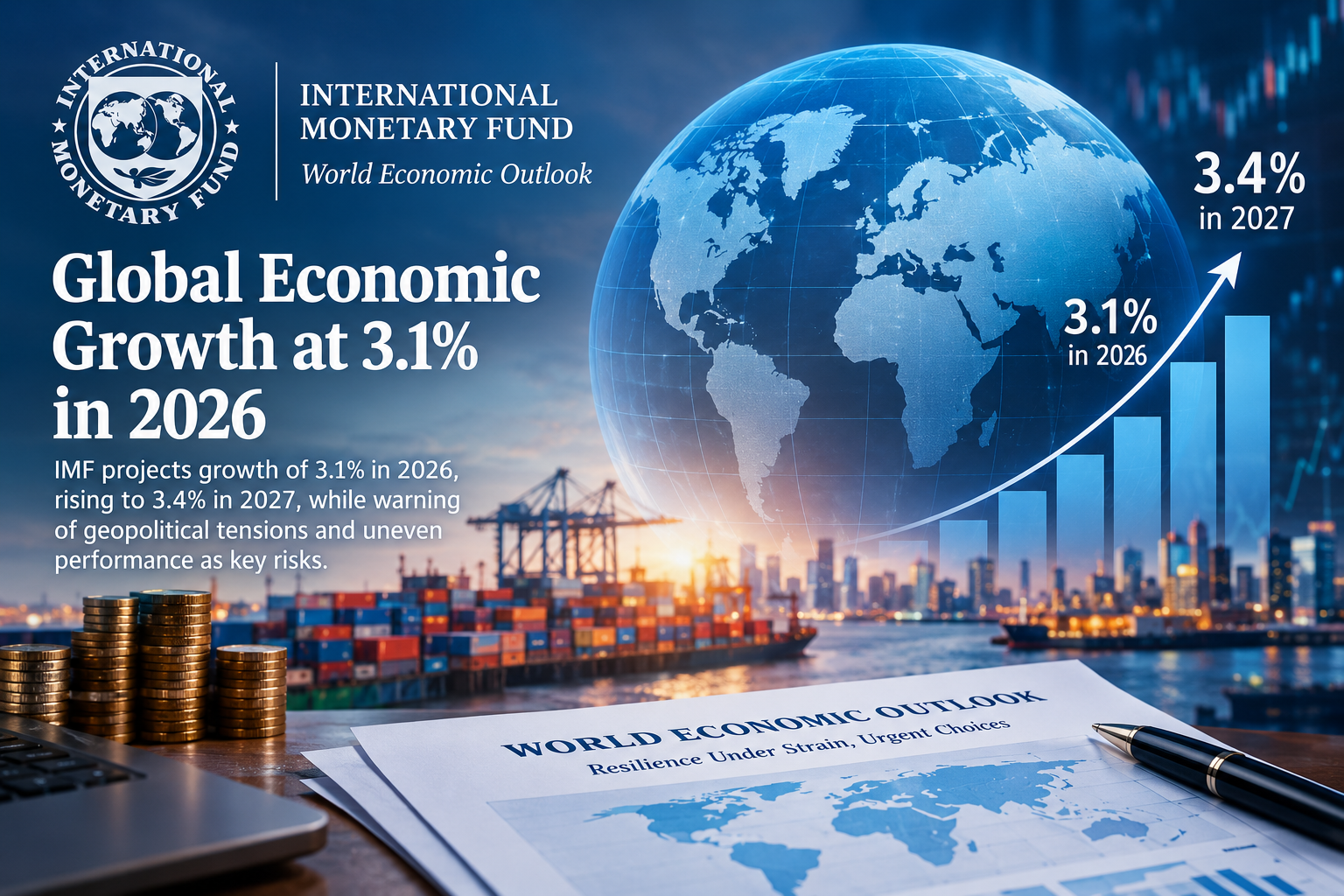
The global economy is expected to grow by 3.1% in 2026, according to the latest projections released by the International Monetary Fund (IMF) in its October 2026 World Economic Outlook. Although the forecast reflects a degree of resilience in the international economic system, it also highlights the growing challenges facing governments, businesses, investors and consumers worldwide. The projection represents a slowdown from the estimated 3.5% growth recorded in 2025, indicating that the global recovery continues to face considerable economic and geopolitical pressures.
The IMF expects global economic growth to improve to 3.4% in 2027, suggesting that economic activity could gradually strengthen if geopolitical conditions stabilise, inflationary pressures ease and investment continues to support productivity. However, the international financial institution has cautioned that the global economic outlook remains vulnerable to unexpected developments, particularly prolonged conflicts, energy market disruptions, trade uncertainties and financial market volatility.
Geopolitical Tensions Continue to Influence Economic Performance
One of the major factors influencing the global economic outlook is the ongoing geopolitical instability, particularly tensions in the Middle East. Disruptions to international energy supplies and shipping routes have increased uncertainty in global commodity markets, putting additional pressure on countries that depend heavily on imported oil and gas.
Rising energy prices have increased production, transportation and operating costs across several industries. Manufacturing companies, logistics providers, airlines and energy-intensive businesses are particularly exposed to these developments. Higher operating expenses can eventually translate into increased prices for goods and services, reducing consumer purchasing power and affecting overall economic demand.
The IMF has highlighted that the global economy has demonstrated an ability to adjust to these disruptions through alternative energy supplies, inventory management, increased production in other regions and improved energy efficiency. Nevertheless, these adjustment mechanisms have limitations, particularly if geopolitical conflicts continue for an extended period.
Inflation Remains a Major Concern for Global Markets
Despite efforts by central banks to control inflation, price stability remains a significant challenge for many economies. The IMF projects global headline inflation at 4.7% in 2026, compared with 4.1% in 2025, before easing to 4.1% in 2027.
Higher energy and food prices are among the key factors contributing to inflationary pressures. These developments are particularly challenging for developing economies, where households often spend a substantial proportion of their income on essential commodities.
Central banks across major economies must therefore maintain a careful balance between controlling inflation and supporting economic growth. Keeping interest rates elevated for longer could increase borrowing costs for businesses and households, potentially slowing investment, housing activity and consumer spending. On the other hand, easing monetary policy too quickly could create additional inflationary risks.
Artificial Intelligence Emerges as a Key Growth Driver
While geopolitical instability and higher commodity prices are creating economic challenges, technological investment is providing an important source of support for global growth.
Artificial intelligence (AI), semiconductor manufacturing, cloud computing and data centre infrastructure have attracted significant investment from businesses across major economies. The expansion of these industries is creating opportunities in technology, manufacturing, telecommunications, infrastructure and international trade.
According to the IMF, the AI-driven investment boom has helped support global economic activity and offset some of the negative effects of the energy shock. Strong demand for advanced computing infrastructure and related technologies has also contributed to international trade and investment flows.
However, the rapid expansion of AI-related investment carries certain risks. If expected productivity improvements and corporate earnings fail to meet investor expectations, financial markets could experience significant corrections. Policymakers and businesses will need to ensure that technological investment translates into sustainable productivity gains, employment opportunities and long-term economic value.
Uneven Growth Across Advanced and Emerging Economies
The IMF’s projections indicate that economic performance will differ considerably across regions. Advanced economies are expected to grow by 2.1% in 2026, while emerging market and developing economies are projected to expand by 3.7%.
This difference reflects variations in domestic demand, investment opportunities, industrial capacity, technological development and exposure to global economic disruptions.
Emerging economies continue to offer considerable opportunities through expanding consumer markets, infrastructure development, manufacturing and digital transformation. However, many also face challenges associated with currency volatility, external debt, imported energy costs and limited fiscal resources.
India remains an important growth market, supported by domestic consumption, infrastructure investment, services and manufacturing activity. China continues to play a significant role in global manufacturing and international trade, although its economic outlook remains influenced by domestic demand and structural challenges.
Trade, Investment and Supply Chains Under Pressure
International trade remains another important factor shaping the global economic outlook. Changes in trade policies, geopolitical disagreements and supply chain disruptions are influencing business decisions and investment strategies.
Many multinational companies are reassessing their supply chains to reduce dependence on individual countries and regions. Diversification of manufacturing locations, increased regional trade cooperation and investment in logistics infrastructure are becoming important business priorities.
Although these adjustments may improve supply chain resilience over time, they can also increase short-term costs. Countries that maintain stable trade relationships, invest in infrastructure and encourage international cooperation could benefit from changing global production patterns.
What Lies Ahead for the Global Economy?
The IMF’s latest forecast presents a mixed picture of the international economic environment. Global growth remains positive, but the pace of expansion is moderate and increasingly uneven. Inflation, geopolitical instability, energy security, public debt and financial market uncertainty will continue to influence economic decisions throughout 2026 and into 2027.
Governments must prioritise responsible fiscal management, targeted support for vulnerable households, investment in infrastructure and policies that encourage innovation and productivity. Central banks must remain attentive to inflation while ensuring that monetary policy does not unnecessarily restrict economic activity.
Businesses, meanwhile, will need to focus on operational efficiency, technological adoption, supply chain diversification and prudent financial planning to navigate uncertain market conditions.
The Worldonomics Times Views
The global economy is entering a period where resilience matters as much as growth. The IMF’s projection of 3.1% growth in 2026 indicates that the world economy continues to expand, but the benefits of this growth are not being distributed equally across countries, industries and communities.
In our view, the biggest challenge facing the global economy is not simply maintaining growth, but ensuring that growth becomes sustainable, inclusive and capable of withstanding external shocks. Geopolitical conflicts, inflation, rising energy costs and trade uncertainties have demonstrated how interconnected the modern economic system has become. A disruption in one region can quickly affect manufacturing, transportation, commodity prices and consumer markets across the world.
We believe that governments should focus on strengthening domestic production capabilities, improving infrastructure, encouraging technological innovation and developing more resilient international supply chains. Emerging economies, particularly India and other developing markets, have significant opportunities to strengthen their positions in global manufacturing, digital services and international trade.
At the same time, technological advancement, especially artificial intelligence, should be supported by investments in education, workforce development and responsible innovation. Economic progress must create meaningful employment opportunities rather than concentrate its benefits among a limited number of industries or businesses.
Another important priority should be balancing economic expansion with financial stability. Governments and central banks must remain attentive to inflation, public debt and financial market risks while creating an environment that encourages long-term investment.
The Worldonomics Times believes that the true measure of economic success is not merely the percentage of GDP growth, but the quality, inclusiveness and sustainability of that growth. The coming years will test the ability of global leaders to cooperate, adapt and build an economic system that delivers opportunities and stability for future generations.
As the world moves towards 2027, the focus should shift from growth at any cost to growth with resilience, responsibility and shared prosperity.
Conclusion
The IMF’s projection of 3.1% global economic growth in 2026 underlines both the resilience and vulnerability of the international economy. While technological investment and the adaptability of businesses have helped sustain economic activity, persistent geopolitical tensions, inflation and financial risks continue to limit the pace of expansion.
The outlook for 2027 offers some optimism, with growth expected to improve to 3.4%. However, achieving stronger and more inclusive economic growth will depend on international cooperation, effective policymaking, stable financial markets and the ability of economies to adapt to an increasingly complex global environment.
For businesses, investors and policymakers, the message is clear: the global economy continues to move forward, but resilience, strategic planning and sustainable development will be essential for navigating the challenges ahead.