New Delhi, November 2026: India’s Micro, Small and Medium Enterprises (MSME) sector is witnessing a growing push towards better market access, technology adoption, easier finance, digital commerce and sustainable business practices through the Government’s Raising and Accelerating MSME Performance (RAMP) Programme.
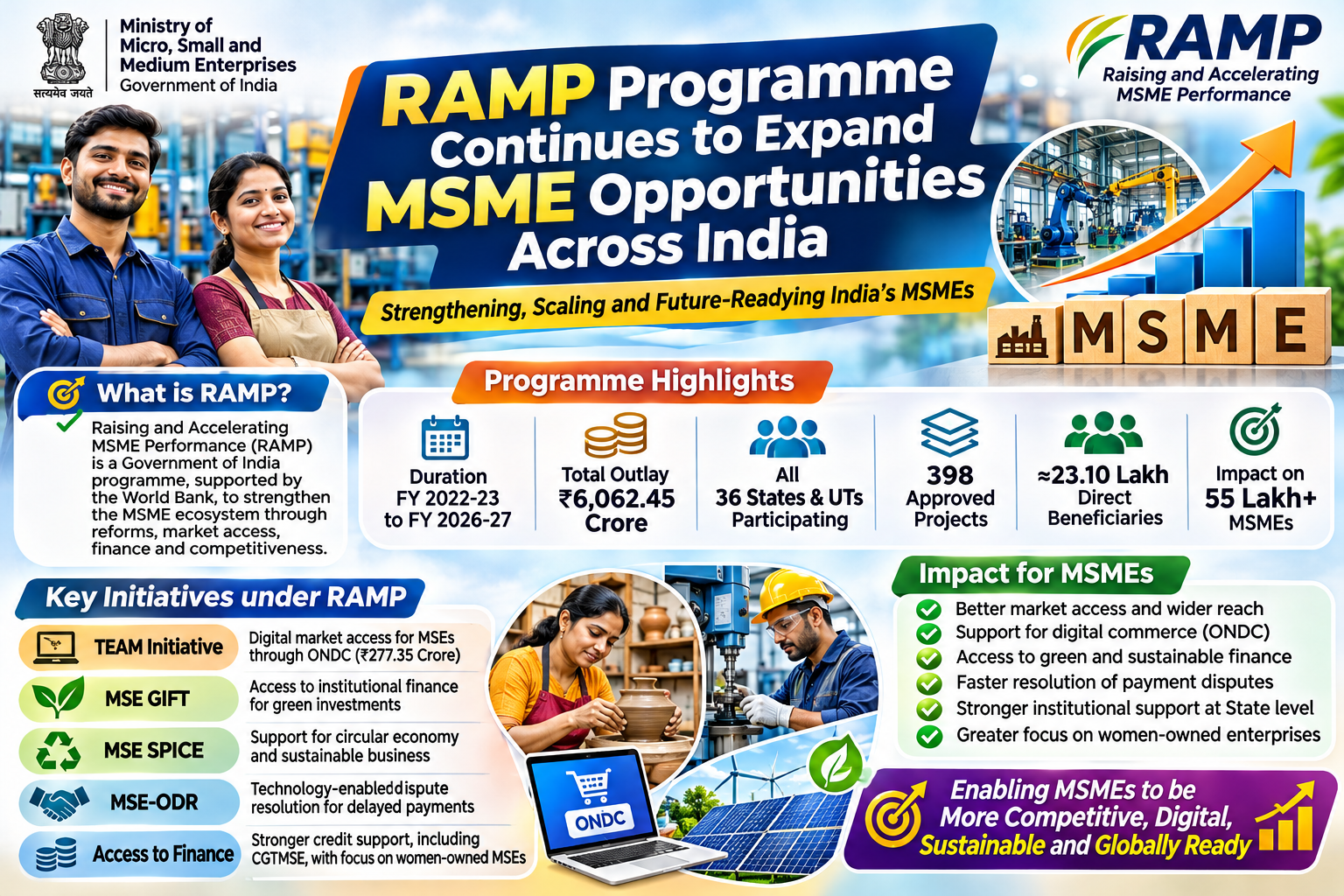
Supported by the World Bank and implemented by the Ministry of Micro, Small and Medium Enterprises, RAMP is a ₹6,062.45 crore Central Sector programme covering the period from FY 2022-23 to FY 2026-27. The programme is designed not simply as another subsidy scheme, but as a broader effort to strengthen the MSME ecosystem through institutional reforms, Centre-State collaboration and targeted interventions for enterprise-level competitiveness.
Focus Shifts From Survival to Competitiveness
For years, Indian MSMEs have faced common challenges including limited access to institutional finance, delayed payments, technology gaps, inadequate market linkages and difficulties in adopting modern business practices.
RAMP attempts to address these challenges through two broad result areas: strengthening institutions and governance of MSME programmes, and providing support for market access, firm capabilities and access to finance. Its framework also gives importance to women-owned enterprises, green investments, technology solutions and private-sector participation.
The programme is being implemented through States and Union Territories, making Centre-State coordination an important part of its design.
All States and UTs Join the Programme
One of the significant developments under RAMP has been the expansion of State-level participation.
According to Government information, all 36 States and Union Territories have submitted Strategic Investment Plans (SIPs). These plans provide a roadmap for strengthening the MSME ecosystem according to the specific requirements of each State and Union Territory.
The latest RAMP portal reports 398 approved projects, covering 36 participating States and Union Territories, with an approved budget of approximately ₹3,351.47 crore and expenditure of around ₹1,157.74 crore. The portal currently reports approximately 23.10 lakh beneficiaries under the programme.
Government reporting has also used a broader measure of MSME impact. A June 2026 Government update stated that initiatives undertaken under RAMP had impacted more than 55 lakh MSMEs across the country. The difference reflects the distinction between beneficiaries directly recorded under programme interventions and the wider MSME population impacted through system-level reforms and initiatives.
TEAM Initiative Opens the Digital Market
One of the most important initiatives operating under RAMP is the Trade Enablement and Marketing (TEAM) Initiative.
Launched in June 2024 with an outlay of ₹277.35 crore for three years, TEAM aims to help Micro and Small Enterprises access digital commerce through the Open Network for Digital Commerce (ONDC).
The initiative provides support for onboarding, creation of ONDC-compliant catalogues, account management, logistics and packaging. The programme is expected to benefit approximately 5 lakh MSEs, with a target that 50% of beneficiaries will be women-owned enterprises.
This is particularly significant for small businesses that traditionally depend on local markets. Digital commerce can allow a manufacturer, artisan, home-based entrepreneur or retailer to reach customers beyond its immediate geographical area.
A May 2026 Government update highlighted examples of enterprises from regions including Jammu & Kashmir and Manipur gaining access to wider markets through the ONDC-enabled support ecosystem.
Green Transformation Becomes a Business Priority
RAMP is also supporting the transition towards environmentally sustainable MSME operations.
Two initiatives—MSE GIFT and MSE SPICE—are part of the RAMP ecosystem.
MSE GIFT focuses on helping MSEs access institutional finance for green investments, while MSE SPICE provides capital subsidy support for enterprises moving from linear to circular-economy models. These interventions are aimed at encouraging MSMEs to adopt cleaner technologies, improve resource efficiency and reduce waste.
For export-oriented MSMEs, green production is increasingly becoming a commercial necessity as international buyers and supply chains place greater emphasis on environmental standards.
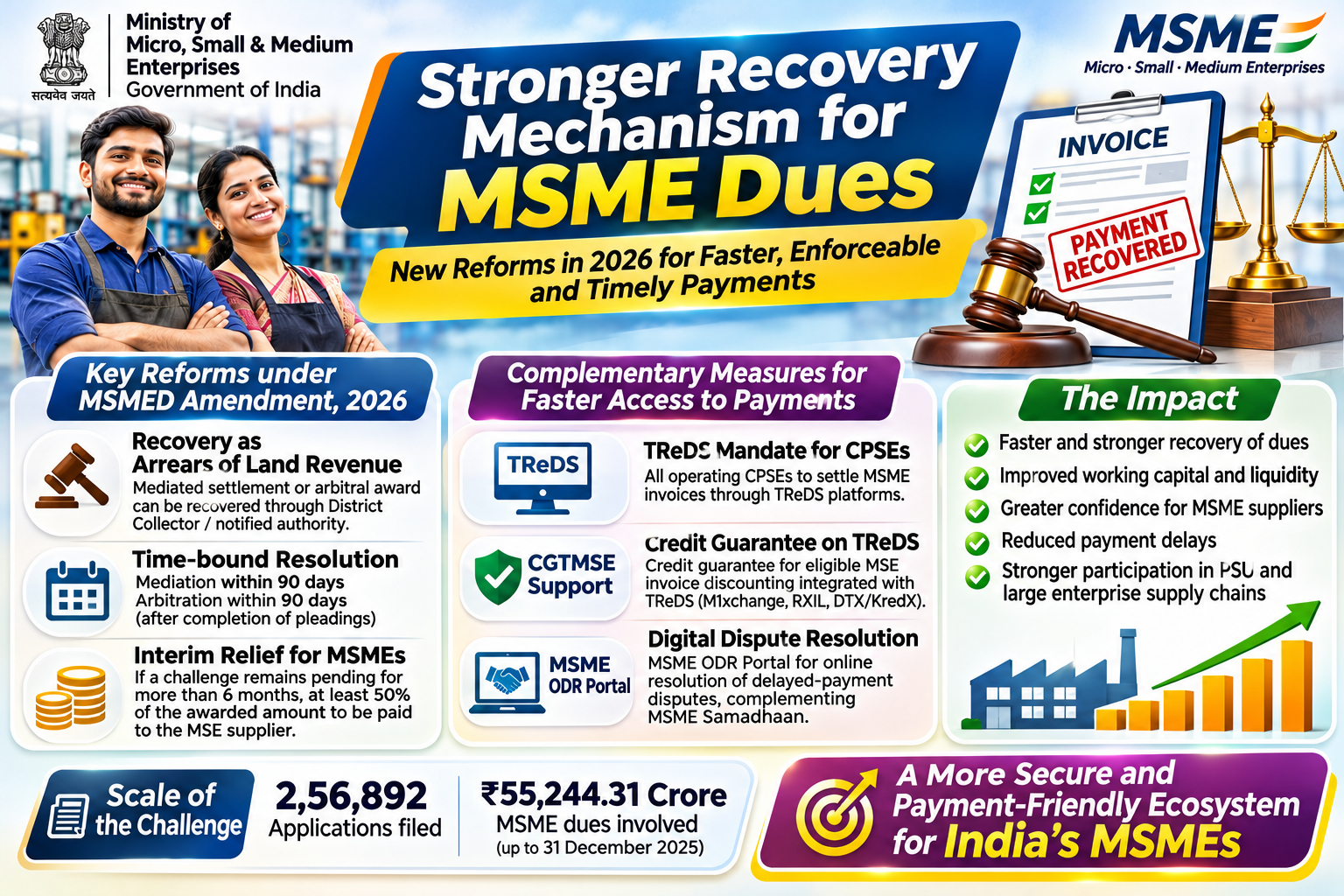
Tackling the Delayed-Payment Problem
Cash-flow pressure caused by delayed payments remains one of the biggest challenges for small businesses.
RAMP includes measures to strengthen the receivables-financing ecosystem and reduce delayed payments. The programme also supports the MSE-ODR initiative, which uses technology-enabled online dispute resolution to help MSEs resolve delayed-payment disputes more quickly and cost-effectively.
Improving the speed at which MSMEs recover their legitimate dues can have a direct impact on working capital, employment and the ability of enterprises to accept new orders.
Strengthening Access to Finance
Another important objective of RAMP is to improve the effectiveness of existing credit-support mechanisms, including the Credit Guarantee Fund Trust for Micro and Small Enterprises (CGTMSE).
The programme also focuses on improving access to finance for women-owned MSEs and supporting green investments. This approach recognises that MSME growth requires more than traditional bank lending—it requires an ecosystem that combines credit, guarantees, technology and market opportunities.
A New Era of Market-Ready MSMEs
The importance of RAMP becomes clearer when viewed alongside other Government initiatives such as GeM, ONDC, the Procurement and Marketing Support Scheme, TReDS and MSME competitiveness programmes.
Together, these initiatives can help an enterprise move through a broader growth journey:
Formalisation → Finance → Technology → Digital Commerce → Government Procurement → Market Expansion → Export Readiness.
The Government’s recent ₹10,000 crore commitment towards the SME Growth Fund further reinforces the policy direction towards helping promising small and medium enterprises scale operations, invest in technology, expand internationally and integrate into global value chains.
The Road Ahead
RAMP is scheduled to operate through FY 2026-27, making the current phase particularly important for MSMEs, State governments and implementing agencies.
The programme’s long-term significance may ultimately depend not only on the amount of money deployed, but on whether the interventions create lasting improvements in how MSMEs access markets, finance, technology and institutional support.
For India’s millions of small businesses, the opportunity is increasingly moving beyond simply obtaining government assistance. The larger objective is to become more competitive, digitally connected, financially resilient and capable of serving larger domestic and global markets.
As India advances towards the vision of a more developed and globally competitive economy, programmes such as RAMP could play an important role in transforming MSMEs from small local enterprises into stronger suppliers, exporters, technology adopters and future growth champions.