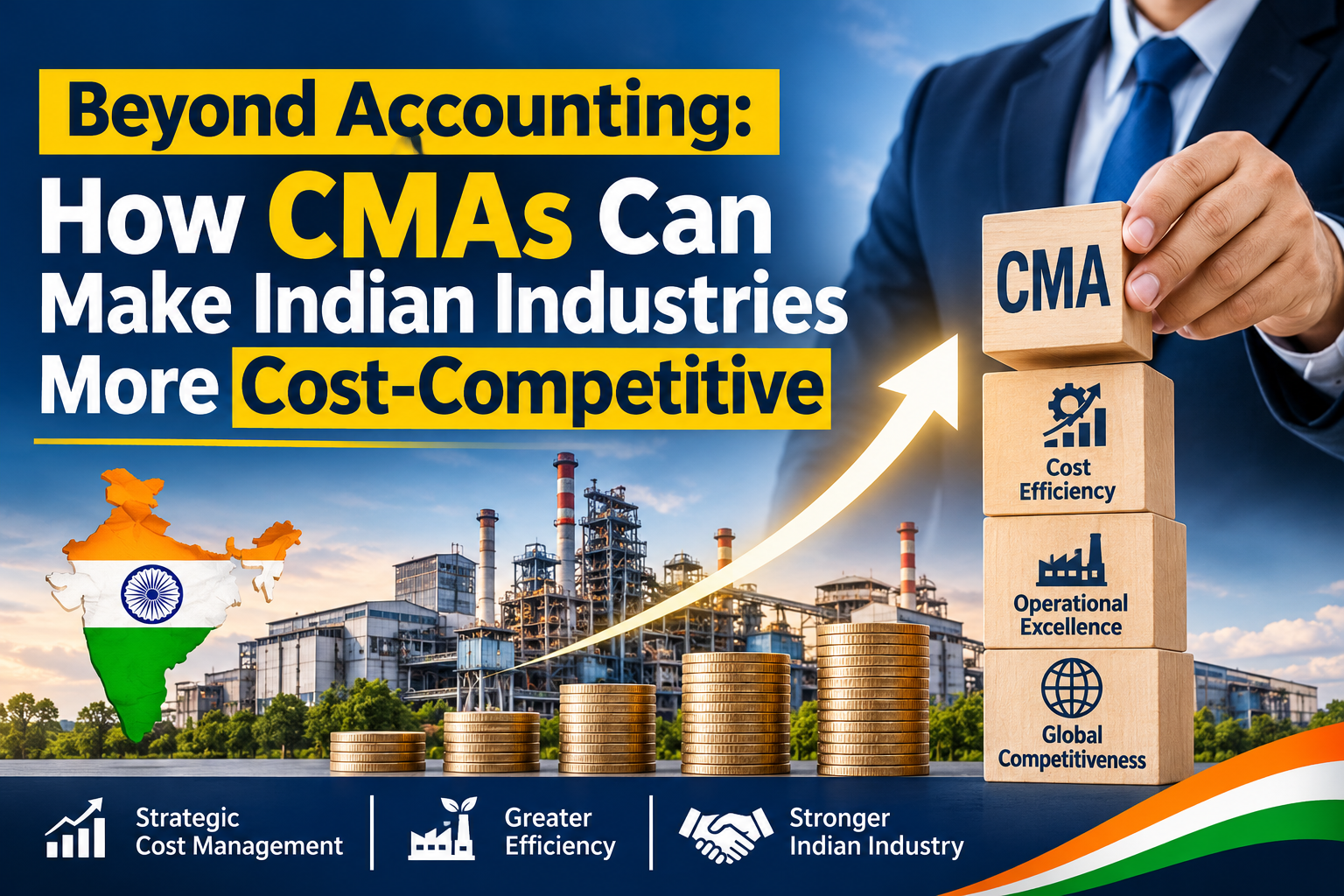
India’s ambition to become a global manufacturing powerhouse depends not only on expanding production but also on producing efficiently, controlling costs and delivering quality at competitive prices. As Indian industries face rising input costs, global competition, supply-chain disruptions and pressure on profit margins, cost management is becoming a strategic necessity rather than merely an accounting function.
This creates an important opportunity for Cost and Management Accountants (CMAs). Their role is evolving beyond maintaining cost records and conducting audits towards improving operational efficiency, strengthening business decisions and making Indian industries globally competitive.
India’s Cost-Competitiveness Challenge
India has made considerable progress in manufacturing, infrastructure and industrial development. However, several structural challenges continue to affect the competitiveness of domestic industries.
According to the DPIIT-NCAER Assessment of Logistics Cost in India, released in September 2025, India’s logistics costs were estimated at 7.97% of GDP for 2023–24, equivalent to approximately ₹24.01 lakh crore. The study also highlights that smaller businesses face relatively higher logistics costs, affecting their ability to compete and expand.
Other challenges include:
- Rising raw material and energy costs.
- Inefficient inventory and working-capital management.
- Low productivity and underutilisation of production capacity.
- Dependence on imported components and critical inputs.
- Limited access to advanced technology among smaller manufacturers.
- Increasing pressure to maintain quality while controlling prices.
The Economic Survey 2025–26 also emphasises the importance of reducing input costs, particularly raw materials, intermediate goods, energy, logistics and compliance expenses, to strengthen India’s industrial competitiveness.
These challenges require more than traditional financial reporting. They demand professionals who understand the relationship between cost, production, productivity and profitability.
How CMAs Can Transform Industrial Competitiveness
1. Strategic Cost Management: Beyond Traditional Cost Accounting
One of the most important contributions of CMAs is identifying where businesses spend money and whether those expenses generate sufficient value.
Through standard costing, variance analysis, activity-based costing and cost benchmarking, CMAs can identify unnecessary expenditure, inefficient processes and cost deviations.
For example, a manufacturing company experiencing declining margins may initially consider increasing product prices. However, a detailed cost analysis might reveal excessive material wastage, machine downtime or inefficient procurement practices.
By addressing these issues, companies can improve profitability without necessarily increasing prices.
2. Improving Supply Chain and Inventory Efficiency
Inventory management directly affects production costs, cash flow and profitability. Excessive inventory increases storage, insurance and financing expenses, while insufficient inventory can interrupt production.
CMAs can help businesses introduce techniques such as:
- Economic Order Quantity (EOQ).
- Just-in-Time (JIT) inventory management.
- ABC inventory analysis.
- Material consumption and wastage analysis.
- Supply-chain cost optimisation.
By analysing procurement patterns, supplier performance and inventory turnover, CMAs can help businesses reduce unnecessary working-capital blockages and improve operational efficiency.
3. Supporting MSMEs Through Better Cost Management
Micro, Small and Medium Enterprises (MSMEs) are essential to India’s industrial ecosystem, but many operate with limited financial resources, technology and professional management systems.
NITI Aayog’s 2025 report, Enhancing Competitiveness of MSMEs in India, identifies financing, skilling, innovation and market access as important areas requiring attention.
CMAs can help MSMEs establish proper costing systems, prepare realistic budgets, calculate product-wise profitability, control overheads and improve pricing decisions.
Professional cost management can also help smaller businesses identify unprofitable products, negotiate better supplier contracts and make informed investment decisions.
4. Technology, Automation and Data-Driven Decisions
Digital transformation is changing the way industries operate. Artificial intelligence, enterprise resource planning (ERP), data analytics and automation are creating opportunities to improve productivity and reduce operational costs.
However, technology investments must generate measurable financial returns.
CMAs can evaluate capital expenditure through investment appraisal techniques such as Net Present Value (NPV), Internal Rate of Return (IRR) and payback period. They can also measure the financial impact of automation, analyse production performance and monitor cost savings.
Their contribution is particularly valuable in ensuring that technology adoption improves business efficiency rather than simply increasing expenditure.
5. Energy Efficiency and Sustainable Manufacturing
Energy is a significant operating expense for industries such as steel, cement, chemicals, textiles and automobiles.
CMAs can identify energy-intensive processes, measure energy consumption per unit of production and evaluate investments in energy-efficient machinery and renewable energy.
They can also integrate environmental costs into business decisions through environmental management accounting and life-cycle costing.
This approach enables businesses to achieve two objectives: reducing operating expenses and moving towards more sustainable manufacturing practices.
6. Strengthening India’s Export Competitiveness
Indian manufacturers increasingly compete with producers from countries that benefit from efficient supply chains, economies of scale and advanced production technologies.
High production costs can reduce export margins and make Indian products less attractive in international markets.
CMAs can contribute by analysing export product costs, identifying cost disadvantages, benchmarking manufacturing performance and evaluating pricing strategies.
NITI Aayog’s manufacturing competitiveness research highlights challenges such as high logistics costs, infrastructure gaps, power reliability and limited technology adoption. These are areas where effective cost and performance management can support industrial improvement.
The Changing Role of CMAs: From Cost Controllers to Strategic Business Partners
The traditional perception of CMAs as professionals responsible primarily for costing, budgeting and cost audits needs to evolve.
Modern industries require CMAs who can work closely with production managers, procurement teams, supply-chain professionals and senior management.
Their responsibilities increasingly include:
- Strategic financial planning and forecasting.
- Product and customer profitability analysis.
- Performance measurement and KPI monitoring.
- Capital budgeting and investment decisions.
- Risk management and cost optimisation.
- Business intelligence and data analytics.
The Institute of Cost Accountants of India (ICMAI) has also highlighted the profession’s expanding contribution to strategic management, digital transformation, sustainability and efficient resource utilisation.
This transformation makes CMAs important participants in business strategy rather than merely contributors to financial reporting.
The Road Ahead: Making Cost Competitiveness a National Priority
The announcement of the National Manufacturing Mission in the Union Budget 2025–26 reflects India’s commitment to strengthening manufacturing capabilities, supporting MSMEs, improving technology adoption and enhancing product quality.
However, achieving these objectives requires collaboration between policymakers, industries, financial institutions and professional bodies.
Indian businesses must recognise that cost competitiveness does not mean compromising product quality, reducing employee wages or cutting essential investments. It means achieving greater output from available resources, eliminating inefficiencies and making smarter business decisions.
CMAs can play a significant role in this transformation by connecting financial information with operational performance and long-term business strategy.
Conclusion
India’s journey towards becoming a globally competitive manufacturing economy will depend not only on how much it produces but also on how efficiently it produces.
The future of the CMA profession therefore extends far beyond accounting, compliance and cost audits. It lies in strategic decision-making, productivity improvement, resource optimisation and sustainable value creation.
As Indian industries prepare to compete in an increasingly demanding global marketplace, CMAs can become the architects of cost efficiency and the strategic partners behind India’s industrial competitiveness.
The real contribution of a CMA is not simply measuring what production costs, but identifying how industries can produce better, waste less and compete stronger.