From discarded smartphones to precious metals, India’s electronic waste is emerging as both an environmental challenge and an untapped economic opportunity.
Introduction: The Gold We Throw Away
What happens to your old smartphone, damaged laptop, unused television or outdated electronic equipment?
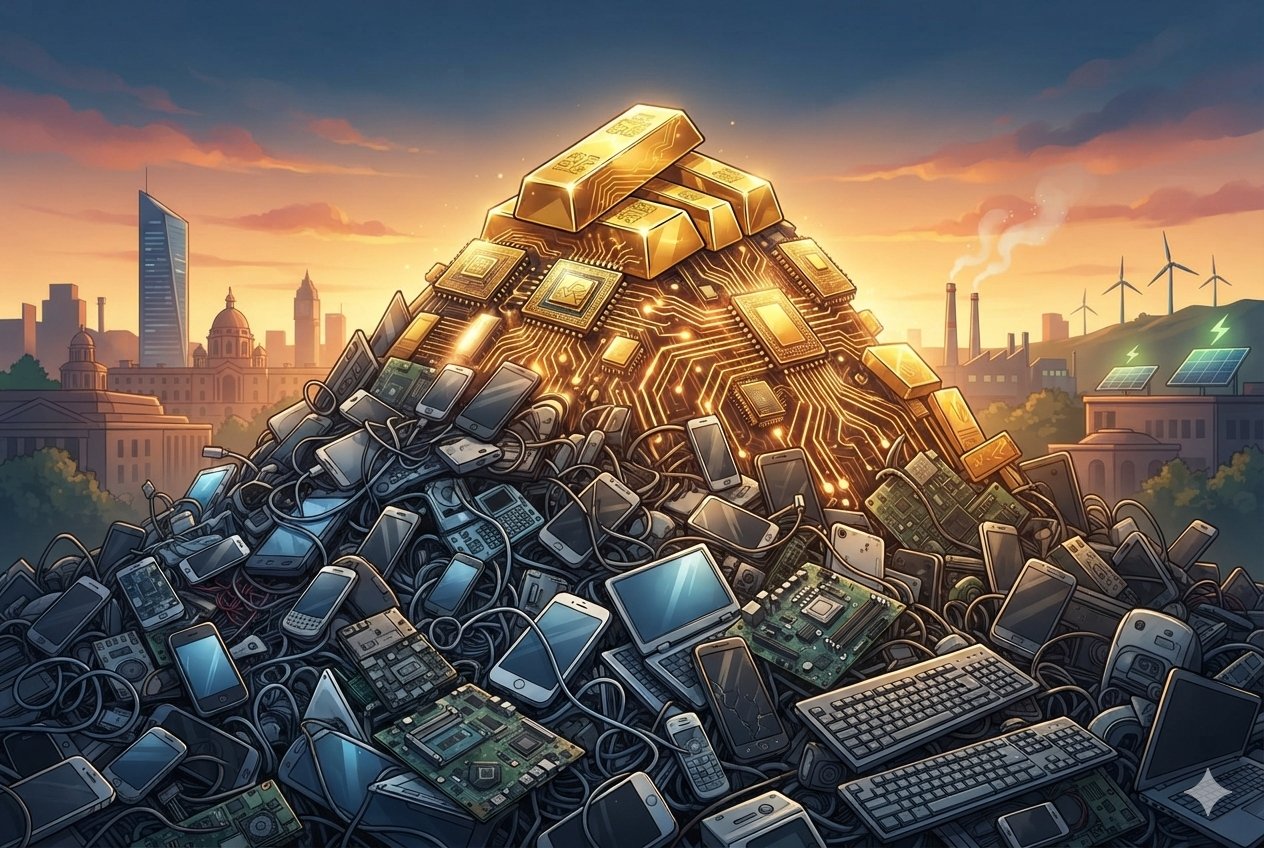
For many people, these products simply become waste. But economically, they may contain something far more valuable: recoverable gold, silver, copper and other useful materials.
Welcome to the world of urban mining, where yesterday’s electronic waste can become tomorrow’s industrial resource.
As India accelerates its digital transformation, the growing volume of discarded electronics presents an important question: Are we treating e-waste merely as garbage, or recognising it as a valuable economic resource?
India’s Growing E-Waste Challenge
India is among the world’s largest generators of electronic waste.
According to government data presented in Parliament, India’s estimated e-waste generation increased from approximately 12.54 lakh metric tonnes in FY 2023–24 to 13.98 lakh metric tonnes in FY 2024–25.
The government also reported that approximately 11.59 lakh metric tonnes were recycled in FY 2024–25.
These numbers reveal two realities:
- India’s consumption of electronic products is creating a rapidly expanding waste stream.
- Recycling is becoming an increasingly important part of the country’s industrial ecosystem.
The challenge is no longer limited to collecting discarded electronics. It is about ensuring that they are processed safely, efficiently and transparently.
Urban Mining: Turning Waste into Wealth
Electronic waste is not ordinary garbage.
Discarded electronic products contain valuable materials, including:
- Gold and Silver: Used in electronic connectors and components.
- Copper: Essential for wiring and electrical systems.
- Aluminium: Used in electronic casings and components.
- Lithium and other critical materials: Important for batteries and emerging technologies.
Recovering these materials can reduce dependence on virgin raw materials, support domestic manufacturing and create new business opportunities.
This is where urban mining becomes economically significant.
Instead of extracting every resource from the earth, industries can recover valuable materials from products already circulating in the economy.
The Business Opportunities Hidden in E-Waste
The e-waste ecosystem offers opportunities across several business segments:
1. Recycling and Material Recovery
Companies can invest in specialised facilities that extract valuable metals and reusable materials from discarded electronics.
2. Refurbishment and Resale
Not every discarded electronic product is beyond repair. Refurbishing and reselling usable devices can create affordable alternatives while extending product life cycles.
3. Reverse Logistics
Efficient collection, transportation and sorting systems can become an independent business opportunity.
4. Technology and Innovation
Artificial intelligence, automation and advanced material-separation technologies can improve recycling efficiency and resource recovery.
5. Employment and Entrepreneurship
Formal recycling networks can create skilled employment and encourage new enterprises in waste management and resource recovery.
EPR: When Environmental Responsibility Becomes Corporate Accountability
An important regulatory mechanism in India’s e-waste ecosystem is Extended Producer Responsibility (EPR).
Under the E-Waste (Management) Rules, 2022, producers are assigned recycling-related obligations, supported by a framework involving registered manufacturers, producers, refurbishers and recyclers.
The idea is simple: businesses should consider the environmental impact of their products beyond the point of sale.
However, compliance must be genuine, not merely documented.
A significant development reported on 13 November 2026 highlights this concern.
According to Reuters, the government has ordered inspections of more than 2,000 recyclers, including 309 e-waste facilities, to investigate inflated processing claims and forged compliance documents.
The reported inspection process includes physical verification of machinery, trial runs and comparisons between electricity consumption and reported production.
This development sends an important message: environmental compliance requires evidence, accountability and independent verification.
The Role of Finance Professionals, Auditors and Cost Accountants
This emerging industry also creates an important role for finance professionals.
E-waste management is not just an environmental issue; it is also a matter of financial reporting, internal control and regulatory compliance.
Finance and audit professionals can contribute through:
- Verification of recycling-related records and supporting documents.
- Evaluation of capital expenditure and operating costs of recycling facilities.
- Internal audits of EPR-related processes and controls.
- Assessment of inventory, material recovery and production efficiency.
- Identification of financial and compliance risks.
- Evaluation of sustainability-related disclosures.
For cost accountants in particular, material recovery ratios, process costing, capacity utilisation and waste reduction can become important areas of professional contribution.
The Road Ahead: From Waste Management to Resource Management
India’s next opportunity is not simply to recycle more electronics. It is to build a reliable circular economy in which products and materials retain their value for as long as possible.
This requires stronger collection systems, transparent compliance mechanisms, technological investment and greater integration of the informal recycling sector into safer formal systems.
Businesses that recognise this opportunity early may find new avenues for innovation, investment and sustainable growth.
Conclusion: The Future May Be Hidden in What We Discard
The next big business opportunity may not always come from creating something new. Sometimes, it comes from discovering the value of something we have already thrown away.
Electronic waste reminds us that economic value does not necessarily disappear when a product reaches the end of its useful life.
Perhaps the real question is not how much waste India generates, but how much wealth India is yet to recover from it.
Because in the economy of tomorrow, waste could become one of our most valuable resources.