Introduction
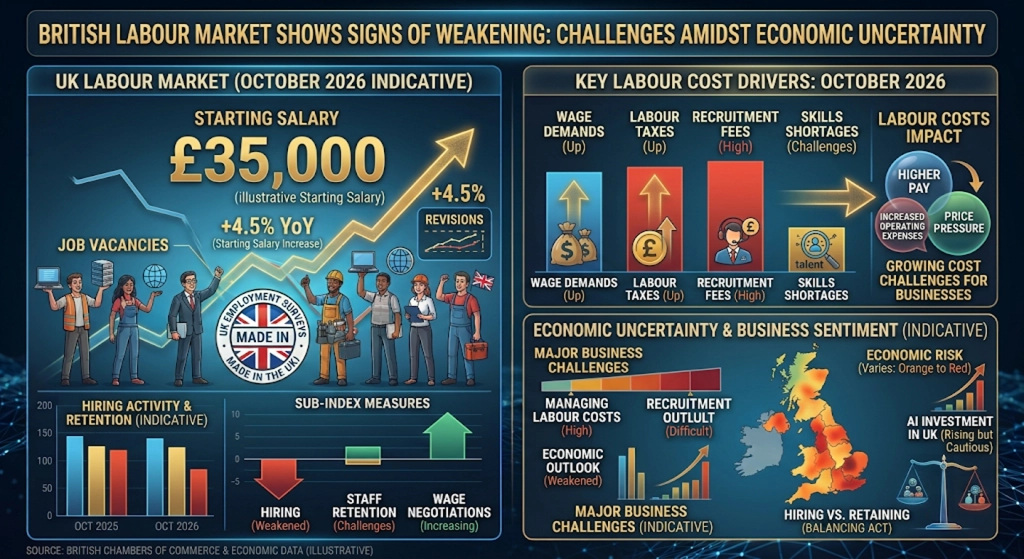
The United Kingdom’s labour market showed further signs of weakening in October 2026, as employers became more cautious about recruitment while starting salaries continued to increase. A survey conducted by the Recruitment and Employment Confederation (REC) and KPMG found that permanent job placements declined for the first time in four months. At the same time, starting salaries for newly appointed permanent employees increased at a faster pace.
The findings highlight a difficult situation for British businesses. Companies are facing economic uncertainty, higher operating expenses and rising employment costs, making recruitment decisions increasingly complicated. Although demand for workers has not collapsed, the latest indicators suggest that employers are prioritising cost control and delaying some hiring plans.
Permanent Hiring Activity Loses Momentum
The KPMG–REC UK Report on Jobs, compiled by S&P Global, recorded a decline in permanent staff placements during October. The Permanent Placements Index fell to 46.6, down from 50.9 in September. A reading below 50 indicates a contraction in recruitment activity.
This represented the first decline in permanent placements in four months. Recruiters reported that businesses were postponing recruitment decisions, reducing hiring plans and taking a more cautious approach because of economic uncertainty and rising employment costs.
Temporary recruitment also weakened. The Temporary Billings Index declined to 48.9 from 50.9 in September, marking the first fall in temporary staff billings since March.
The figures suggest that businesses are becoming more selective about workforce expansion. Instead of committing to permanent appointments, some employers may be relying on existing employees, restructuring teams or delaying recruitment until economic conditions become clearer.
Starting Salaries Continue to Increase
Despite weaker hiring activity, starting salaries for permanent positions increased at a faster pace in October. Recruiters also reported stronger growth in temporary staff wages.
The increase reflects continued competition for skilled candidates in particular occupations. Employers seeking experienced professionals may need to offer higher starting salaries to attract suitable applicants, even when their overall recruitment budgets are under pressure.
However, the survey noted that salary growth remained subdued compared with historical averages. This suggests that the increase should not be interpreted as evidence of widespread wage inflation across the entire UK labour market.
The situation creates a difficult balance for businesses. Companies want to control employment expenses, but offering competitive salaries remains important for attracting and retaining workers with specialist skills.
Candidate Availability Increases as Vacancies Decline
Another important development was the increase in the availability of candidates. Recruiters reported a sharper rise in the number of people seeking permanent and temporary positions during October.
Redundancies and fewer available job opportunities contributed to the increase. As recruitment activity slowed, more candidates entered the employment market, giving businesses a larger pool of potential applicants.
At the same time, overall vacancies declined at the slowest pace in more than two years. Permanent vacancies fell at their weakest rate since August 2024, while demand for temporary workers increased slightly after two months of contraction.
This indicates that the labour market is not experiencing a uniform decline. Some businesses continue to recruit, while others are reducing vacancies or delaying appointments. Demand for permanent workers remained relatively strong in information technology, engineering, construction and accounting and finance, whereas retail and hospitality experienced weaker recruitment demand.
Rising Employment Costs Increase Business Pressure
Employment costs remain an important consideration for British companies. Businesses must account for wages, recruitment expenses, workplace regulations and other operating obligations when deciding whether to expand their workforce.
Higher borrowing costs and uncertainty about future economic conditions can make these decisions more difficult. Smaller companies are particularly vulnerable because they generally have less financial flexibility than large corporations.
The Bank of England’s October assessment of business conditions also highlighted the pressure. Its regional intelligence indicated that subdued demand, high labour costs and uncertainty surrounding domestic policy were limiting recruitment across several sectors.
Businesses are increasingly focusing on productivity and operational efficiency. Some manufacturers are investing in automation to manage labour expenses, while service-sector companies are reviewing staffing requirements to protect profit margins.
If these pressures continue, employers may become even more cautious about creating new positions, potentially slowing employment growth over the coming months.
Bank of England Faces a Difficult Economic Balance
The weakening recruitment environment comes at a challenging time for the Bank of England. The central bank increased its Bank Rate from 3.75% to 4% in November 2026, its first interest-rate increase since August 2023.
The decision reflects concerns about persistent inflationary pressures, including higher energy-related costs. However, tighter monetary policy can also increase borrowing expenses for households and businesses, potentially weakening investment and employment demand.
Bank of England Deputy Governor Clare Lombardelli has described the labour market as operating in a low-activity environment, with reduced hiring and fewer workers changing jobs. She has also indicated that another interest-rate increase cannot be ruled out, depending on inflation, energy prices and wider economic developments.
The central bank therefore faces a difficult balancing act. It must prevent inflation from becoming persistent without creating excessive pressure on businesses that are already showing signs of recruitment weakness.
Implications for the UK Economy
The labour market plays a central role in determining household income, consumer spending and overall economic growth. When employers reduce recruitment, fewer people may find new employment opportunities, while existing workers may become more cautious about changing jobs.
This can influence consumer confidence and spending, particularly if households become concerned about job security or future income growth.
For retailers, hospitality businesses and other consumer-facing industries, weaker employment conditions may eventually translate into reduced demand. Businesses could respond by limiting expansion, reducing investment or postponing new recruitment.
However, the increase in candidate availability and relatively gradual decline in vacancies also suggest that the market retains some resilience. The performance of individual sectors will be important in determining whether the slowdown becomes more widespread.
Implications for India and Global Businesses
Developments in the British labour market are relevant to India because the two countries maintain important commercial relationships across information technology, financial services, pharmaceuticals, engineering, education and professional services.
If UK companies become more cautious about hiring and investment, Indian IT service providers and outsourcing businesses may face slower demand for certain projects. Companies supplying professional services to British clients may also experience greater pressure on pricing and contract renewals.
However, rising demand for specialised skills could continue to create opportunities for Indian technology professionals and service providers, particularly in areas such as software development, cybersecurity, data analytics and artificial intelligence.
Indian businesses operating in the UK should monitor employment costs, consumer demand and interest-rate developments when planning recruitment and investment.
The Worldonomics Times Views
The UK’s October labour-market survey highlights an increasingly complicated environment for businesses. Permanent hiring has weakened, temporary recruitment has also declined, and candidate availability has increased. At the same time, starting salaries are rising as employers compete for selected skilled workers.
This combination reflects the challenge of managing employment expenses while maintaining access to the talent required for business growth. If recruitment weakness continues, it could affect household confidence, consumer spending and the wider economic outlook.
Policymakers should focus on encouraging business investment, supporting skills development and maintaining a stable environment for employment creation. The Bank of England must also carefully assess the relationship between inflation and labour-market weakness when determining future interest-rate decisions.
For the UK economy, the central challenge is to prevent a cautious hiring environment from becoming a prolonged employment slowdown. The coming months will reveal whether businesses regain confidence or continue prioritising cost control over workforce expansion.