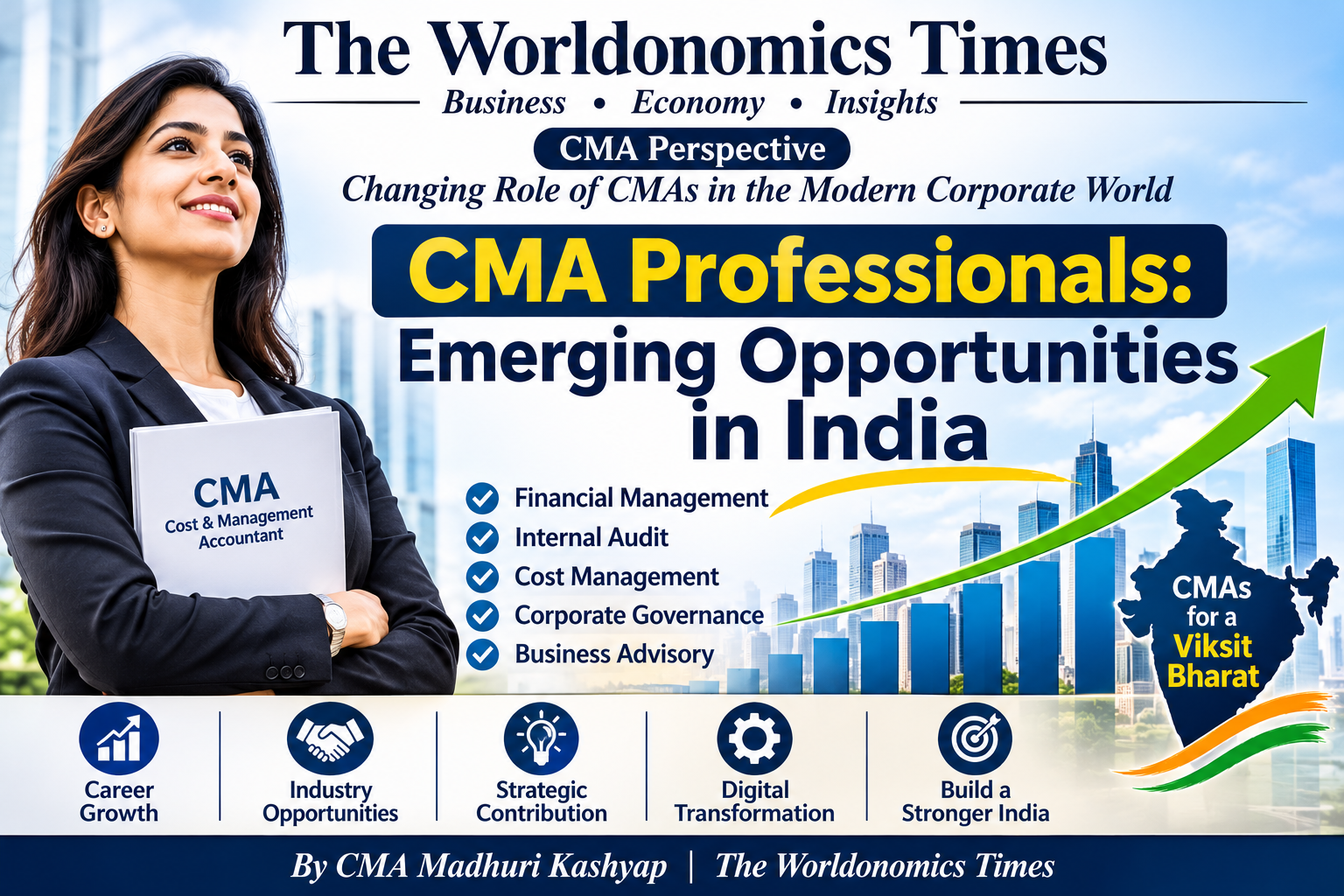
Changing Role of CMAs in the Modern Corporate World
By CMA Madhuri Kashyap
The Worldonomics Times | CMA Perspective
Introduction
India’s rapidly growing economy, expanding corporate sector and evolving business environment have created new opportunities for finance and accounting professionals. Among them, Cost and Management Accountants (CMAs) are playing an increasingly important role in strengthening financial management, improving business efficiency and supporting strategic decision-making.
Traditionally, CMAs were primarily associated with cost accounting, cost control and cost audit. However, their professional responsibilities have expanded significantly. Today, organisations increasingly require professionals who can analyse financial information, manage business risks, improve operational performance and contribute to long-term corporate strategy.
With India’s focus on manufacturing growth, infrastructure development, MSME expansion, digital transformation and global trade, CMAs have opportunities across multiple industries and professional domains.
1. Growing Demand in Corporate Financial Management
Financial management is one of the most important areas where CMAs can build successful careers. Businesses need professionals who can manage financial resources, prepare budgets, monitor expenditure and evaluate financial performance.
CMAs contribute through:
- Budget preparation and financial planning.
- Working capital management.
- Cash flow forecasting.
- Financial performance analysis.
- Cost optimisation and profitability assessment.
- Management reporting and decision support.
Their ability to connect financial data with business operations makes them valuable members of corporate finance teams.
2. Opportunities in the Manufacturing and Industrial Sector
India’s manufacturing sector offers significant opportunities for CMA professionals. Government initiatives promoting domestic manufacturing, infrastructure and industrial development have increased the importance of cost efficiency and productivity.
Manufacturing organisations require CMAs to analyse production costs, identify operational inefficiencies, evaluate capacity utilisation and improve resource allocation.
CMAs can work in sectors such as automobiles, textiles, pharmaceuticals, steel, cement, engineering, chemicals, electronics and food processing.
Their contribution helps companies improve competitiveness while maintaining product quality and profitability.
3. Expanding Role in MSME Development
Micro, Small and Medium Enterprises are essential to India’s economic development. However, many MSMEs face challenges involving financial planning, working capital, cost management, pricing and access to institutional finance.
CMA professionals can support MSMEs by providing:
- Cost and profitability analysis.
- Financial planning and budgeting.
- Project reports and feasibility studies.
- Working capital assessment.
- Inventory and cash flow management.
- Financial discipline and management reporting.
By helping small businesses understand their financial position and improve operational efficiency, CMAs can contribute to entrepreneurship, employment generation and sustainable industrial growth.
4. Emerging Opportunities in Internal Audit and Risk Management
Corporate governance and risk management have become important priorities for businesses. Organisations need effective internal controls to protect assets, prevent irregularities and ensure compliance with applicable laws and policies.
CMAs can contribute to internal audit, operational audit, risk assessment and process improvement. Their understanding of financial systems and business processes enables them to identify weaknesses and recommend corrective measures.
Internal audit opportunities are available in companies, financial institutions, manufacturing organisations, consulting firms and professional practices.
5. Cost Audit and Corporate Governance
Cost audit remains an important professional area for CMAs, particularly in industries covered by the applicable provisions of the Companies Act, 2013 and the Cost Records and Audit Rules.
Cost records and cost audit can help organisations understand production costs, resource utilisation and operational performance. They also support transparency and accountability.
CMA professionals can build expertise in cost audit, cost compliance, cost records maintenance, cost analysis and management reporting.
6. Opportunities in Taxation, GST and FEMA
The increasing complexity of regulatory requirements has created opportunities for CMAs in taxation and compliance-related services.
Professionals can develop expertise in GST, tax planning, tax audits where legally permitted, indirect tax compliance, transfer pricing support and Foreign Exchange Management Act (FEMA) matters.
Businesses engaged in imports, exports, foreign investments and international transactions require professionals who understand financial regulations and compliance procedures.
CMAs can contribute by helping organisations strengthen documentation, monitor regulatory obligations and manage financial compliance risks, subject to applicable professional and statutory requirements.
7. Digital Transformation and Data Analytics
Technology is changing the finance profession. Artificial intelligence, automation, enterprise resource planning systems, business intelligence tools and data analytics are transforming the way organisations manage financial information.
Modern CMAs need to develop digital capabilities alongside traditional accounting and finance knowledge.
Skills in advanced Excel, ERP platforms, Power BI, data analytics, financial modelling and automation can improve their professional opportunities.
A CMA who can interpret large volumes of business data and convert them into meaningful insights can contribute directly to strategic decision-making.
8. Consulting, Entrepreneurship and Independent Practice
CMA professionals can also explore independent professional practice, consultancy and entrepreneurship, subject to applicable regulations.
They may provide eligible services in cost management, financial planning, business advisory, project consultancy, internal audit, management accounting and performance improvement.
There is considerable potential in serving MSMEs, startups, manufacturing units and growing enterprises that require professional financial guidance but may not have large in-house finance departments.
9. Skills Required for the Future CMA
To remain competitive, CMA professionals must continuously upgrade their knowledge and capabilities.
Important skills include:
- Strategic thinking and business communication.
- Financial analysis and modelling.
- Data analytics and digital technology.
- Risk management and corporate governance.
- Leadership and problem-solving.
- Knowledge of taxation and regulatory developments.
- Industry-specific cost and performance management.
Professional development, practical exposure and continuous learning will be essential for long-term career growth.
Conclusion
The role of Cost and Management Accountants in India is moving beyond traditional cost accounting. CMAs are increasingly contributing to financial strategy, corporate governance, risk management, digital transformation and business development.
As India advances towards becoming a stronger manufacturing and globally competitive economy, the demand for professionals who can improve financial efficiency and support sustainable business growth is likely to create new opportunities.
For CMA professionals, the future will belong to those who combine technical expertise with strategic thinking, digital capabilities and practical business understanding.
CMAs are not merely financial professionals; they are emerging partners in business growth, corporate efficiency and India’s economic progress.