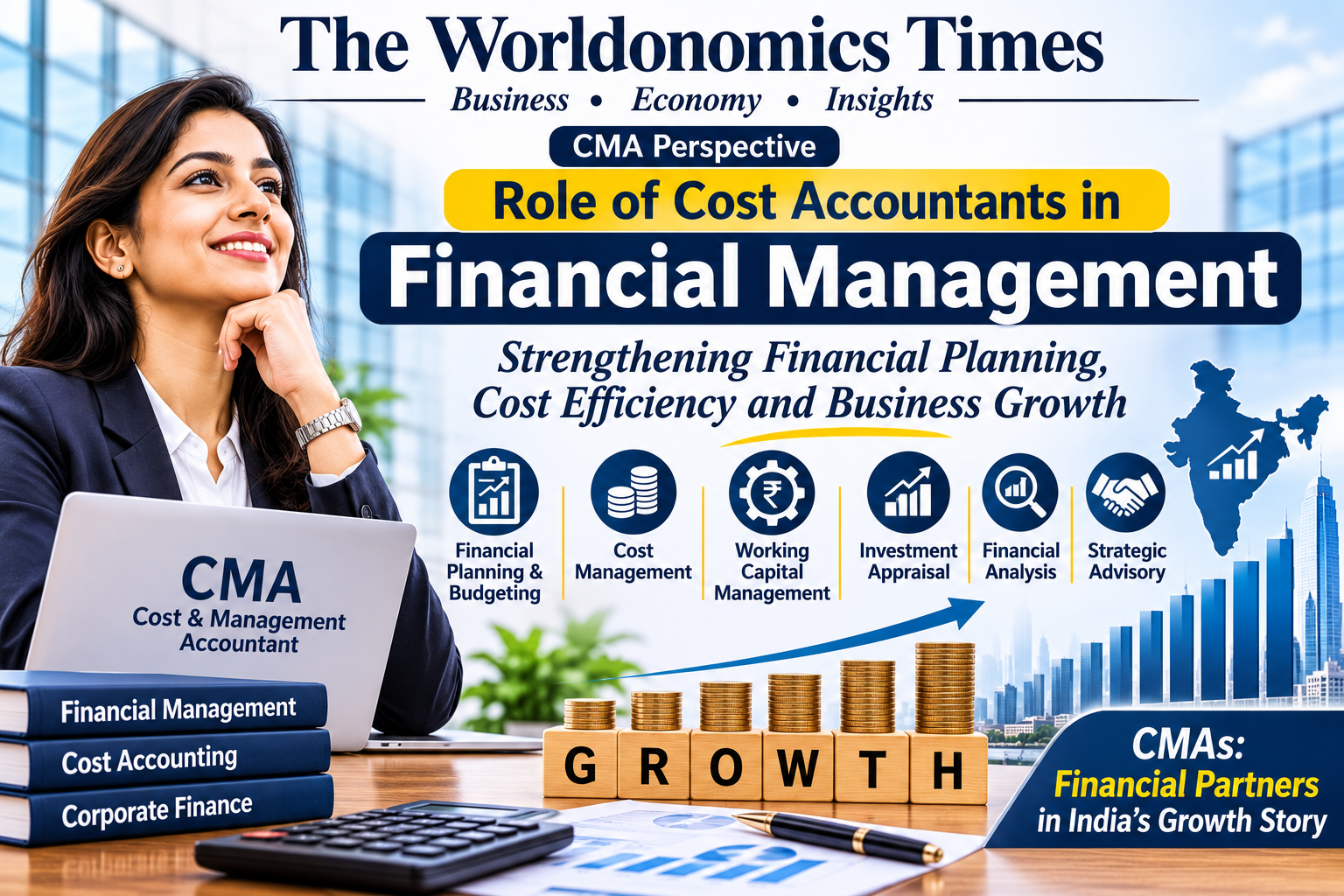
Strengthening Financial Planning, Cost Efficiency and Business Growth
By CMA Madhuri Kashyap
The Worldonomics Times | CMA Perspective
Introduction
Financial management is the backbone of every successful organisation. In an increasingly competitive business environment, companies must manage their financial resources carefully, control expenditure, improve profitability and make informed investment decisions. This has made the role of Cost and Management Accountants (CMAs) increasingly important in modern business.
Traditionally, cost accountants were associated mainly with cost calculation, cost control and cost audit. Today, their responsibilities extend far beyond these traditional functions. They contribute to financial planning, budgeting, working capital management, investment evaluation, performance measurement and strategic decision-making.
By combining financial knowledge with an understanding of business operations, CMAs help organisations achieve financial discipline and sustainable growth.
1. Financial Planning and Budgetary Control
Financial planning enables an organisation to determine how financial resources should be generated, allocated and utilised. CMAs play an important role in preparing financial plans that support organisational objectives.
They assist management in preparing budgets for production, sales, administration, capital expenditure and operating activities. They also compare actual performance with budgeted targets to identify variations.
Through budgetary control, CMAs help organisations:
- Monitor expenditure and prevent unnecessary costs.
- Identify unfavourable financial variances.
- Improve departmental accountability.
- Allocate resources efficiently.
- Maintain financial discipline.
Effective budgeting helps businesses anticipate financial requirements and respond to changing market conditions.
2. Cost Management and Profitability Improvement
Cost management is one of the core strengths of CMA professionals. Every organisation seeks to improve profitability without compromising product quality or customer satisfaction.
CMAs analyse material costs, labour expenses, overheads, production processes and operating expenditure. They identify cost inefficiencies and recommend corrective measures.
Important techniques include standard costing, marginal costing, activity-based costing, cost-volume-profit analysis and variance analysis.
By applying these techniques, CMAs help management understand product-wise and service-wise profitability, establish appropriate pricing strategies and improve the overall cost structure.
3. Working Capital Management
Working capital is essential for maintaining the day-to-day operations of a business. Insufficient working capital can affect production, delay payments and disrupt business activities.
CMAs contribute to working capital management by analysing inventory levels, receivables, payables and cash requirements.
Their responsibilities may include:
- Monitoring inventory turnover.
- Evaluating customer credit policies.
- Improving collection efficiency.
- Planning short-term cash requirements.
- Analysing the working capital cycle.
Efficient working capital management helps organisations maintain liquidity while reducing the cost of holding excessive funds in inventory or receivables.
4. Cash Flow Management and Financial Stability
Profitability does not always mean that a business has sufficient cash. Even profitable organisations can experience financial difficulties when cash inflows and outflows are not managed properly.
CMAs help prepare cash flow forecasts, monitor liquidity and identify possible funding gaps. They analyse the timing of receipts and payments and assist management in planning short-term financial requirements.
This is particularly important for MSMEs, startups and growing enterprises, where delayed customer payments and limited access to finance can create operational challenges.
5. Investment Appraisal and Capital Budgeting
Businesses regularly make decisions about purchasing machinery, expanding production capacity, establishing new facilities and adopting technology.
Such decisions involve significant financial commitments. CMAs support investment appraisal by evaluating the financial feasibility and expected returns of proposed projects.
Common capital budgeting techniques include:
- Net Present Value (NPV).
- Internal Rate of Return (IRR).
- Payback Period.
- Profitability Index.
- Cost-benefit analysis.
These techniques help management assess investment risks, compare alternatives and select projects that align with long-term business objectives.
6. Financial Analysis and Management Decision-Making
Financial statements provide important information about an organisation’s financial position and performance. However, management needs meaningful analysis to convert accounting information into business decisions.
CMAs use financial ratios, trend analysis, variance analysis and performance indicators to evaluate profitability, liquidity, solvency and operational efficiency.
They prepare management reports that highlight financial strengths, weaknesses and emerging risks. Their analysis helps management make decisions relating to pricing, production, expansion, financing and resource allocation.
7. Financial Management in MSMEs
Micro, Small and Medium Enterprises are important contributors to employment, manufacturing and economic development in India. However, many MSMEs face challenges involving limited financial resources, rising input costs, delayed payments and inadequate financial planning.
CMA professionals can support MSMEs through cost analysis, project feasibility reports, financial planning, budgeting, working capital assessment and profitability improvement.
By strengthening financial management practices, CMAs can help small businesses improve their financial discipline, become more competitive and prepare for sustainable expansion.
8. Digital Transformation in Financial Management
Technology is changing the way businesses manage financial information. Enterprise Resource Planning (ERP) systems, artificial intelligence, automation, cloud accounting and data analytics are making financial processes faster and more integrated.
Modern CMAs can use digital tools to analyse large volumes of financial data, automate reporting, monitor business performance and identify unusual cost patterns.
Knowledge of advanced Excel, ERP platforms, Power BI, financial modelling and data analytics can strengthen a CMA’s ability to provide timely and actionable financial insights.
9. CMAs as Strategic Financial Partners
The modern CMA is increasingly becoming a strategic partner to business leadership. Instead of merely reporting historical financial information, CMAs help management understand future financial implications and evaluate business alternatives.
They contribute to long-term planning, risk assessment, operational improvement, investment decisions and corporate performance management.
Their ability to connect financial outcomes with operational activities makes them valuable participants in boardroom discussions and strategic business planning.
Conclusion
The role of Cost Accountants in financial management has evolved from traditional cost calculation and expenditure control to a broader responsibility involving financial strategy, business performance and organisational growth.
In today’s corporate world, CMAs are important contributors to budgeting, working capital management, investment appraisal, financial analysis and digital transformation. Their expertise helps organisations use financial resources efficiently, strengthen profitability and maintain long-term financial stability.
As India’s economy expands and businesses face increasingly complex financial challenges, the contribution of CMA professionals will become even more significant.
A modern CMA is not just a custodian of costs but a financial partner who helps businesses make better decisions, create value and achieve sustainable growth.