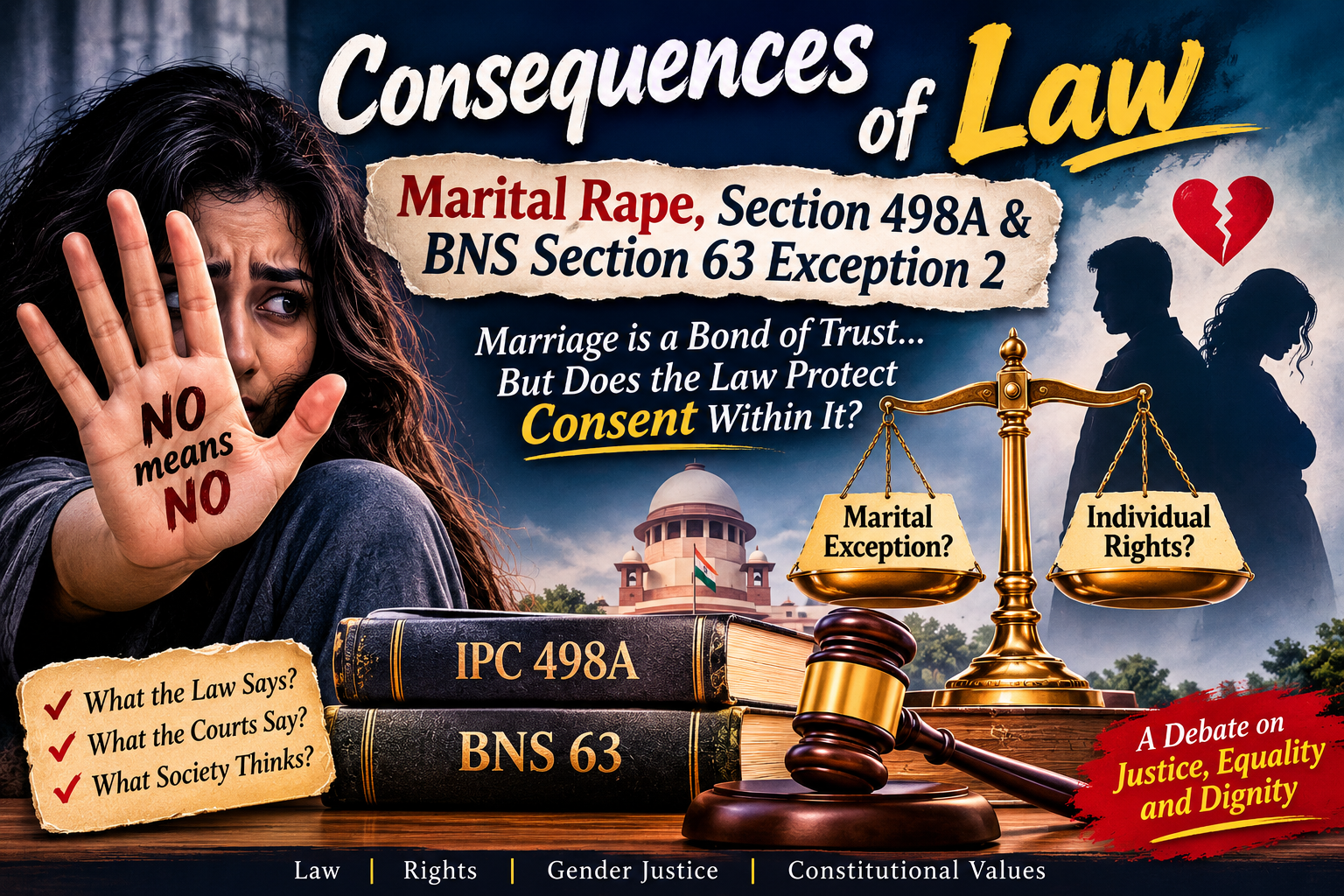
Marital Rape, Section 498A of the IPC and Exception 2 to Section 63 of the Bharatiya Nyaya Sanhita, 2023
An exploration of legal protection, marital rights, individual autonomy and the consequences of legislative exceptions.
Introduction: Does Marriage Mean Permanent Consent?
Marriage is traditionally regarded as a social institution founded upon companionship, trust, mutual respect and shared responsibilities. However, when a relationship that is expected to provide emotional and physical security becomes a source of coercion, violence or exploitation, an important legal and constitutional question emerges: Does marriage give one spouse an unrestricted right over the body and autonomy of the other?
This question becomes particularly significant in the debate surrounding marital rape in India.
The issue is not simply about sexual relations between married individuals. It concerns the meaning of consent, the limits of marital obligations, the protection of individual dignity and the extent to which criminal law should intervene in private relationships.
India’s legal framework presents an interesting contradiction. On one hand, the law recognises cruelty within marriage as a punishable offence. On the other hand, it continues to maintain a statutory exception that excludes certain non-consensual sexual acts by a husband against his adult wife from the legal definition of rape.
This raises a fundamental question: Can an act be considered an infringement of a woman’s dignity and bodily autonomy, yet remain outside the statutory definition of rape merely because the parties are legally married?
1. Understanding the Legal Framework: From IPC to BNS
To understand the controversy, it is necessary to examine three important statutory provisions.
A. Section 498A of the Indian Penal Code, 1860
Section 498A was introduced to address cruelty inflicted upon married women by their husbands or their relatives.
It defines cruelty broadly through two principal categories:
- Wilful conduct likely to drive a woman to suicide or cause grave injury or danger to her life, limb or physical or mental health.
- Harassment intended to coerce her or her relatives into meeting unlawful demands for property or valuable security, or harassment arising from failure to meet such demands.
The provision recognises that cruelty within marriage is not limited to physical violence. Mental suffering, coercion and harassment can also attract criminal consequences when the statutory ingredients are established.
However, an important distinction must be understood: Section 498A does not specifically define marital rape as a separate offence. Depending upon the facts, conduct involving sexual coercion may form part of the evidence of cruelty, but that does not automatically establish an offence under Section 498A.
B. Exception 2 to Section 375 of the IPC
The controversy surrounding marital rape primarily originates from Exception 2 to Section 375 of the IPC.
The exception provided that sexual intercourse or sexual acts by a man with his own wife, where the wife was not below eighteen years of age, would not constitute rape.
Consequently, conduct that could otherwise satisfy the ingredients of rape when committed outside marriage was excluded from that definition when the parties were married and the wife was an adult.
The provision has historically been criticised for treating marital status as a basis for distinguishing between sexual violence within and outside marriage.
C. Section 63 of the Bharatiya Nyaya Sanhita, 2023
With the introduction of the Bharatiya Nyaya Sanhita (BNS), effective from 1 July 2024, the criminal law framework underwent substantial restructuring.
However, the controversy did not disappear.
Exception 2 to Section 63 of the BNS retains the following position:
“Sexual intercourse or sexual acts by a man with his own wife, the wife not being under eighteen years of age, is not rape.”
Thus, although the IPC was replaced by the BNS, the fundamental statutory exception concerning marital rape was retained.
It is also important to note that Section 498A IPC has a corresponding provision under Sections 85 and 86 of the BNS, dealing with cruelty by a husband or his relatives and the meaning of cruelty.
Accordingly, the distinction between the two criminal law regimes must be maintained: the IPC ordinarily governs offences committed before 1 July 2024, subject to the applicable savings provisions, while the BNS governs offences committed thereafter.
2. The Central Conflict: Consent Versus Marital Status
One of the most significant features of Section 63 BNS is its explanation of consent.
The provision recognises consent as an unequivocal voluntary agreement communicated through words, gestures or any form of verbal or non-verbal communication. It also clarifies that merely failing to physically resist does not, by itself, amount to consent.
This recognition reflects an important legal principle: consent must be voluntary and specific to the sexual activity.
However, Exception 2 creates a different statutory treatment for sexual acts within an existing marriage where the wife is at least eighteen years old.
This creates an apparent contradiction within the same provision.
The law recognises that consent is essential in determining rape, yet it excludes certain acts from the definition of rape because of the marital relationship.
The debate, therefore, is not whether marriage creates responsibilities between spouses. It is whether those responsibilities can legally override the individual’s right to decide what happens to their own body.
A marriage certificate cannot, in an ethical sense, be treated as a perpetual declaration of consent.
3. The Consequences of the Existing Legal Position
The consequences of retaining the marital rape exception extend beyond the interpretation of a single statutory provision.
A. The question of unequal legal protection
A woman subjected to non-consensual sexual intercourse by a person outside marriage may invoke the provisions relating to rape, subject to the statutory requirements.
However, where the same conduct occurs within a marriage involving an adult wife, Exception 2 excludes it from the definition of rape.
This creates a distinction based on marital status.
The constitutional debate concerns whether such a distinction is compatible with Articles 14 and 21 of the Constitution, particularly the principles of equality, dignity, privacy and personal liberty.
B. The difficulty of recognising sexual violence within marriage
Sexual violence within marriage may be accompanied by threats, emotional manipulation, physical force, financial dependence or fear of social consequences.
Victims may also face difficulties in reporting such conduct because of family pressure, social stigma, economic dependence and concerns about children or the future of the marriage.
When the law excludes a particular category of conduct from the definition of rape, it may also influence how victims understand their rights and how society perceives their experiences.
C. The limitations of alternative legal remedies
The existence of the marital rape exception does not mean that every form of violence within marriage is legally permissible.
Depending on the facts, other legal provisions may apply.
These include:
- Sections 85 and 86 of the BNS, where the ingredients of cruelty are established.
- The Protection of Women from Domestic Violence Act, 2005, which expressly recognises sexual abuse as a form of domestic violence.
- Other applicable provisions concerning physical assault, hurt, grievous hurt, criminal intimidation and other offences.
- Section 67 of the BNS, which addresses sexual intercourse by a husband with his wife during separation, subject to its statutory ingredients.
Nevertheless, these remedies are not necessarily equivalent to recognising non-consensual sexual intercourse within marriage as rape.
A remedy for domestic violence, cruelty or physical injury does not automatically provide the same legal recognition, classification or consequences as a prosecution for rape.
This is where the debate becomes particularly important.
4. The Constitutional Dimension: Is Marriage a Reasonable Classification?
The marital rape debate is not merely a disagreement about social values. It raises serious questions of constitutional interpretation.
Three constitutional principles deserve particular attention.
Article 14 – Equality before the law
Does the distinction between married and unmarried women, in the context of non-consensual sexual acts, satisfy the constitutional requirements of reasonable classification?
Article 21 – Right to life and personal liberty
The right to life has been interpreted to include dignity, bodily integrity, privacy and personal autonomy. Can these rights be meaningfully protected if consent is treated differently solely because of marriage?
Article 15 – Prohibition of discrimination
Does the differential treatment of married women raise concerns about discrimination on the ground of sex, particularly when considered alongside the constitutional guarantees of equality?
The central constitutional challenge is whether the institution of marriage can justify an exception that would otherwise deny an adult woman the same protection against sexual violence.
5. The Judicial Debate: An Issue Still Before the Supreme Court
The controversy has already received considerable judicial attention.
In May 2022, the Delhi High Court delivered a split verdict in RIT Foundation v. Union of India concerning the constitutional validity of Exception 2 to Section 375 IPC.
One judge considered the exception unconstitutional, while the other upheld its validity. Consequently, the exception was not struck down by a majority of the Delhi High Court.
The matter subsequently reached the Supreme Court.
The Supreme Court is examining challenges concerning the exception under the IPC and its corresponding provision under Section 63 of the BNS.
In September 2026, the Supreme Court indicated that it would examine both the constitutional validity of the exception and whether prosecution could be sustained despite its continued existence.
The Court also recognised that marriage does not extinguish an individual’s autonomy, while highlighting the legal difficulty of prosecuting conduct expressly excluded by a statutory provision.
As of 24 November 2026, the matter remains pending. The Supreme Court has indicated that the final hearing is tentatively scheduled for 9 or 10 December 2026.
Therefore, it would be legally incorrect to state that the marital rape exception has already been declared unconstitutional or that the issue has been finally settled.
6. The Broader Social Consequences: Beyond the Courtroom
The implications of the marital rape exception are not confined to criminal proceedings.
They extend into the social understanding of marriage itself.
First, the perception of marital rights: If sexual access is perceived as an automatic consequence of marriage, the distinction between mutual intimacy and coercion becomes blurred.
Second, the importance of awareness: A lack of understanding of consent may normalise behaviour that causes physical and psychological harm.
Third, the role of the legal system: Criminal law must balance the protection of victims, the rights of the accused, due process and the constitutional limitations on state power.
Fourth, the institution of marriage: Recognising consent does not undermine marriage. Rather, it encourages a relationship based on mutual respect instead of entitlement.
The objective should not be to treat every marital disagreement as a criminal offence. Nor should the privacy of marriage become a shield for conduct that violates individual dignity.
The challenge lies in creating a framework that protects victims while ensuring fair investigation, reliable evidence and safeguards against misuse of criminal law.
7. The Way Forward: What Should the Law Recognise?
A meaningful legal reform debate should consider the following questions:
- Should the absence of consent have the same legal significance irrespective of whether the parties are married?
- Should marital rape be recognised as a distinct offence or incorporated within the general definition of rape?
- How should the law distinguish between ordinary marital disagreements and coercive sexual conduct?
- What safeguards should be introduced to protect both complainants and accused persons against procedural injustice?
- Should the law provide specialised investigation, medical assistance, counselling and support mechanisms for survivors?
- How can the legal system address false or malicious allegations without discouraging genuine victims from reporting sexual violence?
These questions deserve serious consideration by Parliament, the judiciary, legal practitioners, women’s rights organisations and society.
Conclusion: Does the Law Protect the Relationship or the Individual?
The debate surrounding marital rape ultimately forces society to confront an uncomfortable question: What should prevail when the traditional understanding of marital obligations conflicts with an individual’s fundamental right to bodily autonomy?
Section 498A IPC and Sections 85–86 BNS recognise that marriage does not eliminate the possibility of cruelty. The Protection of Women from Domestic Violence Act, 2005, also recognises sexual abuse within domestic relationships.
Yet Exception 2 to Section 375 IPC and Exception 2 to Section 63 BNS continue to distinguish certain sexual acts within marriage from rape.
The consequences of this distinction are significant because legal recognition shapes not only the remedies available to individuals but also society’s understanding of rights, responsibilities and acceptable conduct.
Ultimately, the purpose of marriage should be companionship, not ownership; intimacy, not entitlement; and mutual consent, not compulsion.
The real question is not whether the law should protect marriage. It is whether the protection of marriage should ever come at the cost of the dignity and autonomy of an individual.