Published by: The Worldonomics Times
Date: 24 November 2026
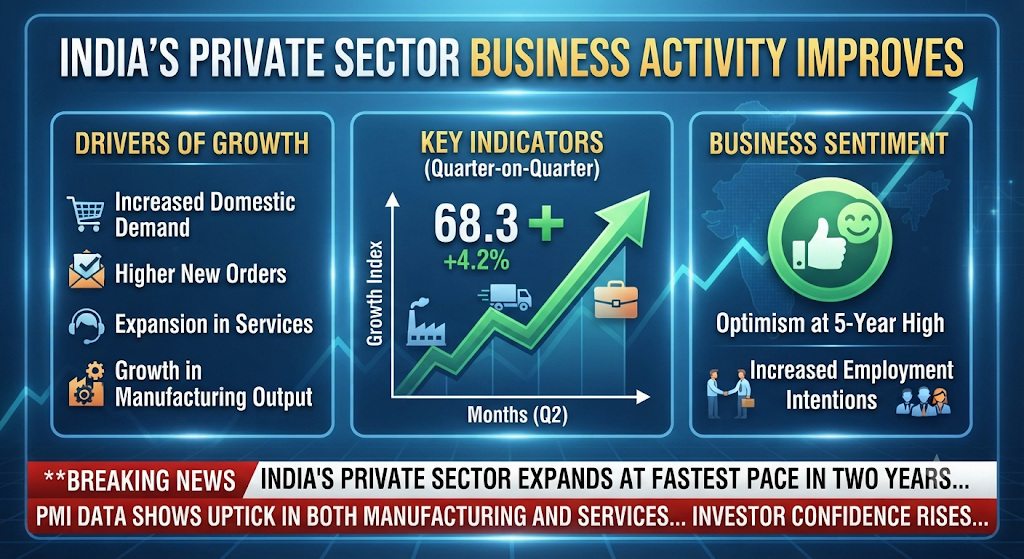
India’s private sector business activity showed signs of improvement in November 2026, supported by stronger manufacturing performance and continued expansion across key business segments. The improvement highlights the resilience of India’s domestic economy and reflects sustained demand across various industrial and service sectors.
The latest business activity trends offer encouraging signals for India’s economic outlook, particularly at a time when inflationary pressures, global uncertainties and changing international trade conditions continue to influence business decisions.
The manufacturing sector’s contribution is especially important because industrial expansion supports employment generation, investment, supply-chain development and overall economic productivity.
Manufacturing Sector Provides Support to Economic Growth
Manufacturing remains an important pillar of India’s economic development. From automobiles and electronics to pharmaceuticals, textiles and engineering goods, the sector contributes significantly to industrial output and employment.
Improved manufacturing activity indicates that businesses may be experiencing stronger demand, better production conditions and increased confidence in market opportunities.
Government initiatives such as Make in India, the Production Linked Incentive (PLI) schemes and infrastructure development have also encouraged domestic manufacturing capabilities.
These initiatives aim to reduce dependence on imports, attract investment and strengthen India’s position in international supply chains.
An improvement in manufacturing performance can create positive effects across connected industries, including transportation, logistics, raw materials, packaging and industrial equipment.
Domestic Demand Continues to Play an Important Role
India’s large consumer market remains one of its major economic strengths. Rising urbanisation, infrastructure development, digital adoption and changing consumption patterns have contributed to demand across several industries.
When consumer demand improves, businesses may increase production, expand distribution networks and invest in additional capacity.
The automobile, consumer electronics, construction materials and household goods industries can benefit from stronger purchasing activity.
Domestic consumption is particularly important because it provides a degree of support against fluctuations in global demand.
However, the sustainability of this momentum will depend on employment growth, household purchasing power, inflation trends and the availability of affordable credit.
Business Confidence and Investment Opportunities
Improving private sector activity can influence business confidence and investment decisions.
When companies experience stronger demand and better operating conditions, they may become more willing to invest in new facilities, technology, machinery and workforce expansion.
For small and medium-sized enterprises (SMEs), improving industrial activity can create opportunities to secure new orders and become part of larger manufacturing supply chains.
India’s startup ecosystem and technology-driven businesses may also benefit from stronger economic activity, particularly in areas such as industrial automation, financial technology, software development and digital commerce.
Nevertheless, businesses must continue to manage operational expenses, financing costs and competitive pressures.
Services Sector Remains an Important Economic Contributor
Although manufacturing has supported the improvement in private sector activity, the services sector remains central to India’s economic performance.
Information technology, financial services, telecommunications, hospitality, transportation and professional services contribute significantly to economic output.
The expansion of digital infrastructure and technology adoption has helped businesses improve efficiency and reach wider markets.
India’s IT and business services industries also maintain an important presence in international markets, generating export earnings and employment opportunities.
A balanced expansion across manufacturing and services will be important for maintaining economic stability and supporting long-term development.
Challenges That Could Influence Future Growth
Despite the encouraging improvement, India’s private sector continues to face several economic challenges.
Inflation remains a concern because rising raw material, energy and transportation costs can affect business profitability.
Global economic uncertainty may also influence export demand, foreign investment and international supply chains.
Small businesses can face additional difficulties due to limited access to affordable financing, changing market conditions and operational expenses.
Furthermore, manufacturing growth needs to be supported by improvements in logistics, workforce skills, technological capabilities and infrastructure.
Addressing these structural challenges will be necessary to ensure that improvements in business activity translate into sustainable economic development.
What Does This Mean for India’s Economic Outlook?
The improvement in private sector business activity provides a positive indication of economic momentum heading into the final months of 2026.
Stronger manufacturing performance can support industrial production, encourage investment and create additional employment opportunities.
However, business activity indicators should be considered alongside other economic measures, including GDP growth, industrial production, inflation, employment and exports.
A single month’s improvement does not necessarily guarantee sustained economic expansion. Consistency across multiple months and sectors will be important in assessing the strength of India’s recovery and growth trajectory.
For policymakers, the priority will be to maintain a supportive business environment while ensuring price stability and encouraging private investment.
The Worldonomics Times View
The improvement in India’s private sector business activity during November 2026 offers an encouraging indication of the country’s industrial and economic potential.
Stronger manufacturing performance is important not only for increasing production but also for generating employment, strengthening domestic supply chains and attracting long-term investment.
However, sustainable economic growth requires more than an increase in business activity. India must continue addressing inflation, improving infrastructure, expanding access to finance and developing a skilled workforce.
The Worldonomics Times believes that manufacturing-led growth, supported by a competitive services sector and healthy domestic consumption, can play an important role in India’s economic development.
The focus should now be on converting short-term business momentum into long-term industrial competitiveness.
India’s economic progress will ultimately depend on its ability to transform rising business activity into higher productivity, better employment opportunities and inclusive economic growth.