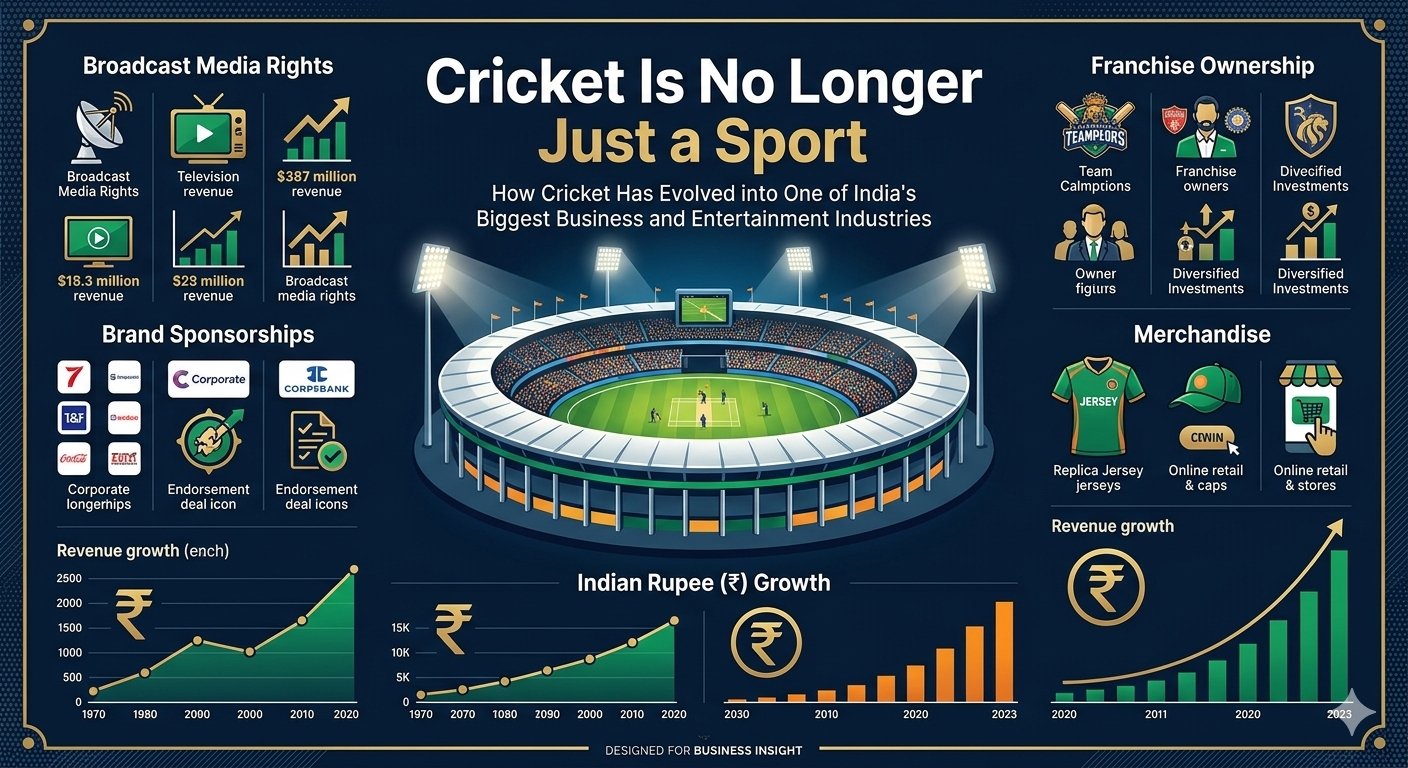
How Cricket Has Evolved into One of India’s Biggest Business and Entertainment Industries
For millions of Indians, cricket is an emotion. A last-over finish, a spectacular century or a World Cup victory can bring an entire nation together.
But beyond the cheering crowds and thrilling performances, another game is being played – the game of business.
Today, cricket is no longer limited to stadiums and sporting achievements. It has evolved into a sophisticated commercial ecosystem involving broadcasting companies, advertisers, corporate sponsors, investors, franchise owners, technology platforms and thousands of professionals.
The real question is: How did a sport become such a powerful economic engine?
1. Cricket: A Multi-Billion-Rupee Industry
India’s sports economy crossed an important milestone in 2025.
According to WPP Media’s Sporting Nation report, India’s sports economy reached ₹18,864 crore in 2025, growing 13.4% over the previous year. Cricket alone accounted for approximately 89% of the total revenue.
This demonstrates how cricket has become the dominant commercial force in India’s sporting landscape.
The Indian Premier League (IPL), international tournaments and bilateral cricket series have created enormous opportunities for businesses to monetise sporting audiences.
2. The IPL: Where Sport Meets Corporate Strategy
The launch of the Indian Premier League in 2008 transformed the commercial structure of Indian cricket.
It introduced a franchise-based model that combined sporting competition with entertainment, investment and corporate ownership.
Today, IPL franchises operate much like commercial enterprises.
Their revenue streams include:
- Broadcasting and central revenue distributions.
- Team sponsorships and brand partnerships.
- Ticket sales and stadium hospitality.
- Merchandise and licensing.
- Digital engagement and commercial collaborations.
The commercial scale is significant. According to BCCI’s audited FY 2024–25 accounts, IPL income was approximately ₹12,005.55 crore, including media rights income of ₹8,744.24 crore.
This illustrates how broadcasting rights have become one of the most important pillars of modern cricket’s financial structure.
3. Broadcasting Rights: The Real Financial Game
Have you ever wondered why companies are willing to pay enormous amounts to broadcast cricket matches?
The answer is audience reach.
Cricket attracts millions of viewers, creating valuable advertising opportunities for broadcasters and digital platforms.
Television and streaming platforms compete for broadcasting rights because live cricket offers something particularly valuable: a large audience watching the same event at the same time.
This creates opportunities for advertising, subscriptions, sponsorship integrations and premium content.
For broadcasters, however, expensive media rights also create financial pressure. They must recover these investments through advertising revenue, subscriptions and other commercial arrangements.
4. Players Are Also Powerful Business Brands
Modern cricketers are no longer recognised only for their sporting performances.
They are also influential commercial personalities.
A successful player can attract brand endorsements, sponsorship contracts, merchandise sales and advertising campaigns.
For companies, associating with popular cricketers provides an opportunity to build brand visibility, credibility and emotional connections with consumers.
The commercial value of a player therefore extends beyond the cricket field.
Performance creates popularity, popularity creates influence, and influence creates commercial opportunities.
5. The Business Behind a Cricket Franchise
Owning a cricket franchise is not simply about assembling a talented team.
It involves financial planning, brand management, commercial negotiations, operational efficiency and long-term investment decisions.
Franchise owners must evaluate:
- Player acquisition and team-building costs.
- Revenue-sharing arrangements.
- Sponsorship opportunities.
- Brand valuation and commercial partnerships.
- Marketing and operational expenses.
- Long-term profitability and investment returns.
Interestingly, the value of a franchise may depend not only on its sporting performance but also on its brand strength, audience loyalty, revenue potential and future commercial opportunities.
This makes franchise cricket an interesting case study in business valuation and strategic financial management.
6. Women’s Cricket: A New Commercial Opportunity
The growth of women’s cricket is opening another important chapter in India’s sporting economy.
The Women’s Premier League (WPL) has created opportunities for female athletes, broadcasters, sponsors and franchise investors.
Beyond promoting gender representation in professional sports, women’s cricket offers brands an opportunity to engage with new audiences and support a growing sporting ecosystem.
Its long-term commercial success will depend on sustained investment, audience development, competitive quality and stronger grassroots infrastructure.
7. The Challenges Behind the Commercial Success
Despite its impressive growth, cricket’s business model is not without challenges.
Excessive dependence on cricket within India’s sports economy can limit the commercial development of other sports.
Other challenges include:
- High player acquisition and operational costs.
- Dependence on broadcasting and advertising revenue.
- Sponsorship concentration in particular industries.
- Changing consumer viewing habits.
- Maintaining financial sustainability alongside sporting competitiveness.
The industry must also ensure that commercial interests do not overshadow the integrity and spirit of the game.
8. What Does This Mean for Finance Professionals?
Cricket’s commercial expansion has created interesting professional opportunities.
The industry requires expertise in:
- Financial planning and budgeting.
- Cost and management accounting.
- Audit and internal controls.
- Corporate taxation and regulatory compliance.
- Business valuation and investment analysis.
- Revenue management and contract evaluation.
For finance professionals, cricket provides a fascinating example of how financial discipline, commercial strategy and brand value work together in a modern business.
Conclusion: From Sporting Passion to Economic Power
Cricket’s transformation reflects a broader change in the way entertainment and business interact.
What once depended primarily on ticket sales and sporting achievements has evolved into an industry powered by media rights, corporate partnerships, digital platforms, franchise investments and global audiences.
The future of cricket will not be determined by sporting performance alone. Its commercial success will also depend on innovation, financial sustainability, responsible governance and the ability to create value for all stakeholders.
Cricket may be played with a bat and ball, but its modern business is built on strategy, investment, technology and economics.
And perhaps that is the biggest transformation of all: cricket is no longer just a sport – it is an industry.