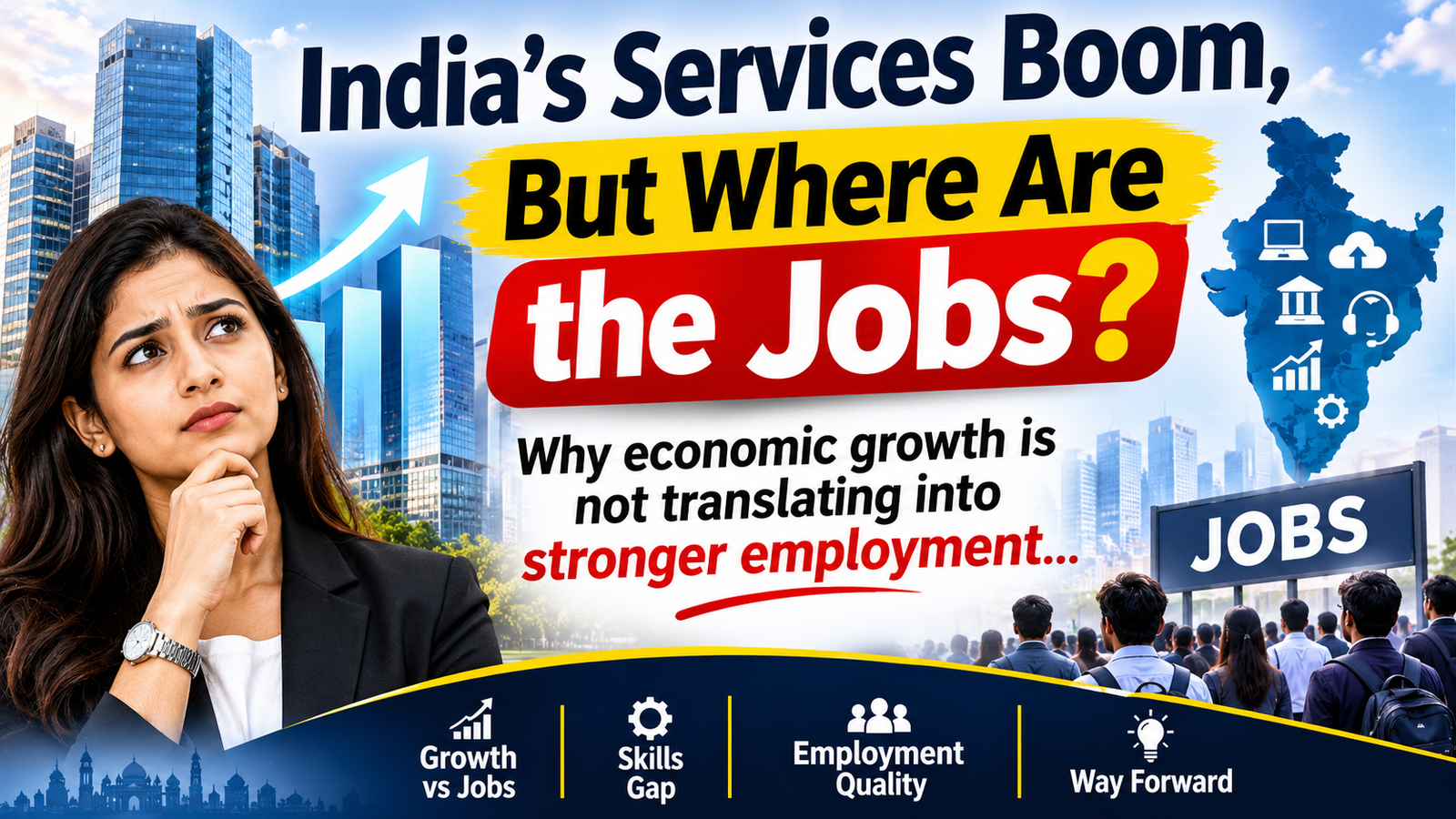
Why economic growth is not translating into stronger employment ?
India’s services sector is expanding, exports are creating economic value, and business activity remains resilient. Yet a crucial question persists: if businesses are growing, why isn’t employment growing at the same pace?
The answer lies in the difference between expanding economic output and creating jobs. India’s challenge is no longer simply to grow its services economy, but to make that growth more employment-intensive, inclusive and accessible to its expanding workforce.
The growth–employment gap
According to the Government of India’s Economic Survey 2025–26, services contribute more than half of India’s gross value added (GVA) and have grown by around 7–8% annually over an extended period. India has also strengthened its position in global services exports.
Yet the latest business survey reveals a warning sign. On 4 November 2026, Reuters reported that the HSBC India Services PMI rose to 55.8 in October, indicating continued expansion. However, employment growth almost stalled, reaching its slowest pace in ten months. Export-order growth was also weak.
This contrast captures the central problem: business activity can accelerate without companies hiring proportionately more workers.
Why the services boom is not creating enough jobs
1. High output does not always require more workers
Modern services—software, finance, consulting and digital platforms—can generate substantial revenue through technology, automation and specialised expertise. A company may increase its output without expanding its workforce at the same rate.
This makes high-productivity services valuable for economic growth, but their employment potential depends on how quickly businesses expand and how widely their benefits spread.
2. India’s services economy has two different realities
NITI Aayog’s 2025 report, India’s Services Sector: Insights from Employment Trends and State Level Dynamics, estimates that services employed approximately 188 million people in 2023–24, adding around 40 million workers over six years. However, the sector accounted for less than one-third of employment despite contributing over half of economic output.
The divide is structural:
- Modern services: IT, finance and professional services generate high value but require specialised skills and employ a relatively smaller share of workers.
- Traditional services: retail, transport, hospitality and personal services absorb more workers, but jobs can be informal, low-paid and vulnerable to fluctuations in demand.
Consequently, a booming services sector does not automatically mean widespread access to secure, well-paid employment.
3. The skills gap limits access to better jobs
Employers increasingly seek digital literacy, analytical ability, communication skills and practical experience. Educational qualifications alone may not demonstrate that a candidate can perform a job from day one.
The Economic Survey 2025–26 identifies technological change and the gap between technology adoption and worker adaptation as important challenges.
The result is a mismatch: companies may struggle to find suitable candidates even as graduates struggle to find suitable jobs. The problem is not simply a shortage of jobs or skills in isolation, but a failure to connect the two effectively.
4. Employment quality matters as much as employment numbers
India’s official labour data shows some improvement. The Ministry of Statistics and Programme Implementation reported that the share of workers in regular wage or salaried employment increased from 22.4% in 2024 to 23.6% in 2025.
Nevertheless, regular employment alone does not guarantee adequate wages, social security or career progression. Self-employment and informal work remain significant, while many young people seek stable jobs that offer opportunities to develop professionally.
For economic progress to improve living standards, job creation must be measured not only by the number of people working, but also by their earnings, security and productivity.
What the latest labour data tells us
The September 2026 Periodic Labour Force Survey reported an overall unemployment rate of 5.0% for people aged 15 and above under the Current Weekly Status measure. The overall labour force participation rate stood at 55.5%.
These figures provide important context, but they do not tell the whole story. The unemployment rate measures the share of the labour force without work and seeking or available for work; it does not directly reveal whether jobs match qualifications, provide sufficient income or offer long-term stability.
The latest PMI and official labour statistics also measure different things: PMI tracks business sentiment and changes in activity, while the PLFS estimates labour-market conditions. They should be read together, not treated as interchangeable measures.
What India needs to do
India must make its services-led growth more employment-intensive.
- Expand labour-absorbing services: Support tourism, healthcare, education, logistics, hospitality and business services that can create opportunities across skill levels.
- Connect education with industry: Strengthen apprenticeships, practical training and employer-linked curricula.
- Help smaller businesses grow: Improve access to finance, technology and markets so small service enterprises can hire and formalise jobs.
- Make digital growth inclusive: Help workers acquire the skills needed to benefit from AI and automation rather than simply compete against them.
- Measure job quality: Track wages, job security, formal contracts, social protection and career progression alongside GDP growth.
Conclusion: Growth must reach the workforce
India’s services boom is real, but its success cannot be judged by business activity, exports or GDP alone. The October 2026 PMI reading offers a timely reminder that expansion and hiring do not always move together.
The objective should not be to slow technological progress or discourage high-productivity businesses. It should be to build stronger connections between economic output and employment—through skills, labour-intensive services, enterprise growth and better-quality jobs.
Ultimately, the real test of India’s services boom is not how much value the economy creates, but how many people can participate in that prosperity.