By The Worldonomics Times Business Desk
Date: 15 November 2026
Introduction
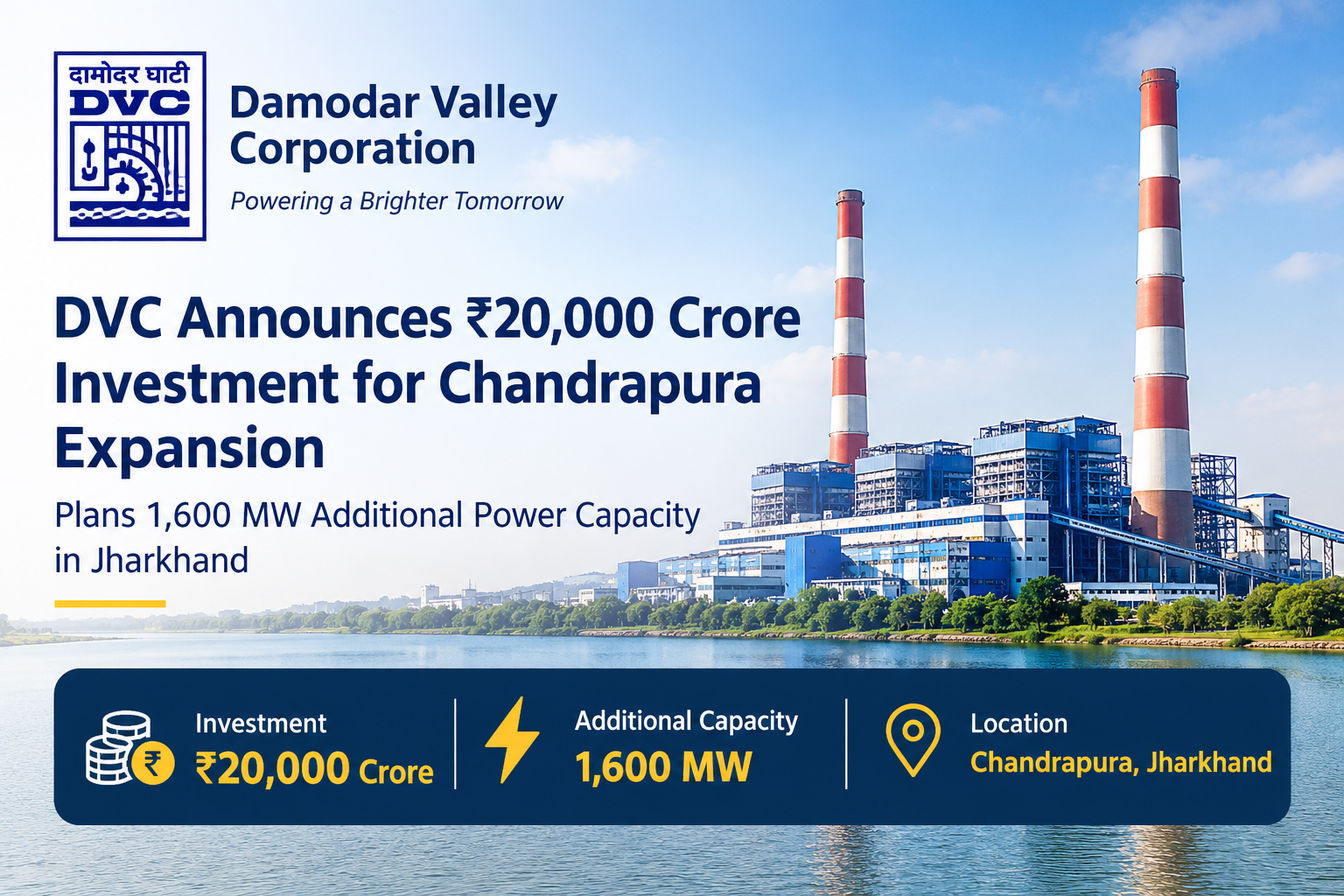
The Damodar Valley Corporation (DVC) has announced a major investment plan of approximately ₹20,000 crore for expanding its Chandrapura Thermal Power Station (CTPS) in Bokaro district of Jharkhand. The proposed expansion will add 1,600 MW of electricity generation capacity through two new units of 800 MW each, strengthening the state’s position as an important contributor to India’s power infrastructure.
DVC Chairman Shri Rajesh Pandey, IAS, reviewed the Chandrapura Thermal Power Station and outlined the corporation’s investment and development priorities for Jharkhand. The proposed expansion is expected to support India’s increasing electricity requirements, strengthen regional energy security and generate new employment opportunities.
The announcement represents an important development for the power sector, particularly at a time when industrial expansion, infrastructure development and rising electricity consumption are increasing the demand for reliable power generation.
DVC Chairman Reviews Chandrapura Thermal Power Station
During his visit to Chandrapura, DVC Chairman Rajesh Pandey reviewed plant operations and various ongoing developmental initiatives. He emphasised the importance of strengthening power generation infrastructure while ensuring that industrial growth is accompanied by improvements in the quality of life of surrounding communities.
According to reports, the Chairman also inaugurated several facilities and initiatives, including:
- A new project office.
- A Smart Training Centre.
- A Solar Tree.
- A modern Tuberculosis (TB) Testing Centre.
He also reviewed the corporation’s Corporate Social Responsibility (CSR) activities and highlighted the importance of healthcare, education, skill development and community participation in the overall development of industrial regions.
The initiatives reflect DVC’s broader approach of combining infrastructure development with social responsibility.
₹20,000 Crore Investment for 1,600 MW Expansion
The most significant announcement relates to the proposed expansion of Chandrapura Thermal Power Station through two additional power generation units of 800 MW each.
The project is expected to involve an investment of approximately ₹20,000 crore and will increase the generation capacity of the Chandrapura facility by 1,600 MW.
The proposed expansion is particularly significant because of its potential to strengthen electricity availability for industrial consumers, commercial establishments and households in the eastern region.
The project is also expected to generate direct and indirect employment during different stages, including construction, engineering, equipment manufacturing, transportation, operations and maintenance.
For Jharkhand, which has substantial mineral resources and an expanding industrial ecosystem, additional electricity generation capacity could support the development of new industries and investment opportunities.
Strategic Partnership Between DVC and Coal India
An important aspect of the Chandrapura expansion is the strategic partnership between DVC and Coal India Limited (CIL).
In April 2025, the two public sector organisations signed a Memorandum of Understanding to establish two 800 MW ultra-supercritical thermal power units at Chandrapura through a joint venture.
Subsequently, in November 2025, the organisations signed a joint venture agreement for implementing the project.
The project is being developed through DVC-CIL Power Private Limited, a 50:50 joint venture between the two government-owned energy organisations.
The project has an estimated investment of approximately ₹20,886.4 crore, according to the joint venture’s official project website.
This partnership combines DVC’s experience in electricity generation and power infrastructure with Coal India’s strength in coal production and fuel supply.
The proposed facility will use ultra-supercritical technology, which operates at higher steam temperatures and pressures than conventional thermal power plants. This technology can improve generation efficiency and reduce specific emissions per unit of electricity generated.
L&T Secures Major Order for Chandrapura Project
The Chandrapura expansion has also attracted significant participation from India’s engineering and infrastructure sector.
In October 2026, L&T Energy CarbonLite Solutions secured a major order exceeding ₹5,000 crore for the main plant package of the 1,600 MW Chandrapura thermal power project.
The scope of work includes the design, engineering, manufacturing, supply, erection, testing and commissioning of major power plant equipment, including boilers, steam turbines, generators and electrostatic precipitators.
The order represents an important step towards the project’s implementation. However, the company indicated that the final notice to proceed would be subject to the requisite environmental clearances and completion of the limited notice-to-proceed period.
Employment Generation and Economic Opportunities for Jharkhand
The proposed investment is expected to create substantial economic opportunities for Chandrapura, Bokaro and neighbouring areas.
Large-scale power infrastructure projects generate employment across multiple sectors, including civil construction, electrical engineering, mechanical engineering, project management, logistics, equipment manufacturing and technical services.
Local businesses, contractors, transport operators and small enterprises may also benefit from increased economic activity during the construction and operational phases.
The project could create additional opportunities for engineering graduates, diploma holders, ITI-trained candidates and skilled workers.
DVC’s Smart Training Centre initiative is also relevant in this context, as technical training and skill development can help prepare local youth for emerging employment opportunities in the power and infrastructure sectors.
DVC’s Commitment to Community Development
Alongside its investment plans, DVC has highlighted the importance of community welfare and social development around its industrial establishments.
During the Chairman’s visit, healthcare initiatives received particular attention. A modern TB Testing Centre was inaugurated at Chandrapura, reinforcing the organisation’s focus on accessible healthcare facilities.
DVC has also undertaken CSR initiatives in areas such as education, healthcare, women’s empowerment, livelihood development and vocational training.
These initiatives are important for industrial regions where the development of power infrastructure needs to be accompanied by improvements in public services and community welfare.
Significance for India’s Power Sector
India’s electricity demand is increasing due to industrialisation, urbanisation, infrastructure development and the expansion of commercial activities.
Reliable baseload electricity generation remains important for supporting manufacturing, mining, railways, infrastructure and other energy-intensive industries.
The Chandrapura expansion will contribute additional thermal generation capacity to the country’s electricity infrastructure. Its ultra-supercritical technology is expected to offer improved efficiency compared with conventional coal-based generation.
At the same time, India continues to expand renewable energy capacity, energy storage and modern transmission infrastructure. The future power system will require a balanced combination of conventional generation, renewable energy and storage solutions to maintain reliability and grid stability.
Conclusion
DVC’s proposed investment of approximately ₹20,000 crore in the Chandrapura Thermal Power Station expansion represents a significant development for Jharkhand’s industrial and energy infrastructure.
The proposed addition of 1,600 MW through two 800 MW units, supported by the strategic partnership between DVC and Coal India, is expected to strengthen regional power availability and contribute to India’s long-term electricity requirements.
Beyond power generation, the project offers opportunities for employment, industrial growth, technical skill development and local economic progress.
With major engineering contracts progressing and the joint venture structure in place, the Chandrapura project is emerging as an important addition to India’s thermal power development pipeline. Its successful implementation will depend on timely regulatory clearances, project execution and effective coordination among the participating organisations.
For Jharkhand, the investment could mark another important step towards strengthening its position as a major energy and industrial development hub.
The Worldonomics Times will continue to track important developments in India’s public sector enterprises, power infrastructure, investment announcements and employment opportunities.