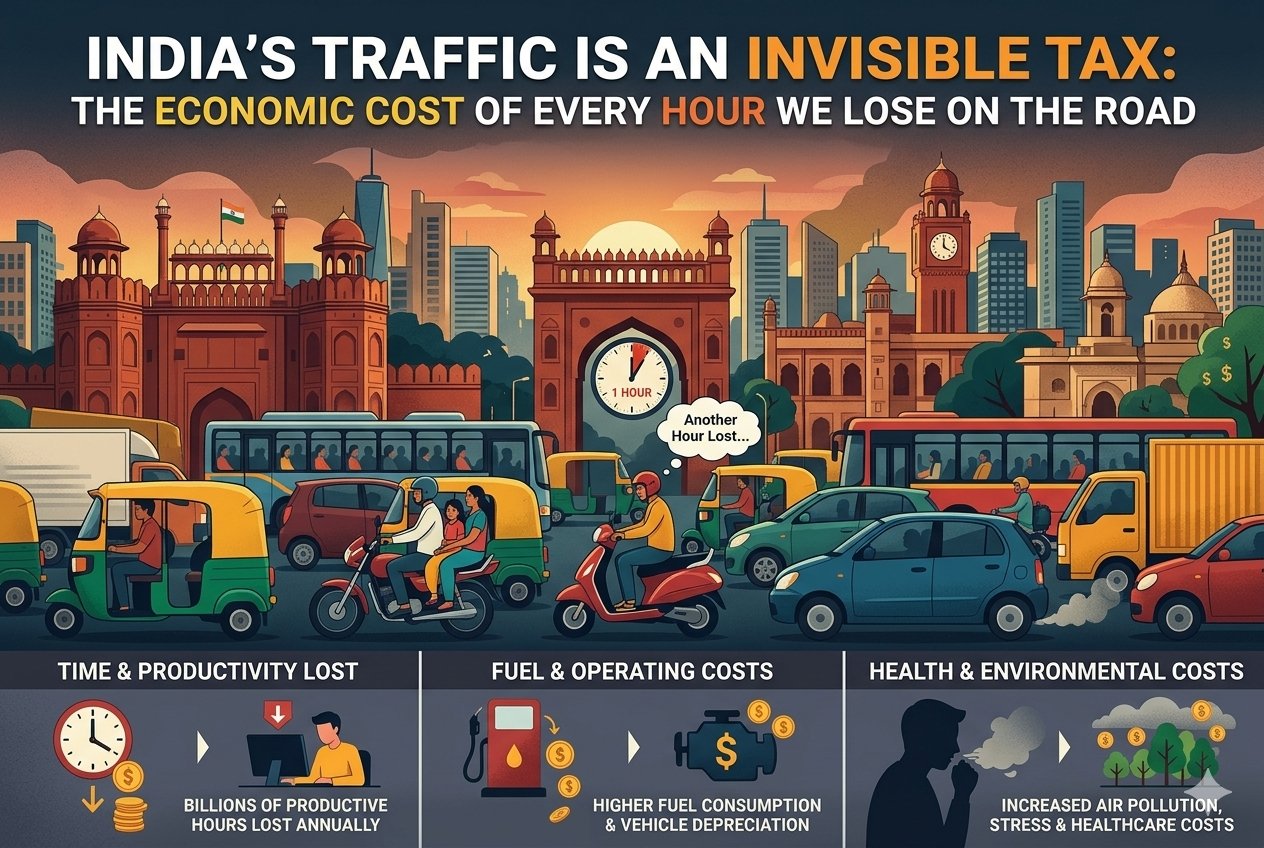
We pay taxes on income, goods and services. But there is another cost that rarely appears in our financial statements: the economic value of time lost in traffic.
Every morning, millions of Indians leave their homes to reach offices, factories, schools and business meetings. Yet a significant part of their day is spent waiting at traffic signals, navigating congested roads and searching for alternative routes.
We often consider this an inconvenience of urban life. Economically, however, traffic congestion is much more than a transportation problem.
It is an invisible tax on productivity, income, business efficiency and economic growth.
1. The Cost of Time We Never Recover
According to the TomTom Traffic Index 2025, commuters in Bengaluru lost approximately 168 hours during rush hours over the year. Pune recorded 152 hours, while Kolkata recorded 150 hours.
That is a substantial amount of productive time lost simply because people cannot move efficiently.
Consider an employee who spends an additional 45 minutes every working day travelling because of congestion. Over 250 working days, that amounts to approximately 187.5 hours annually.
This is not merely lost personal time. It represents potential productivity that could have been used for work, learning, family or rest.
2. How Traffic Affects Business Economics
The economic consequences extend far beyond individual commuters.
Employee Productivity: Late arrivals, fatigue and reduced working hours affect organisational efficiency.
Logistics and Supply Chains: Delivery delays increase transportation costs, disrupt inventory planning and affect customer satisfaction.
Fuel Consumption: Vehicles operating in congested conditions consume fuel inefficiently, increasing operating expenses.
Business Competitiveness: Companies operating in congested cities may face higher employee commuting costs and less predictable delivery schedules.
Emergency Services: Delays can affect ambulances, fire services and other essential services, creating costs that cannot easily be measured in money.
3. The Hidden Financial Impact on Households
Traffic congestion also affects household budgets.
More time on the road can mean higher fuel expenditure, additional vehicle maintenance, parking expenses and greater dependence on private transport.
For daily-wage workers, delivery personnel and professionals whose earnings depend on the number of trips completed, congestion can directly reduce earning opportunities.
The burden is therefore not equally distributed. People with flexible working arrangements may adjust their schedules, while workers dependent on fixed shifts or daily travel often have fewer alternatives.
4. Why Building More Roads Is Not Always the Complete Answer
One common response to congestion is expanding road infrastructure.
Flyovers, expressways and wider roads can improve connectivity. However, road expansion alone may not solve the underlying problem if the number of vehicles continues to grow faster than the capacity of the transport system.
The real challenge is to move more people efficiently, not simply accommodate more private vehicles.
Investment in reliable public transport, better last-mile connectivity, pedestrian infrastructure, intelligent traffic management and integrated urban planning can create more sustainable mobility.
5. Can Traffic Be Measured as an Economic Loss?
Economists can evaluate congestion through several measurable indicators:
- Value of working hours lost.
- Additional fuel consumption.
- Vehicle operating and maintenance costs.
- Delayed delivery and logistics expenses.
- Productivity losses due to fatigue and stress.
- Environmental and public health costs.
India’s Economic Survey 2025–26 also discusses the economic consequences of mobility inefficiencies and highlights the importance of prioritising the movement of people rather than vehicles.
This suggests that urban mobility should be viewed as an economic productivity issue, not merely a matter of road infrastructure.
6. Turning Mobility into an Economic Opportunity
India’s growing cities need a different approach to urban transportation.
Better public transport systems, technology-enabled traffic management, transit-oriented development and improved pedestrian infrastructure can create opportunities for investment, employment and greater economic efficiency.
Cities that enable people and goods to move efficiently can strengthen their attractiveness as destinations for businesses and investment.
The objective should be to reduce the economic cost of movement while improving accessibility for everyone.
Conclusion: Time Is an Economic Resource Too
A country’s economic strength is not determined only by how much it produces, invests or exports. It also depends on how efficiently people, goods and services move.
Every hour lost in traffic represents an opportunity that may never return.
We calculate the cost of fuel, labour, machinery and capital with considerable precision. Perhaps it is time we gave equal importance to the economic value of time.
Because when a city loses time, its economy loses productivity. And when millions of people lose time every day, the cost becomes a national economic concern.
— Ankita Nag