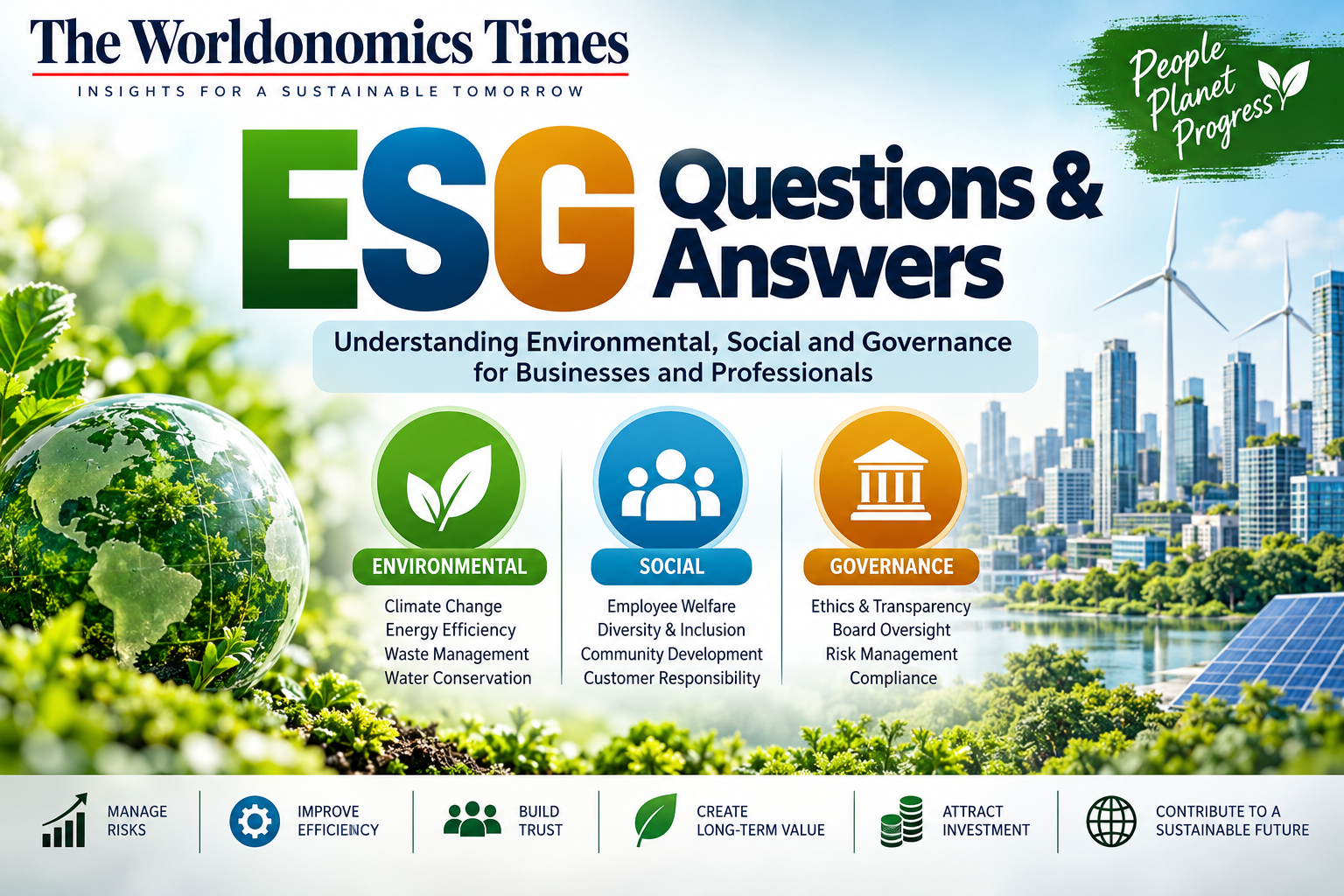
A Complete Guide to ESG Scores, ESG Ratings, Methodologies and Investor Use
One of the most common questions in sustainable investing is:
What is an ESG score?
Investors, companies, analysts and financial institutions increasingly encounter ESG scores and ratings when evaluating companies.
A company may receive an ESG score such as 85/100, 72/100, BBB, AA or another rating depending on the provider.
But an important question follows:
Why can the same company receive different ESG ratings from different providers?
The answer is that ESG ratings are based on different methodologies, data sources, definitions of materiality, weighting systems and objectives.
ESMA describes ESG ratings as opinions, scores or combinations of both that express a rating provider’s judgement using an established methodology and ranking system.
1. What Is an ESG Score?
An ESG score is a numerical or categorical assessment intended to represent a company’s performance, exposure or risk relating to environmental, social and governance factors.
Depending on the provider, an ESG score may evaluate:
- Environmental performance
- Social performance
- Governance
- Exposure to ESG risks
- Management of ESG risks
- ESG opportunities
- Sustainability impacts
- Quality of ESG disclosures
Therefore, there is no single universal ESG score.
A score of 80 from one provider does not necessarily mean the same thing as a score of 80 from another.
2. What Is an ESG Rating?
An ESG rating is a broader assessment that may express ESG performance or risk through:
- Numbers
- Letters
- Grades
- Categories
- Rankings
For example, a provider may use:
AAA to CCC
or:
0 to 100
or:
Low → Medium → High
The exact meaning depends on the provider’s methodology.
Under the EU ESG Ratings Regulation, ESG ratings can be presented through numerical, alphabetical, colour or other ranking categories.
3. ESG Score vs ESG Rating
Although the terms are often used interchangeably, they can be distinguished conceptually.
ESG Score
Usually refers to a numerical measure.
Example:
ESG Score = 78/100
ESG Rating
Usually refers to a broader ranking or classification.
Example:
ESG Rating = AA
However, market terminology is not completely uniform.
The most important issue is therefore not the label but:
What exactly does the methodology measure?
4. The Three Pillars of an ESG Score
Most ESG methodologies consider three broad dimensions.
Environmental
Possible indicators include:
- Greenhouse-gas emissions
- Energy consumption
- Renewable energy
- Water
- Waste
- Pollution
- Biodiversity
- Climate risk
- Resource efficiency
Social
Possible indicators include:
- Employee health and safety
- Diversity
- Human rights
- Labour practices
- Employee turnover
- Training
- Supply-chain practices
- Customer responsibility
- Data privacy
Governance
Possible indicators include:
- Board structure
- Board independence
- Executive remuneration
- Anti-corruption
- Business ethics
- Internal controls
- Shareholder rights
- Risk management
- Whistleblower systems
5. How Is an ESG Score Calculated?
There is no single universal formula.
However, a simplified ESG scoring model can be represented as:
ESG Score = Environmental Score × E Weight + Social Score × S Weight + Governance Score × G Weight
For example, assume:
- Environmental = 70
- Social = 80
- Governance = 90
And the methodology uses:
- E = 40%
- S = 30%
- G = 30%
Then:
70 × 40% = 28
80 × 30% = 24
90 × 30% = 27
Total:
ESG Score = 79/100
This is only an illustrative calculation.
Actual commercial methodologies can be much more complex.
6. Why Are ESG Scores Different?
Two ESG providers may analyse the same company and reach different conclusions.
This can happen because of differences in:
1. Data sources
One provider may rely heavily on company disclosures.
Another may use:
- Public databases
- News
- Regulatory filings
- Controversy data
- Third-party datasets
- Estimates
2. Indicators
Providers may measure different ESG issues.
3. Weightings
One provider may give greater importance to climate risk.
Another may give greater importance to governance.
4. Materiality
Different providers may define financially material ESG issues differently.
5. Industry methodology
A water-intensive company may be assessed differently from a software company.
6. Forward-looking assumptions
Some methodologies may consider future targets and transition plans.
7. Controversies
Some providers may heavily penalise controversies while others may treat them differently.
ESMA has previously noted that divergence among ESG ratings can arise from differences in data sources, criteria, identified risks and methodologies.
7. Absolute vs Relative ESG Scores
An ESG score can be:
Absolute
The company is assessed against predefined standards.
For example:
Company A = 75/100
The score theoretically has meaning independent of its competitors.
Relative
The company is compared with peers.
For example:
A company may rank in the top 10% of its industry.
A company could therefore have a high relative ranking even if the underlying industry has significant ESG challenges.
This distinction is extremely important for investors.
8. Industry-Specific ESG Scoring
ESG risks differ significantly across industries.
For example:
Oil & Gas
Important issues may include:
- Methane emissions
- Climate transition
- Spill management
- Worker safety
- Community relations
Banking
Important issues may include:
- Responsible lending
- Data security
- Financial inclusion
- Governance
- Financed emissions
IT Services
Important issues may include:
- Data privacy
- Cybersecurity
- Employee retention
- Digital ethics
- Energy consumption
Manufacturing
Important issues may include:
- Energy
- Emissions
- Water
- Waste
- Worker safety
- Supply chain
Therefore, ESG scoring often requires industry-specific analysis.
9. What Is ESG Risk?
ESG risk refers to the possibility that an environmental, social or governance issue could negatively affect a company.
Examples include:
Climate risk → Physical damage → Higher costs
Poor labour practices → Employee turnover → Productivity loss
Weak governance → Fraud → Financial loss
An ESG rating may therefore measure a company’s exposure to ESG risks and how effectively it manages those risks.
ESMA has distinguished ESG ratings that measure exposure to ESG risks and how they are managed from ratings that focus on impacts.
10. ESG Performance vs ESG Risk
These are not always the same.
A company can have:
High environmental impact but strong management of environmental risks.
Another company may have:
Lower environmental impact but weak environmental controls.
Consequently, investors need to understand what the ESG score represents.
A high score does not automatically mean:
“This company has no ESG problems.”
It may mean:
“The company is managing financially material ESG risks relatively well under this particular methodology.”
11. What Is an ESG Impact Score?
An impact-focused rating can assess the company’s effects on people and the environment.
For example:
- Carbon emissions
- Water pollution
- Labour practices
- Community impact
- Biodiversity impact
This can produce a different result from a rating focused on investor risk.
This distinction is important because:
Impact on the world and financial risk to the company are related but not identical concepts.
12. What Data Goes Into an ESG Score?
An ESG provider may use information from:
Company Reports
- Annual reports
- Sustainability reports
- BRSR
- Climate reports
Regulatory Filings
- Stock-exchange disclosures
- Regulatory submissions
- Legal filings
Public Information
- News
- Government databases
- Court records
- NGO reports
External Data
- Industry datasets
- Satellite information
- Emission databases
- Supply-chain information
Estimates
Where company-specific information is unavailable, providers may use estimates or models.
Therefore, investors should understand the source and quality of the underlying information.
13. ESG Data Quality Matters
A high-quality ESG score requires reliable information.
Important data-quality characteristics include:
- Accuracy
- Completeness
- Consistency
- Comparability
- Timeliness
- Verifiability
Poor data can result in poor scores.
This is why ESG reporting, internal controls and assurance are becoming increasingly important.
14. What Is ESG Controversy Data?
Some ESG providers track controversies involving companies.
Examples include:
- Environmental accidents
- Labour disputes
- Human-rights allegations
- Corruption cases
- Product safety issues
- Data breaches
- Regulatory violations
A company with strong policies may still experience a significant ESG-rating impact if a major controversy occurs.
The treatment of controversies varies among rating providers.
15. ESG Score and Greenwashing
A company should not use an ESG score as automatic proof that it is sustainable.
For example:
High ESG score ≠ Zero environmental impact
Similarly:
Low ESG score ≠ Bad company
The score is an analytical tool.
Companies should support sustainability claims with reliable evidence and transparent disclosures.
Investors should examine the methodology before relying on ESG claims.
16. ESG Score and Investment Decisions
Investors may use ESG scores as one input among many.
A typical process could be:
Financial Analysis
↓
ESG Analysis
↓
Risk Assessment
↓
Valuation
↓
Portfolio Decision
For example, an investor may compare two companies:
| Factor | Company A | Company B |
|---|---|---|
| ESG Score | 82 | 68 |
| Revenue Growth | 12% | 15% |
| Debt | Low | High |
| Governance | Strong | Moderate |
| Climate Risk | Moderate | High |
The investor should not automatically select Company A solely because its ESG score is higher.
Financial fundamentals and valuation remain important.
17. ESG Score and Company Valuation
ESG issues can affect valuation through:
- Revenue
- Operating costs
- Capital expenditure
- Regulatory costs
- Insurance
- Financing
- Asset values
- Business continuity
For example, a carbon-intensive company facing stricter environmental regulation may need substantial capital expenditure to transition its operations.
That could affect future free cash flow and valuation.
18. ESG Score and Cost of Capital
ESG risk can potentially affect financing costs.
A company with:
- Weak governance
- Significant environmental liabilities
- Poor risk management
- Weak disclosure
may be perceived as carrying greater risk.
However, investors should avoid assuming a direct mechanical relationship between an ESG score and cost of capital.
The actual impact depends on the company’s industry, financial condition, market conditions and specific risks.
19. How Should Companies Improve Their ESG Score?
Companies should not simply try to “game” the score.
Instead, they should improve their underlying ESG performance.
Environmental
- Reduce emissions
- Improve energy efficiency
- Increase renewable energy
- Reduce waste
- Improve water management
Social
- Improve safety
- Strengthen labour practices
- Develop employees
- Improve diversity
- Strengthen human-rights due diligence
Governance
- Improve board oversight
- Strengthen internal controls
- Enhance ethics programmes
- Improve transparency
- Strengthen whistleblower mechanisms
Better ESG performance should come first.
The score should be a consequence—not the objective.
20. ESG Score Improvement Through Better Disclosure
Sometimes a company may actually have strong ESG practices but poor disclosure.
For example:
The company may have:
- Renewable-energy projects
- Safety programmes
- Supplier policies
- Anti-corruption systems
but fail to disclose them clearly.
Better reporting can therefore improve the quality of information available to ESG analysts.
However, disclosure should never substitute for actual performance.
21. Role of BRSR in ESG Scoring in India
For Indian listed companies, BRSR provides structured sustainability information.
BRSR covers areas including:
- Environmental performance
- Social indicators
- Governance
- Employees
- Human rights
- Responsible business conduct
BRSR Core focuses on selected ESG indicators and is being implemented through a phased framework.
This structured disclosure can provide useful data for investors and ESG analysts.
SEBI’s framework also provides for value-chain disclosures for the top 250 listed entities on a voluntary basis from FY 2025-26.
22. ESG Scores and MSMEs
MSMEs may not always have formal ESG ratings.
However, they can increasingly become part of ESG assessments through their customers.
A large company may ask an MSME supplier about:
- Carbon emissions
- Energy use
- Labour practices
- Health and safety
- Human rights
- Waste
- Governance
Therefore, MSMEs should maintain basic ESG data even when they are not directly required to publish an ESG report.
23. ESG Ratings Regulation in the European Union
The European Union has introduced a dedicated regulatory framework for ESG rating activities.
The EU ESG Ratings Regulation entered into force in January 2025 and applies from 2 July 2026. ESMA is responsible for important aspects of the regulatory framework.
The framework is intended to improve transparency and integrity in ESG rating activities.
Among other things, providers must disclose information about:
- Rating methodologies
- Supporting models
- Key assumptions
- Data quality and reliability
- Ranking categories
- Industry classifications
- Engagement processes
- Methodology updates
ESMA’s technical standards provide detailed transparency requirements.
This is an important development for investors using ESG ratings.
24. Questions Investors Should Ask About an ESG Rating
Before relying on an ESG score, investors should ask:
1. What does the rating measure?
Risk? Impact? Performance? Disclosure?
2. What data is used?
Company data, public data or estimates?
3. What is the methodology?
Is it transparent?
4. What are the E, S and G weights?
Are they equal or industry-specific?
5. Is the score absolute or relative?
Does it compare companies with peers?
6. How are controversies treated?
Are major incidents heavily penalised?
7. How frequently is the rating updated?
8. How are missing data and estimates handled?
9. Does the rating consider forward-looking information?
10. What are the limitations?
These questions can help investors avoid over-reliance on a single ESG score.
25. Can Companies Compare ESG Scores From Different Providers?
They can compare them cautiously, but should not assume that scores are directly interchangeable.
For example:
Provider A: 85/100
Provider B: AA
Provider C: 68/100
This does not necessarily mean that one provider is correct and the others are wrong.
They may be measuring different concepts.
ESMA has highlighted that divergence in ESG ratings can result from differences in measurement, criteria, data sources and aggregation methods.
26. What Is ESG Rating Divergence?
ESG rating divergence means that different providers assign significantly different assessments to the same company.
Possible causes include:
Different Data
↓
Different Indicators
↓
Different Materiality
↓
Different Weightings
↓
Different Methodologies
↓
Different ESG Rating
This is one of the most important concepts for ESG investors to understand.
27. ESG Score vs ESG Report
These are completely different.
ESG Report
A company publishes information about its sustainability performance.
ESG Score
A rating provider analyses information and produces an assessment.
Therefore:
Company disclosure → Data → Analysis → ESG Score/Rating
The quality of the final score depends partly on the quality and availability of underlying information.
28. Role of CA and CMA Professionals
Finance professionals can contribute significantly to ESG scoring and data quality.
Chartered Accountants
Can contribute through:
- ESG reporting
- Assurance
- Internal controls
- Governance
- Risk assessment
- Financial materiality analysis
Cost Accountants
Can contribute through:
- Carbon costing
- Resource efficiency
- Cost measurement
- ESG KPIs
- Sustainability budgeting
- Operational performance analysis
Both professions can help companies create reliable ESG data systems.
29. A Simple ESG Scorecard for Companies
A company can internally create a basic scorecard:
| ESG Area | KPI | Target | Actual | Status |
|---|---|---|---|---|
| Environment | GHG emissions | 10,000 | 11,200 | Improve |
| Environment | Renewable energy | 40% | 35% | Improve |
| Social | Safety incidents | <10 | 7 | On Track |
| Social | Female workforce | 35% | 32% | Improve |
| Governance | Training coverage | 100% | 98% | On Track |
Such internal dashboards can help management improve actual ESG performance.
30. The Future of ESG Scores
ESG scoring is likely to become more transparent as regulators, investors and companies demand better methodologies and data.
The EU’s ESG Ratings Regulation is one example of the broader movement toward greater transparency around ESG rating methodologies, data and ranking systems.
At the same time, companies should expect greater scrutiny of:
- Data quality
- Methodology
- ESG claims
- Sustainability targets
- Greenwashing
- Value-chain information
- Forward-looking assumptions
Conclusion
An ESG score is a useful analytical tool, but it should never be treated as an absolute measure of whether a company is “good” or “bad” from a sustainability perspective.
The most important questions are:
What does the score measure?
How was it calculated?
What data was used?
What assumptions were made?
Is the score absolute or relative?
How does the methodology treat industry-specific risks?
Investors should therefore look beyond the headline ESG rating.
The best approach is:
Understand the Methodology → Examine the Data → Assess the Risks → Analyse Financial Impact → Make the Investment Decision
For companies, the objective should not be to maximise an ESG score simply for reputational purposes.
The objective should be to improve genuine ESG performance, strengthen data quality and communicate that performance transparently.
For finance professionals, this creates a growing opportunity at the intersection of ESG data, accounting, assurance, risk management, valuation and investment analysis.