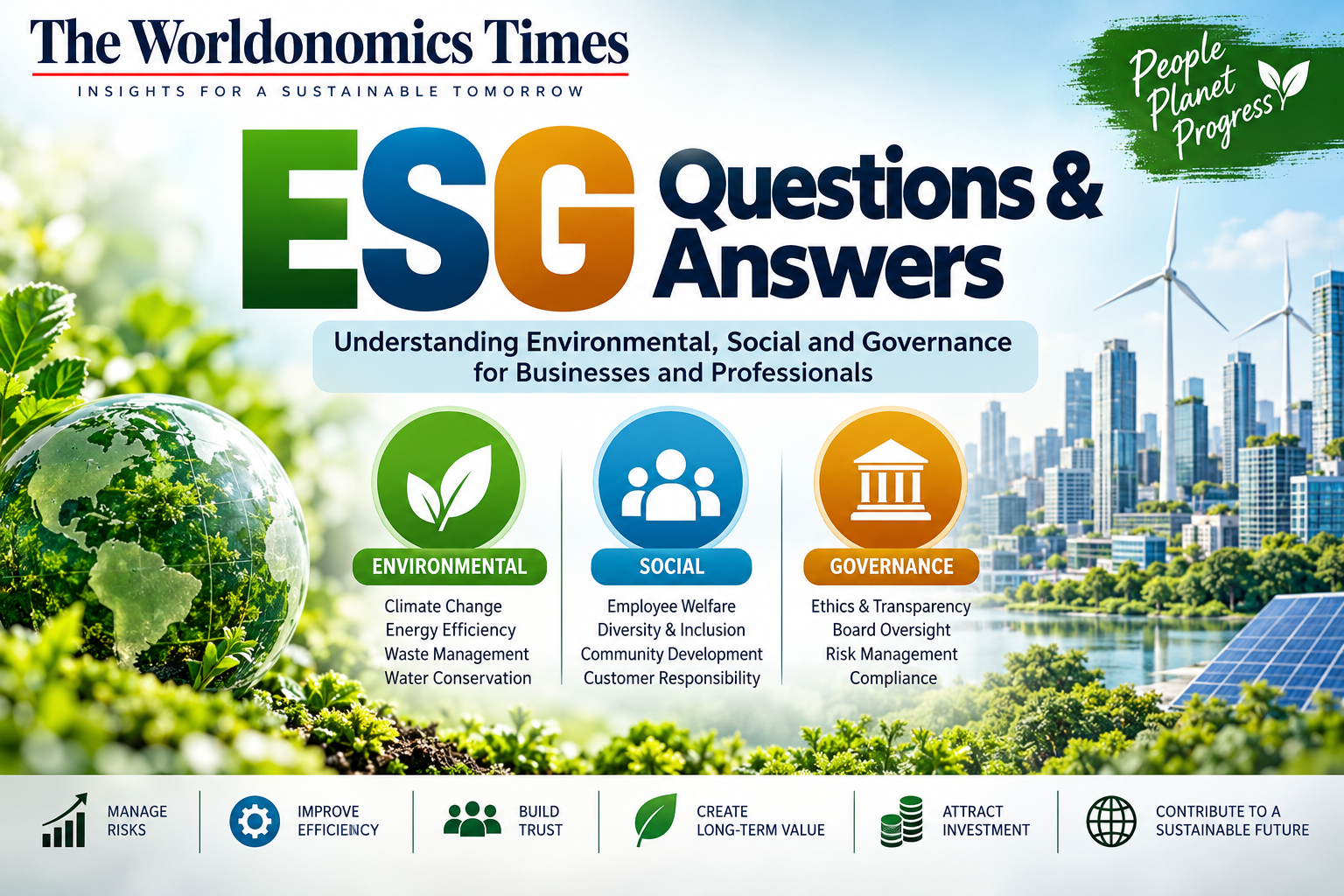
ESG Meets Finance: Accounting, Investment, Risk and Business Performance
Q121. Why should CFOs care about ESG?
Answer: ESG issues can affect revenue, operating costs, capital expenditure, financing, taxation, regulatory exposure and reputation. CFOs are therefore increasingly involved in connecting ESG objectives with financial planning and corporate strategy.
Q122. How does ESG affect financial planning?
Answer: ESG considerations can influence budgets and forecasts through energy costs, carbon-related investments, compliance expenditure, technology upgrades, employee costs and climate-related risks. Financial planning can help determine the economic impact of ESG initiatives.
Q123. Can ESG be included in capital budgeting?
Answer: Yes. Companies can consider ESG factors while evaluating capital investments. For example, an energy-efficient machine may require higher initial investment but generate long-term savings through lower energy consumption and maintenance costs.
Q124. What is the ESG business case?
Answer: The ESG business case explains how sustainability initiatives can contribute to business objectives. It may include cost savings, risk reduction, revenue growth, access to capital, customer demand, regulatory preparedness and improved resilience.
Q125. How can ESG affect operating costs?
Answer: ESG can both increase and reduce operating costs. Investments in clean technology or compliance may initially increase costs, while energy efficiency, waste reduction, process optimisation and resource conservation can generate savings over time.
Q126. What is the role of management accounting in ESG?
Answer: Management accountants can help measure the financial impact of ESG initiatives, allocate costs, analyse resource consumption, evaluate investment decisions and develop performance indicators that connect sustainability with business performance.
Q127. What is environmental management accounting?
Answer: Environmental management accounting combines financial and environmental information to help organisations understand the costs and benefits associated with environmental activities. It can help identify resource inefficiencies and opportunities for cost reduction.
Q128. How can companies account for carbon-related costs?
Answer: Companies can identify and measure costs associated with emissions, energy consumption, environmental compliance, carbon-reduction projects and related risks. The exact accounting treatment depends on the applicable accounting standards and the nature of the transaction.
Q129. What is an internal carbon price?
Answer: An internal carbon price is a management tool that assigns a hypothetical or internal cost to greenhouse-gas emissions. Companies may use it when evaluating projects, investments and strategic decisions that could be affected by future carbon-related costs.
Q130. How can ESG influence investment decisions?
Answer: Investors may consider ESG factors alongside financial metrics to identify risks and opportunities that could influence long-term returns. Issues such as climate exposure, governance quality, workforce practices and regulatory risks may be relevant depending on the investment.
Q131. What is ESG integration in portfolio management?
Answer: ESG integration involves systematically incorporating material ESG factors into investment analysis and portfolio decisions. The objective is generally to improve risk-adjusted decision-making rather than simply selecting companies based on an ESG label.
Q132. What is an ESG exclusion strategy?
Answer: An exclusion strategy avoids investments in specified companies, sectors or activities based on defined environmental, social or ethical criteria. The exclusions depend on the investment mandate and policy.
Q133. What is ESG thematic investing?
Answer: Thematic ESG investing focuses on specific sustainability themes such as renewable energy, clean transportation, water management, sustainable agriculture, energy efficiency or social inclusion.
Q134. What is stewardship in ESG investing?
Answer: Stewardship refers to investors using their ownership rights and influence to encourage better corporate practices. It can include voting, engagement with management and discussions with companies regarding material ESG issues.
Q135. What is shareholder engagement on ESG issues?
Answer: Shareholder engagement involves investors communicating with company management or boards regarding ESG risks, policies, targets and performance. It aims to encourage better practices and improve long-term value creation.
Q136. How can ESG affect the cost of capital?
Answer: ESG performance can influence perceptions of risk among lenders and investors. Strong risk management and transparent disclosures may support investor confidence, while significant unmanaged ESG risks may increase perceived risk and potentially affect financing conditions.
Q137. Can ESG affect credit ratings?
Answer: ESG factors can influence credit risk where they have a material effect on a company’s financial position, cash flows, assets or liabilities. The significance of ESG factors varies by industry, geography and company-specific circumstances.
Q138. How does ESG affect banks’ lending decisions?
Answer: Banks may consider environmental, social and governance risks as part of broader credit and risk assessment. Material ESG risks could affect a borrower’s operations, cash flows, assets, regulatory position or reputation.
Q139. What is sustainable lending?
Answer: Sustainable lending refers broadly to lending practices that incorporate sustainability considerations. It can include financing for environmentally beneficial projects as well as financing structures where terms are linked to defined sustainability performance.
Q140. What are sustainability-linked loans?
Answer: Sustainability-linked loans are financing arrangements in which the financial terms may be linked to the borrower’s achievement of specified sustainability performance targets, subject to the applicable framework and contractual conditions.
Q141. What is the difference between green bonds and sustainability-linked bonds?
Answer: Green bonds generally direct proceeds towards eligible environmental projects or activities. Sustainability-linked bonds generally connect financial characteristics to predefined sustainability performance targets. The distinction is primarily based on the use of proceeds versus performance-linked features.
Q142. What is transition finance?
Answer: Transition finance supports activities, businesses or sectors that are moving towards more sustainable or lower-emission operating models. It can be particularly relevant for industries where immediate complete decarbonisation may be difficult.
Q143. Why is ESG important for long-term investors?
Answer: Long-term investors are concerned with risks and opportunities that may influence future cash flows and business resilience. ESG analysis can help identify issues that traditional short-term financial analysis may not fully capture.
Q144. What is ESG risk-adjusted return?
Answer: ESG risk-adjusted return considers how environmental, social and governance risks may influence the expected return from an investment. It encourages investors to assess both potential returns and sustainability-related risks.
Q145. How can ESG influence mergers and acquisitions?
Answer: ESG considerations can affect acquisition valuation, due diligence, integration planning and future capital requirements. Environmental liabilities, employee issues, regulatory exposure and governance weaknesses can create hidden costs for an acquirer.
Q146. What ESG issues should be checked during due diligence?
Answer: Depending on the transaction, due diligence may examine environmental liabilities, regulatory compliance, employee safety, labour practices, litigation, corruption risks, data privacy, governance structures, supply-chain practices and sustainability commitments.
Q147. What is ESG value creation?
Answer: ESG value creation occurs when responsible environmental, social and governance practices contribute to stronger financial or strategic outcomes. Examples include lower operating costs, improved productivity, stronger customer relationships, reduced risk and access to new markets.
Q148. Can ESG improve employee productivity?
Answer: Good workplace practices, employee development, safety, inclusion and engagement can contribute to employee satisfaction and productivity. However, the actual impact depends on the organisation’s workforce, culture and implementation quality.
Q149. How can ESG support innovation?
Answer: ESG challenges can encourage businesses to develop cleaner technologies, sustainable products, resource-efficient processes and new business models. Sustainability can therefore become a driver of innovation rather than simply a compliance requirement.
Q150. What should businesses remember about ESG?
Answer: ESG should not be treated merely as a publicity exercise or reporting requirement. Effective ESG connects strategy, finance, risk, operations, people and governance. The strongest approach is to identify material issues, measure performance, set credible targets and continuously improve.
Key Takeaway
For finance professionals, ESG is increasingly moving into the core areas of capital allocation, budgeting, risk management, investment analysis, cost management and corporate reporting.
The future ESG professional will therefore need to understand not only sustainability—but also finance, accounting, data, governance and business strategy.