Concerns over high AI valuations and massive technology investments are creating uncertainty among global investors.
By The Worldonomics Times | Global Economy
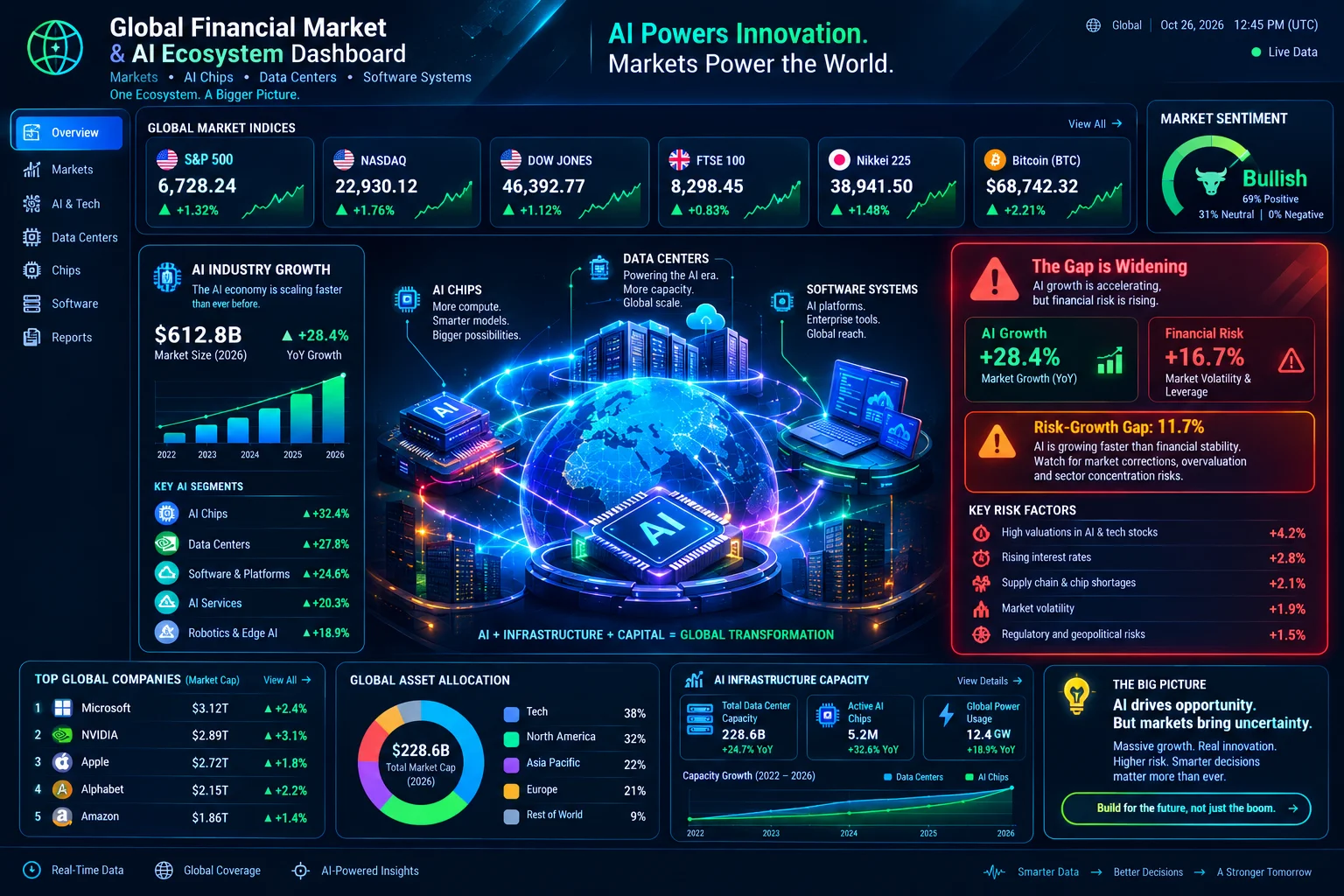
Artificial intelligence has become one of the most influential forces shaping the global economy and financial markets. Major technology companies are investing billions of dollars in advanced chips, data centres, cloud computing infrastructure and AI software. These investments have strengthened expectations of future productivity growth and created significant opportunities for technology businesses. However, the scale of spending and rapidly increasing market valuations are raising questions about whether the financial returns will justify the enormous capital being committed.
Investors are increasingly examining the sustainability of the AI investment boom. While artificial intelligence has the potential to transform industries, concerns about excessive valuations, rising corporate debt and uncertain profitability are creating new risks for global financial markets.
AI Investment Boom Reshapes Global Markets
The rapid expansion of artificial intelligence has encouraged major technology companies to increase their capital expenditure. Businesses are building large data centres, purchasing advanced semiconductors and expanding computing capacity to meet growing demand for AI services.
The investment cycle extends beyond technology companies. Semiconductor manufacturers, electricity providers, construction firms, cloud service operators and financial institutions are also benefiting from the expansion of AI infrastructure.
According to the International Monetary Fund, private-sector investment related to artificial intelligence could exceed $2 trillion globally in 2026, making it an important driver of economic activity.
The scale of this investment has supported stock market valuations, particularly among large technology and semiconductor companies. However, the growing concentration of market performance in a relatively small group of businesses has also increased investor exposure to developments within the AI sector.
High Valuations Raise Investor Concerns
One of the major concerns surrounding the AI boom is the gap that may develop between company valuations and their actual financial performance.
Investors have assigned high valuations to several technology businesses based on expectations of strong future earnings, expanding AI demand and long-term productivity improvements. These expectations may be justified if companies successfully commercialise their technology and generate sustainable revenue.
However, if adoption grows more slowly than anticipated or competition reduces profit margins, current valuations could become difficult to support.
Recent market movements have highlighted this uncertainty. Reuters reported on October 30 that more than $2 trillion in market value was at risk of being erased from the Nasdaq 100 during October as investors reassessed the scale of AI spending and the returns expected from major technology companies.
Such developments demonstrate how quickly investor sentiment can change when expectations become uncertain. A correction in highly valued technology stocks could also affect broader market indices, pension funds and investment portfolios with substantial exposure to the sector.
Massive Capital Spending Creates Financial Pressure
The construction of AI infrastructure requires enormous financial resources. Data centres need expensive computing equipment, reliable electricity supplies, cooling systems and advanced networking infrastructure. These facilities also involve substantial long-term operating and maintenance costs.
Major technology companies have historically financed much of their expansion through strong operating cash flows. However, the scale of the current AI investment cycle is increasing the importance of debt markets, borrowing arrangements and other financing structures.
A report by S&P Global Ratings in August 2026 projected that combined capital expenditure by major hyperscalers could exceed $1.3 trillion by 2027. It also highlighted the growing use of debt, leases and other financing arrangements to support infrastructure expansion.
Higher borrowing can increase financial pressure if AI-related revenue does not grow quickly enough. Companies may face rising interest expenses, reduced financial flexibility and greater difficulty funding future projects.
The risk becomes more significant when several businesses depend on similar assumptions about continued demand for computing capacity.
Risks of Overinvestment and Market Concentration
Another concern is the possibility of overinvestment. Technology companies are expanding data-centre capacity rapidly, but future demand may not increase at the same pace as infrastructure supply.
If businesses build more computing capacity than customers ultimately require, utilisation rates and returns on investment could decline. This may lead to delayed projects, reduced spending and weaker financial performance across the AI supply chain.
The concentration of investment also creates interconnected risks. Semiconductor manufacturers, cloud providers, infrastructure developers and electricity suppliers are increasingly dependent on the spending decisions of a relatively small number of major technology companies.
The IMF’s October 2026 Global Financial Stability Report warned that weaker AI investment or less durable profitability could trigger a correction in AI-related asset prices. It also highlighted leverage and concentrated exposures as factors that could amplify market disruption.
These risks are not limited to stock markets. A decline in technology valuations could affect corporate borrowing, investment funds and lenders financing AI infrastructure.
Global Investors Reassess Their Strategies
Growing uncertainty is encouraging investors to examine technology companies more carefully. Rather than focusing only on future growth potential, market participants are paying greater attention to cash flow, debt levels, operating margins and the commercial performance of AI products.
Some investors may diversify their portfolios to reduce exposure to highly valued technology stocks. Others may focus on businesses with established revenue streams and stronger financial positions.
The impact could also extend to international markets. Countries with significant exposure to semiconductor manufacturing, technology exports and AI infrastructure investment may experience greater volatility if global spending expectations weaken.
At the same time, emerging economies could benefit from AI adoption through improved productivity, digital services and new business opportunities. However, access to infrastructure, investment capital and advanced technology will influence how widely these benefits are distributed.
The Worldonomics View
Artificial intelligence represents a major technological opportunity, but the financial markets must distinguish between genuine economic value and excessive investment expectations.
The long-term potential of AI should not be underestimated. It can improve productivity, support scientific research, strengthen business operations and create new industries. Nevertheless, technological progress does not automatically guarantee attractive investment returns for every company involved.
Investors should pay close attention to the relationship between capital expenditure, revenue growth and profitability. Companies must demonstrate that their investments can generate sustainable returns rather than relying entirely on expectations of future demand.
Policymakers and financial regulators should also monitor increasing leverage, interconnected financing arrangements and concentrated market exposures. A more transparent financial environment would help identify vulnerabilities before they develop into wider market problems.
Conclusion
The rapid expansion of artificial intelligence is transforming global financial markets, attracting unprecedented investment and creating new opportunities for businesses and investors. However, high valuations, rising borrowing requirements and uncertainty surrounding future returns are increasing financial risks.
The coming years will test whether the current investment boom can deliver sustainable economic value. Companies that combine technological innovation with financial discipline are likely to be better positioned to withstand market volatility.
For global investors, the challenge will be to recognise the long-term potential of artificial intelligence while remaining cautious about excessive valuations and unsustainable investment expectations.