By The Worldonomics Times
Category: Global Economy & Industrial Development | November 2026
The global manufacturing industry is undergoing a significant transformation as businesses increasingly focus on innovation, automation and advanced technologies to improve productivity and remain competitive. From automotive production and electronics to pharmaceuticals, textiles and industrial machinery, manufacturers are adopting modern solutions to respond to changing market demands and rising operational challenges.
Manufacturing remains a major contributor to economic growth, employment and international trade. However, changing consumer expectations, supply chain uncertainty, labour costs and environmental concerns are encouraging companies to rethink traditional production methods. Innovation and automation are becoming important tools for building more efficient, flexible and resilient manufacturing operations.
Automation Reshapes Modern Manufacturing
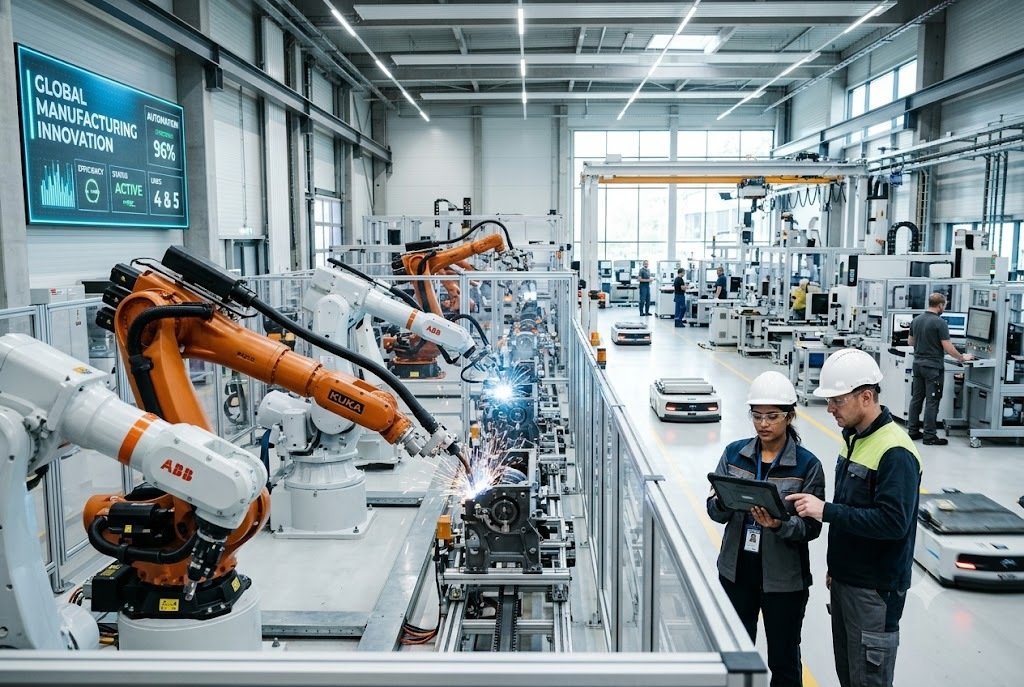
Automation is changing the way factories operate across major industrial economies. Robotics, automated assembly lines and computer-controlled machinery are helping manufacturers improve production speed, accuracy and consistency.
Industrial robots are increasingly used for repetitive, physically demanding and precision-based tasks. In automotive manufacturing, for example, robotic systems can support welding, painting, assembly and quality inspection. Similar technologies are being introduced in electronics, food processing and packaging industries.
Automation can also reduce certain operational risks by limiting workers’ exposure to hazardous production environments. However, its adoption requires significant investment in equipment, maintenance, software and employee training.
For manufacturers, the objective is not simply to replace manual processes but to create production systems that combine human expertise with technological capabilities.
Artificial Intelligence and Smart Factories
Artificial intelligence is emerging as an important driver of industrial innovation. AI-powered systems can analyse production data, identify inefficiencies and help manufacturers make faster operational decisions.
Smart factories use connected machines, sensors and digital platforms to monitor production activities in real time. These systems can detect equipment problems, track inventory and improve coordination between different stages of manufacturing.
Predictive maintenance is another important application. By analysing machine performance and operating conditions, AI systems can help identify potential equipment failures before they cause major production interruptions.
These technologies can improve resource utilisation, reduce unexpected downtime and support better product quality. Nevertheless, successful implementation depends on reliable data, cybersecurity measures and skilled technical personnel.
Investment in Research and Development
Manufacturing companies are increasing their focus on research and development to create innovative products, improve production techniques and develop new materials.
Industries such as semiconductors, electric vehicles, aerospace, pharmaceuticals and renewable energy equipment are particularly dependent on technological advancement.
The semiconductor sector, for example, plays a central role in modern manufacturing because computer chips are essential components in vehicles, smartphones, industrial equipment and communication systems.
Investment in advanced materials, energy-efficient machinery and digital production technologies can also help companies develop products that meet changing consumer and industrial requirements.
Countries that strengthen research institutions, technical education and industry-academia partnerships may gain important advantages in global manufacturing markets.
Global Supply Chains and Industrial Competitiveness
Recent disruptions to international supply chains have encouraged manufacturers to reconsider their sourcing and production strategies. Companies are increasingly evaluating the benefits of diversifying suppliers, developing regional manufacturing facilities and maintaining more flexible inventory systems.
Digital technologies can improve supply chain visibility by providing information about raw materials, transportation and production schedules. This allows businesses to respond more effectively to delays and changing market conditions.
Major manufacturing economies, including China, the United States, Germany, Japan, South Korea and India, continue to play important roles in international industrial production.
India is also seeking to strengthen its manufacturing capabilities through infrastructure development, investment incentives, industrial corridors and greater participation in global supply chains. Opportunities are emerging in electronics, automobiles, engineering goods, pharmaceuticals and renewable energy equipment.
Workforce Skills and Employment Challenges
The growing use of automation is changing the skills required in manufacturing. Traditional production roles are increasingly being complemented by opportunities in robotics, software development, data analysis, equipment maintenance and industrial engineering.
This transition creates both opportunities and challenges for workers. While advanced technologies can improve productivity and create specialised employment, some repetitive tasks may become less labour-intensive.
Businesses and governments therefore need to invest in vocational education, technical training and reskilling programmes. Preparing workers for technology-driven production systems will be essential to ensuring that industrial development benefits a wider section of society.
Sustainability Becomes an Industrial Priority
Environmental sustainability is becoming an important consideration in manufacturing decisions. Companies are exploring energy-efficient machinery, renewable electricity, waste reduction and recycling to lower the environmental impact of production.
Green manufacturing practices can help reduce operating costs over time while supporting wider climate and sustainability objectives.
Industries are also examining ways to use raw materials more efficiently and develop products with longer lifecycles. However, adopting sustainable technologies often requires substantial initial investment and supportive infrastructure.
The Worldonomics Times View
At The Worldonomics Times, we believe that innovation and automation will play a defining role in the future of global manufacturing. Technological progress can strengthen industrial productivity, improve product quality and create new opportunities for international trade and investment.
However, manufacturing transformation should not be measured only by the number of automated machines or the speed of production. It must also be evaluated through its impact on employment, workforce development, environmental responsibility and long-term economic resilience.
Governments should encourage research and development, strengthen technical education and create an environment that supports responsible industrial investment. Manufacturers, meanwhile, should adopt technology while ensuring that workers receive opportunities to develop the skills needed in modern production environments.
The Worldonomics Times believes that the future of manufacturing will depend on the successful combination of technological innovation, skilled human talent and sustainable industrial practices.
Conclusion
The global manufacturing industry is entering a new phase of development driven by automation, artificial intelligence, research and sustainable production methods. These changes are reshaping factories, supply chains and the competitive position of industrial economies.
Although technological adoption involves investment and workforce challenges, it offers significant opportunities to improve efficiency and strengthen long-term industrial growth.
As countries compete to build advanced manufacturing capabilities, innovation, infrastructure and skilled employment will remain essential foundations for a more productive, resilient and sustainable global economy.