By The Worldonomics Times
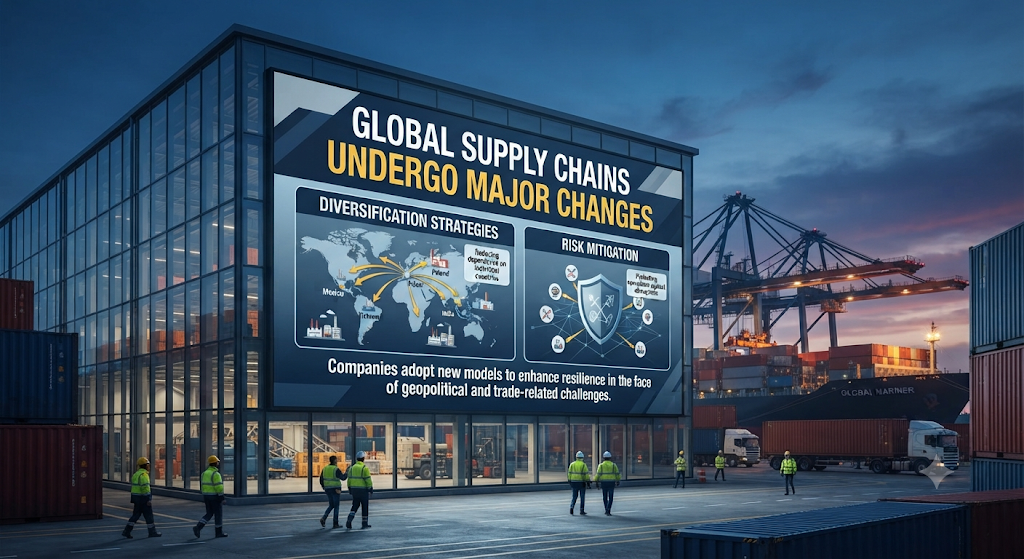
Global supply chains are undergoing a significant transformation as companies reassess where they source materials, manufacture products and distribute goods. Geopolitical tensions, trade restrictions, shipping disruptions and rising economic uncertainty have encouraged businesses to reduce their dependence on individual countries and suppliers.
For decades, companies prioritised low production costs and operational efficiency by establishing manufacturing networks across international markets. However, recent global disruptions have demonstrated that excessive dependence on a limited number of suppliers or regions can expose businesses to serious risks. As a result, supply-chain diversification, regional manufacturing and strategic inventory management are becoming important business priorities.
Geopolitical Tensions Reshape Global Trade
International trade has become increasingly influenced by geopolitical developments. Trade disputes, tariffs, export controls and economic sanctions can affect the availability and cost of essential products, forcing companies to reconsider their sourcing strategies.
The United Nations Conference on Trade and Development (UNCTAD), in its 2026 Trade and Development Report, highlighted how governments are increasingly using trade restrictions, subsidies and technology controls to protect industries considered important for economic and national security.
The report also found that trade between the United States and China had declined by more than 20% since 2024, illustrating the changing relationship between two major participants in global commerce. At the same time, East Asian economies have expanded trade connections with both China and North America.
These developments are encouraging companies to build alternative supplier relationships and reduce exposure to sudden changes in trade policy.
Companies Adopt Supplier Diversification Strategies
Supplier diversification is becoming one of the most important approaches to supply-chain risk management. Instead of relying on a single country or manufacturer, businesses are increasingly purchasing essential materials and components from multiple locations.
This strategy helps companies maintain production when one supplier faces operational difficulties, transportation delays or political restrictions. It can also improve negotiating power and reduce the risk of unexpected shortages.
Industries such as automobiles, electronics, pharmaceuticals and industrial machinery are particularly interested in diversification because their products often depend on complex networks of specialised components.
However, establishing alternative suppliers requires time and investment. Companies must evaluate manufacturing standards, delivery reliability, regulatory requirements and production capacity before shifting orders. In many cases, businesses are choosing to maintain relationships with existing suppliers while gradually developing additional sources.
Nearshoring and Friendshoring Gain Importance
Two important developments in supply-chain restructuring are nearshoring and friendshoring.
Nearshoring involves moving production or sourcing activities closer to the company’s main markets. This can reduce transportation distances, shorten delivery times and improve communication between manufacturers and customers.
Friendshoring involves prioritising suppliers and production locations in countries considered reliable political or economic partners. Governments and companies are increasingly applying this approach to strategic industries such as semiconductors, batteries, pharmaceuticals and critical minerals.
UNCTAD’s 2026 analysis identifies supplier diversification, production relocation and greater control over essential inputs as important features of the changing global trade environment. It also notes that nearly two-thirds of global trade takes place within global value chains, demonstrating how deeply international production networks remain interconnected.
These strategies do not necessarily mean that companies are abandoning international trade. Instead, businesses are reorganising their operations to balance cost efficiency with greater security and flexibility.
Technology Improves Supply-Chain Management
Digital technology is playing an increasingly important role in managing complex supply networks. Artificial intelligence, data analytics, cloud computing and advanced tracking systems allow businesses to monitor shipments, forecast demand and identify potential disruptions.
AI-based forecasting tools can help companies anticipate changes in customer demand and adjust inventory levels. Digital platforms also improve communication between manufacturers, suppliers, logistics providers and distributors.
Real-time tracking technologies provide greater visibility into the movement of goods, helping companies identify transportation delays and respond more quickly to unexpected events.
These capabilities are particularly valuable for multinational businesses operating across several countries. Better information can support faster decisions, reduce unnecessary inventory expenses and improve coordination across international operations.
Nevertheless, technology cannot eliminate every supply-chain risk. Companies must also address cybersecurity threats, data reliability and the cost of implementing advanced digital systems.
Higher Costs Create New Business Challenges
Although supply-chain diversification can improve resilience, it may also increase operating expenses. Establishing additional manufacturing facilities, qualifying new suppliers and maintaining larger inventories require financial resources.
Production in alternative locations may also be more expensive if those markets lack specialised workers, infrastructure or established supplier networks.
A September 2026 Reuters report illustrated these challenges through examples of companies that encountered difficulties after shifting some manufacturing away from China. Certain businesses found that alternative locations lacked the specialised equipment, skilled labour and supporting supplier networks required to maintain competitive production costs. Some subsequently restored part of their Chinese sourcing.
The OECD has also warned that extensive efforts to relocate supply chains domestically could reduce international trade and global economic output without necessarily improving resilience. Its modelling suggests that resilience depends more on effective risk management and diversified networks than on simply bringing all production back within national borders.
Businesses therefore need to evaluate the financial and operational consequences of diversification rather than treating relocation as an automatic solution.
Implications for India
The restructuring of global supply chains presents significant opportunities for India. As international companies look for additional manufacturing and sourcing locations, India can strengthen its position in sectors such as electronics, pharmaceuticals, automobiles, textiles, engineering goods and renewable energy equipment.
India’s large domestic market, expanding industrial capabilities and skilled workforce provide a foundation for attracting investment. Government initiatives supporting domestic manufacturing, infrastructure development and logistics improvements can further strengthen its competitiveness.
A 2026 report by DP World’s Global Trade Observatory found that 70% of surveyed Indian business executives were prioritising supplier diversification, while 59% were increasing inventory levels to prepare for possible disruptions. The findings indicate that Indian businesses are also placing greater emphasis on supply-chain resilience.
However, India must address challenges involving logistics costs, infrastructure capacity, regulatory complexity and dependence on imported components. Stronger domestic supplier networks, reliable electricity, efficient ports and improved transport connectivity will be essential.
India can also benefit by developing partnerships with Southeast Asian, European, American and other Asian markets. Such cooperation could help Indian businesses participate more deeply in international production networks.
The Worldonomics Times View
Global supply chains are moving towards a more diversified and risk-aware structure. Companies are increasingly recognising that relying on a limited number of suppliers or countries can create significant vulnerabilities during periods of geopolitical tension, trade restrictions or transportation disruption.
However, the future of international production is unlikely to be defined by complete economic separation. Global trade remains essential to manufacturing, technology development and economic growth. The more practical approach is to build flexible networks that combine reliable suppliers, regional production capabilities and strong international partnerships.
Businesses should invest in digital monitoring, supplier diversification, strategic inventory and effective risk assessment. Governments should support this transition through reliable infrastructure, predictable trade policies and cooperation with international partners.
For India, the changing trade environment offers an opportunity to attract manufacturing investment, strengthen domestic industries and expand its role in global commerce.
Ultimately, resilient supply chains will not be built by avoiding international trade but by making global economic connections more flexible, transparent and dependable.